Showing posts with label Books. Show all posts

Thursday, January 7, 2010

My 20 Favorite Things of the Decade


Instead of doing a traditional countdown of the best films of the decade (for that you can see the Question of the Day feature that was posted in the last week or so) I thought I would change it up and just list some of the things that made me extremely happy the past 10 years. I think people may be a bit "listed" out right now, and I like doing something more personal than just listing movies I loved…which is an exercise I take pleasure in, but for that just look at my top 10 lists for the past 10 years (check the labels on the left side of the blog). So here are my 20 favorite things (movies, sports moments, music, books, etc.) of the past 10 years…

Wednesday, January 6, 2010

My Favorite Books of the Decade


I hate choosing favorites. Especially when it comes to books…which is why I am just going to list these things alphabetically. I hope you'll ask about some of these choices in the comments section; I also hope that you will pick some of these titles up if you haven't read them. There are some great authors here, but before I reveal the list there is one caveat: my tastes unabashedly lean towards the British writers. Sorry Chuck Palahniuk and Don DeLillo fans (although I do love White Noise and Mao II…I just didn't think DeLillo did anything great in the 2000's). There are a few American authors on here – my favorite being Rick Bass, the best naturalistic writer since Thoreau, and his brilliant collection of short stories The Hermit's Story – but you'll mostly find British authors who either write classically (McEwan, Coetzee and Waters) or sardonically (Barker, Amis, and Rushdie). Because my tastes lean towards the British you could say my tastes are a bit aesthete. I don't mind sounding pretentious here. I get a lot of enjoyment out of postmodern takes on classical tropes likes a WWII story (Atonement), the detective novel (The Light of Day), or just a good old fashion love story (The Powerbook).

If I had a gun to my head I guess I could name a favorite amongst these twenty selections…that would have to be Ian McEwan's Saturday…probably the finest novel about September 11th to be written. It was also interesting to see Martin Amis go to a more classical style of storytelling with House of Meetings after his failed attempts at a September 11th novel, Yellow Dog. Meetings is like Dostoevsky lite…which is a compliment. It's a tightly packed novel with a lot of wonderful Amisisms in it. Salman Rushdie's Shalimar the Clown is brilliant novel, too. Rushdie floods his story with usual pop culture allusions and at the end succeeds at flipping the end of The Silence of the Lambs and making the male the hunted. It's his most impressive and his most garish novel since Midnight's Children. Finally I want to give a shout-out to Nicola Barker's fascinatingly absurd novel Darkmans. It's audacious (800+ pages) and sardonic (it reminded me of Will Self and Martin Amis), and it's not all together a success; however, it's ambition gets you through the rough patches, and by the end of the novel – a hilariously dark and irreverent flip on Bergman's moment of Death playing chess (for Barker Death is more of a jokester, and instead of chess he flips a coin) – I found myself to have laughed more than I did groan throughout the novel. It's really one of the standout works of the last ten years.

Onto the list…

Wednesday, September 23, 2009

Read This Book: The Little Stranger by Sarah Waters


[In an attempt to get book discussion going on this blog I am installing a new feature that will appear every now and then (or whenever I finish a book). Consider this my makeshift book club, and I hope all of you will join in the fun.]

In what I hope to be a feature that makes a somewhat normal appearance on the blog I would like to recommend to all of you Sarah Waters' newest novel The Little Stranger. Perhaps no other author writing today is doing the whole 'history and mystery' thing better than her. Sadly these tropes have become a bit antiquated and gone by the wayside, but there's something refreshingly classical about her approach to writing. She reminds me of another modern master, Ian McEwan, who also specializes in very literary, yet easily consumable mysteries that swirl around historical events (his Amsterdam won the Booker Prize and Atonement made him a household name).

Waters' newest novel (part of a loose trilogy that also include Tipping the Velvet and Fingersmith) is a ghost story on the surface; however, beneath it all are themes as elusive as the phantasms that exist within the pages. The novel is really about how people can create their own nightmares...their own 'ghost stories' if you will. The novel is breezy read that reminds the reader of a more formal, classical novelist like the Bronte's. Her The Night Watch was one of the best novels of 2007, manipulating time and narrative structure to tell a poignant tale revolving around the 1941 blitz and the bombings that took place in 1944. She isn't as playful in her newest novel, and that's okay. I do find it interesting that she has been shortlisted for the Booker prize for the second time in a row. I really like The Little Stranger (I could barely put it down), but if she wins the Booker this year it will be because they passed her up for The Night Watch. Her newest novel is a great read, though, and even though it's not 'Booker good' it's still one of the best things I've read this year.

Coming up next another novel short-listed for the Booker prize: J.M. Coetzee's Summertime (looks like I have to order it from Amazon.com UK, though, because it won't be released here in the States until Christmas eve...booo).

Wednesday, July 15, 2009

Lazy Blogger Repost: Investigating the Detective Novel through a Postmodern Lens


This is another post titled "lazy blogger repost" because as I mentioned in my last repost I have a lot of stuff going on right now, and really it won't be until late August where I will be able to post new material on a semi-daily basis. I'll still be doing the Revisiting 1999 project (I have one "forgotten film" left to do) and I'll post my submissions for Counting Down the Zeroes on here, but the mix of wedding preparation, work, and grad school are making it really hard to go see new movies. Also, this is an excuse to get a post about books on here. I had a different blog awhile back that dealt with music and book reviews, but it was too much trying to keep up with two blogs (I'm lazy I know) so I figured I would start writing about books on here again. The blog will still be primarily movie related, but every now and then I'll throw some posts up about what I've been reading, authors I like, things I want to see adapted into movies, etc. Basically there's going to be more book talk on here...since, you know, I was a lit major and all.


In both Graham Swift and Martin Amis we have two of the premier postmodern writers. In the 1980's each wrote a seminal postmodern novel that influenced authors such as: Don Dellilo, Dave Eggars, Chuck Palahniuk, Nicola Barker, and countless others who are indebted to the postmodern movement. Swift's meta-narrative (a novel that deconstructs, and then seeks to reconstruct, what Jean-Francois Lyotard called “the grand narrative”) Waterland deals with family and history (both personal and world), and how both of those things create horror, and bubble up traumas and bruised memories. Amis' brilliant Money deals with John Self, one of the most hilariously pathetic characters of 1980's postmodern literature. Amis writes debauchery and un-PC humor like no other. Self's journey from London to New York is hilarious, filled with many great one-liners and clever quips; Amisisms if you will. Years later both would tackle something completely generic: the detective novel. In 1997 Amis wrote the police procedural Night Train, and in 2003 Graham Swift wrote the private detective novel The Light of Day. Both were met with a collective critical, "meh." I wanted to see for myself, though. I wanted to see how two of my favorite authors tackled the crime novel; how they put their distinct postmodern twists on the already-established literary tropes of the detective novel.


Martin Amis has cited the crime novelist Elmore Leonard as an idol, and it shows in Night Train; a short breezy work compared to some of Amis' heavier themed novels like Money and London Fields, and his latest success House of Meetings. The novel is more or less about the murder (or is it suicide...that is the mystery) of a police captain's beautiful daughter. The narrator (unreliable, of course) is Det. Mike Hoolihan. Who helpfully points out within the first pages of the novel not to let the name fool you -- she is named Mike, but she is a she.

And from there we're off and running. Amis doesn't throw in the same messes he did with his other novels about suicide and murder. In Money John Self hilariously botches a suicide, and in London Fields, the 'heroine' Nicola Six knows when and where she will be murdered. That novel is not so much about the murder itself, but about how we face such grim certainties.

And that is what makes Night Train so easily consumable. Amis doesn't mess around with heavy themes or pages upon pages of character development (like he usually does, as does Leonard), and even though it doesn't even come close to one of his best novels (it was his ninth at the time), it's never a boring read.

The detective genre in general lends itself to some of Amis' favorite themes. Hoolihan is as unreliable a narrator as there is as she states right from the onset: "And I guess I apologize for the outcome." Look at the word choice and the structure of that sentence; so much is found in something so small. You can see the detectives detachment from the beginning; her reluctance to investigate the murder of the daughter of her superior. She tells us that her notes are going to change; that information may be wrong -- how do we know what we are reading is what really happened?

I think this is the theme that Amis has the most fun with -- turning the crime novel on its ear and playing with its most famous convention: the omniscient narrator. Through Hoolihan's eyes we are taken through 175 pages of police procedural that seem familiar, but upon further investigation you see a metaphor for not just suicide ("suicide is the night train, speeding your way to darkness..."), but you see a stale and blank vision of what it means to investigate murders. In one of my favorite sections Hoolihan talks about how there are certain expectations a cop must live up to or must de-mystify and that they really aren't investigators; they are just cogs in the bureaucratic machine: "Police really are like footsoldiers in this respect at least. Ours not to reason why. Give us the how, then give us the who, we say. But fuck the why."

It's a question Amis hints at delving deeper into, but really he sticks to his conventions and keeps the reader on the surface. The very idea of suicide gets people to ask "why?" But then suicide, as Hoolihan states, "robs us of the why." For a novel seeking motive and explanations there is a shocking amount of nothing in this novel -- staying true to his form I suppose -- Amis crafts a wonderful pulpy surface level entertainment with hints of something deeper beneath the surface. I suppose that's just like how Hoolihan views police work in general:

Motive, motive. 'Motive': That which moves, that which impels. But with homicide, now, we don't care about motive. We never give it a seconds thought. We don't care about the why. We say: Fuck the why. Motive might have been worth considering, might have been in okay shape half a century ago. But now it's all up in the fucking air. With the TV.

I like what Amis does here with a classic postmodern convention: repetition. The sing-songy nature of his sentences and the repeating of key phrases or “passwords” (which also reminds me of the brilliant Jeanette Winterson) is something you often see in these types of novels, and it’s something that makes a whole lot of sense in regards to a detective story – just as a detective will continuously look at a clue, or mull over a certain scenario countless times, so too does Amis return to key phrases that aide the reader into better understanding this not-so-black-and-white police procedural.

The last line “with the TV” is another interesting element Amis brings into his detective story. Hoolihan seems to be suggesting that, as a cop, there’s nothing she can really do in regards to her job to appease the public. The public has their own ideas of who cops are and what they should be doing, and those ideas are formed by what they see on cop shows like “Law and Order”, “Homicide”, and “CSI”. A cop can’t simply act like a cop and investigate because there are all these false ideas of what a cop actually does, and really, they probably feel like they are playing a role more than they want to. There’s something very performance-based and artificial about the way Hoolihan goes about her investigation, and I think that Amis has a lot of fun writing her that way.

So, TV is really to blame; giving those in need a false sense of the detective as some kind knight coming to ease the nerves of a community. So it is with Amis and his detective Hoolihan; their vision of the police procedural is one that is predicated on false realities created by television. Hoolihan investigates the suicide of the young girl, but she already knows what she is going to tell her superior long before the investigation is over (and some interesting truths are revealed). So it is too with Graham Swift and his narrator private Detective George Webb, a man who is more concerned with his own personal investigation and personal crossing of thresholds than Hoolihan is, but both share the same weariness and burden of maintaining the old (and non-sufficient) classic police/investigator archetype in a postmodern world.


--------------------------------------------------


Graham Swift is one of my favorite authors -- much like Amis -- he has never really written an uninteresting book. Some of his material feels a little repetitive (a theme he likes to explore with his characters and their family histories) and even though he seems to always be trying to rehash the success of his masterwork Waterland, (his newest novel Tomorrow is an example) his novels are almost always poignant and heartbreaking works of fiction.

Swift loves to write about characters reminiscing on their past -- whether that past is deeply scarred or fully happy memories -- who must "cross a line" as the main character, George Webb P.I., reminds the reader throughout Swift's novel The Light of Day. Where Amis was concerned with the police procedural, Swift is more interested with the inward dialogue Webb has with himself about his clients. It's a novel that is all about thresholds as Swift uses some of his patented repetition (much like Amis does – again to evoke that investigative practice of dissecting and re-dissecting clues) to remind us that we all must "cross a line."

Swift, as stated before, is in love with the idea of the past coming into play and affecting the future. Most of Swift's characters learn much about the present (usually amidst a swirl of uncertainty and personal reflection) through a further explication of their past; usually bubbling-up moments of bruised and scarred histories. The Light of Day is just as simple a story as Amis' Night Train (again, I think they were both really trying to strip down their usual multi-layer, meta-narrative structures), but seeks to delve a little deeper since it is more about the personal than about the gathering of information.

George Webb is a good private detective, and Swift sets him up with an office and an assistant that seem right out of a Raymond Chandler story. What's unique about Swift's detective is that every case (usually following cheating husbands) leads him to dwell more on his own failed marriage, and in particular one case that changed the rest of his life.

That case is fleshed out mostly through flashback as we learn about a woman who, two years earlier, asked George to do a job for her. A romance between the woman and George is brews and we are told simultaneous stories of the affair between George and his client (and the things he’ll do for her), and another story about George's past as a police officer where an incident occurred that forced him to quit and become a private detective. We also get glimpses into George's adolescence when he was a caddy and the correlation Swift draws between caddying and private investigation – you carry things (burdens) around for other people – is brilliant. I also like the glimpse Swift gives us into Webb's personal life as he connects with his daughter over weekly dinners...the idea of the private investigator as a cook (cooking things up, making the ingredients work as a whole...) is another small, but brilliant touch. These are perfect examples of the capabilities of Swift’s genius; however, it's just too bad the whole novel isn't as good as its parts.

The story doesn't flow as well as Amis', but it is clear that Swift is more interested in detours. Where these kind of personal and epiphianic detours would derail Night Train's strict procedural focus, The Light of Day lingers (albeit a tad too long) on some of the quieter moments of a detective tailing a suspect. These moments of reflection give the novel a different feel, even though Swift never strays from the conventions of a private detective novel, you get the sense as the reader that you can learn something from this character and this novel...whereas Amis is simply going through the motions in an exercise of the genre. A perfect example of this kind of poignant detour is when George is in the airport tailing a suspect; he stops and observes:

In airports there are channels and slots and filters like being in a production line. A great grinding system that takes away aura or -- by the same token -- makes it stand out. So many departures, so many arrivals: you can't tell the simple goodbyes from the agonies, the lovers from the friends. People get excited, they hug, they cling, they kiss. What do those wet eyes mean? See you next Saturday? I'll never see you again? All this intimacy in public. But here it's not unusual, it's almost the done thing.

Such beautiful writing here by Swift, and it is these little moments of thinking about human behavior that elevate The Light of Day from mere genre novel to something much deeper and meaningful. Amidst the postmodern absurdity ("you play cards, you shuffle the deck") of it all, Webb is able to find something deeply existential to dwell on. It’s something that makes him better understand the human race -- not just the disgruntled employees and spurned wives that he is destined to follow through the seedy backstreets filled with adultery and betrayal, or though the normalcy of domesticated homes and airports -- but through the people he encounters everyday: his assistant whom he loves, his daughter, and ex-wife -- the people that define who he is outside of work; those lights that greet the new day.


--------------------------------------------------


Both novels are flawed but are tremendous examples of postmodern authors putting their spin on a done-to-death genre. Something that is evident in both novels is the repetition of the job of the investigator. Like Swift's Webb explains at the end of The Light of Day, the job of the private investigator is all about taking jobs that are "exact replica[s]" (conjuring up thoughts of the great postmodern author Jean Baudrillard who coined the phrase “simulacrum” in his seminal postmodern work Simulations) and begin in the "same spot." The job is not something that is glamorous, like Hoolihan says in Amis' novel; this is not something that is as fun or easy as it looks on television. Hollywood's portrayal of police officers, and the police procedural in general, has perverted and skewed the very monotony the job entails (Hoolihan makes one thing clear: being a police office is not sexy).

Swift and Amis must have been attracted to the detective novel for two reasons: one is that it is so easy to write, needing very little, if any, character development. Second the genre lends itself to some of postmodernisms favorite quandaries: how do we seek answers in this absurd world, and how do we go about getting the "why" when it seems that, as Hoolihan puts it, we live in a world that says "Fuck the why?"

This is where postmodern literature gets a bad reputation. Most people unfamiliar with the genre would say that these authors are only interested in riffing off the ambiguity and chaos of a postmodern society. That is true, as some authors are fascinated by the magical realism and trickster themes postmodern literature lends itself to (Rushdie and Winterson come to mind), but these authors also seek to take this absurdity and try to deconstruct it, to put it under the microscope, and by looking closely at the past and our own histories (or by looking through the cold hard facts and information like Hoolihan does) we can learn something about the present, and perhaps, even the future. Swift’s detective novel seems to be trying to do this more than Amis’, who just seems to be having fun working in the crime genre…and maybe that’s why Swift’s failings seem more noticeable, because he’s going for something bigger. Regardless of their shortcomings, if you’re a fan of the detective novel you’ll find enough familiarity here that will pique your interest, but hopefully you’ll give these two novels a try as they offer fresh, postmodern takes on a familiar genre.

Edited to add: There is a film version of Night Train set to be released in 2010 starring Sigourney Weaver, Nick Nolte, and Michael Madsen; and directed by the great Nicolas Roeg. I'm definitely intrigued.

Monday, May 12, 2008

Meme means breast in Turkish?


Well according to Cerebral Mastication's Ali Arikan, who tagged me for this particular meme, it does. No I am not going to be writing about breasts or Turkish breasts for that matter, but here all the simple rules of this particular meme:

1) Pick up the nearest book.
2) Open to page 123.
3) Locate the fifth sentence.
4) Post the next three sentences on your blog and in so doing…
5) Tag five people, and acknowledge who tagged you.

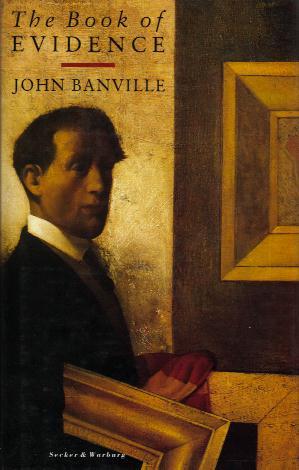
So there ya have it. The book I have next to me at the moment is John Banville's The Book of Evidence which was shortlisted for the Booker Prize in 1989. If you've seen the hilarious French faux-doc "Man Bites Dog", then you can get a good idea of what this novel is about and how it treats its main character, Freddie Montgomery, a man who kills because...well...he can. I wasn't too hot on this book when I started it, but it has really started to grow on me. Here Freddie is explaining the questioning process:

I am merely another name on a list. They are mild, soft-spoken, stolidly deferential, a little bored. I respond to their questions politely, with a certain irony, smiling, lifting an eyebrow -- It is, I tell myself smugly, the performance of my life, a masterpiece of dissembling.

Thanks for the tag Ali...and for the rest of you...tag you're it (okay that was too easy):

Troy Olson's Elusive as Robert Denby
Larry Linebaugh's To Infinity and Beyond
Kennettron 5000
Phillip Kelly's Phil-Zine
Mr. Holman's True Life: I'm a New Yorker?

Thursday, May 1, 2008

Book of the Month, May 2008: Midnight's Children by Salman Rushdie

Now, I must say that in my prepubescent stage of literature knowledge I am certain there are thousands upon thousands of people more qualified to talk about literature in an engaging way than I could ever hope. My degree is in Literature, so I have four years of digging through weighty tomes and literary theory under my belt (postmodernism being the one I am well versed in), but I am not much of a writer, and I fear that writing about such literary giants is out of my league. I am only 26 and have evolved from The Hardy Boys to John Grisham and James Patterson to Ernest Hemingway and Elmore Leonard to Henry David Thoreau and Walt Whitman to Martin Amis and Ian McEwan. All are books that I look at through different lenses, and in now way am I saying that one is better than the other (although I guess I am, since this evolution of literary tastes is shown in an order that can be easily deconstructed as “what I liked when I was too young to know better” to “what I know is good right now”), but I am hoping to highlight some books each month that showcase some of my favorite authors and what it is that they do so well. I will mostly be able to convey how the novel affected me emotionally and the obvious elements of why I think it is a great book, not just based on its technical accomplishments, but also its readability. I hope that comes through as I do these but we’ll see…let’s give it a go shall we?

It is hard to fathom the genius of Salman Rushdie. I have never encountered anything like him before; and that goes for any medium, be it film, art, music, or whatever. He is the Quentin Tarantino of literature (even though some would argue that is Elmore Leonard, but bear with me here) a genius who writes grandiose novels with oddball characters and situations that deal with supernatural and irreverent to the seriously political and historic. He dabbles in postcolonialism, feminism, postmodernism, and an uncanny ability of bringing India to life. He is extremely referential, conjuring up images of pop culture and Bollywood to make a serious point by implementing elements of the artificial and absurd. He is a cinematic writer, everything you read you feel as if you could see it unfolding in front of you as if he were showing the storyboards to his latest film project. He is postmodern to the core, yet he is not, as many anti-postmodern literature lovers would say, irresponsible. His postmodern elements exist for a reason. They always add to the story and heighten the emotion, they are never the story (say like a Dave Eggers novel) and they exist only as unconventional rebuttals to an all too serious worldly debate.


That debate is usually about the calling into question of politics and love and religion and history; which in postmodern terms are what Jean-Francois Lyotard called ‘the grand narrative.’ Rushdie wrestles with ‘the grand narrative’ in a lot of his novels, mostly by using the fantastical to make his points. In Midnight’s Children, his second novel, he tackles the heavily emotional and tumultuous theme of postcolonial India in the moments before, leading up to, and during her independence. Rushdie likes to undercut a lot of the uber serious themes that plague the front pages of our daily news, but again, he is not childish or irresponsible, but rather by tackling these elements of ‘the grand narrative’, he is allowing the reader to enter a world where flying carpets are normal and invites the reader to cross that threshold which allows them to put on a different lens and see what things look like through cracked and smudged glasses.


I don’t know if I will ever read a novel as brilliant as Midnight’s Children. There is a reason is won the “booker of booker’s” (the best novel in the last 25 years, essentially) as it is a novel that revolves around the most formidable time in India’s history all told by one unreliable narrator Saleem Sinai. Saleem is like most postmodern narrators, the relayer of information for us not in the know, he is a narrator who forgets facts is unsure of exact moments in time, and as we come to see, isn’t even really who he says he is (which is a brilliant touch by Rushdie, because when this information is sprung upon the reader it forces them to re-imagine how the previous 300 or so pages went). Always morphing like the snakes that Saleem references throughout, the novel is a beautiful allegory for life with one simple truth: life has its ups and downs. Saleem plays a game called Snakes and Ladders and the metaphor is clear: for every up there is a down, and for every down there must be an up. Never before have I been touched by a novel in so many different ways.

I googled Midnight’s Children so that I could put a good plot synopsis up here, and I found a really good example from Mac Fenwick of Trent University from the Literary Encyclopedia webpage. In no way did I write any of what is below (I always have problems summarizing things which I explain in my post for “Snow Angels”):

Midnight’s Children has been compared in its scope and execution to works such as James Joyce’s Ulysses, Günter Grass’s The Tin Drum and Laurence Sterne’s Tristram Shandy. Like them, Rushdie’s novel presents an encyclopaedic exploration of an entire society through the story of a single person. It is able to do this, in part, by merging with the novel form a number of non-Western texts such as the Sanskrit epics, The Ramayana, The Mahabharata and, most consciously (and not unproblematically) The 1,001 Nights. The narrative takes the form of fictional autobiography as Saleem Sinai, born at the precise moment of Indian Independence at midnight on 15th August 1947, reflects upon his life and the history of his “twin”, the newly formed nation of India. In order to do this he constructs a narrative that is a heterogeneous mixture of the different traditions from which it takes its inspiration. Throughout the story, Saleem seeks to uncover or discover the connections between the personal and the national, the individual and the societal, as he strives to “give meaning” to his life and, somewhat more problematically, to the history of India from the period between World War I and the Indian Emergency (1975-1977) when Prime Minister Indira Gandhi suspended the Constitution and democracy all but collapsed in the country. This connection between Saleem and his national “twin” is a difficult one, and from the outset of the narrative Saleem feels that he has been “handcuffed to history” rather than liberated.

(Me again) This theme of being ‘handcuffed to history’ is throughout Midnight’s Children, and even though it may sound like it is too daunting of a task to read this book, I implore you to not be turned off by the historical data. In no way is Rushdie’s account of India’s history banal, but rather (surprisingly for me since I am not a history buff) by placing this unreliable narrator smack in the middle of India’s most crucial moments, Rushdie actually heightens the interest one might not normally have in such historical information. The reader becomes somewhat of a detective themselves, trying to piece together the truths and non-truths of Saleem’s story, as he mentions that he is ‘literally’ falling apart. He has cracks all over his body and his limbs are close to falling off. This coincides with another major postmodern theme: fragmentation. All through the novel there are characters seeing things through slits or holes or just certain body parts, and of course, the obvious example just mentioned, Saleem’s cracks on his skin. This all leads to the one moment where Saleem, handcuffed to history and cracking and breaking apart will be trampled to dust…he will become one with history and embedded into the dirt of Bombay. Like Whitman who told the reader to look under their boot to find him because he was in the ground and all around (that’s a paraphrase, hehe) so too does Rushdie invoke this kind of imagery, because since Saleem is the child of India, then it is only appropriate that he literally become a part of India.

Midnight’s Children is a book that is all at once spiritual, philosophical, absurd, grotesque, vulgar, metaphysical, magical, and just plain perfect. Rushdie slides these themes in place like he’s Tom Cruise solving a case in "Minority Report." At any given moment the novel can make you laugh out loud with its absurdest postmodern elements, or make you cringe with its graphic details of a society brutalized by colonialism. It also has wonderfully comic and sweet moments between the women and the men which shed humorous light upon its more serious postmodern feminist theories. Midnight’s Children is a book that is 100% satisfying to the intellect and is also 100% emotionally satisfying. The novel is heavy in theme (and weight, the book is 560 pages) and 75 pages should be your daily limit, but that is not to say that the novel is not a great entertainment. There are many moments where you will want to keep reading, no matter what time of night it is, and there are others where you will feel so weighed down by the sheer force of Rushdie’s brilliance (not to mention all of the information about India he throws at you) that you must simply take a break from the memorization of dates, figureheads, and character names.

You don’t have to be as enamored with the literary theory as I am to enjoy this book. It works on both levels and there is a reason why it is my inaugural Book of the Month selection. The novel is insanely popular with both casual readers and literary nerds such as me, and I really hope you run out and give it a shot. I am reading it for the second time right now, and am enjoying it even more the second time around. It has taken me awhile to revisit the novel because of how emotional the ending of the book is. It’s a novel that contains magic carpets and stark realism, children born at midnight with extraordinary powers like telepathy and mind reading to documentary like dealings of a postcolonial India. For all of the great literary devices Rushdie uses and for all of the postmodern, postcolonial, and feminist theories one can excavate from the novel, the only thing I can think of to describe this book to new readers is something so cliché that it works because this novel puts me at a loss for words: it’s a page turner.

Wednesday, April 9, 2008

Martin Amis, Donkey Kong, Pretty Horses, and Bond goes Emo

1.) As I was watching television last night I saw a story on CNN about the new James Bond film entitled Quantum of Solace. The headline was "Bond gets emotional", and that got me thinking on a few things about the newest Bond film:
  • I don't hate the franchise, but they are getting less and less interesting as time goes by, so I was delighted to hear that Marc Forster was directing. He made the interesting and near perfect comedy-drama hybrid Stranger Than Fiction, the criminally underrated uber stylized Stay, and the okay but flawed Finding Neverland and Monster's Ball. I haven't seen The Kite Runner yet, which he also directed, but one thing is clear: Forster is interested in flawed and lonely outsiders. But is Bond so much of an outsider? That's what I am excited to find out. Casino Royale was the sign of the more grizzled Bond; along with suave and the swagger there was a mean streak audiences hadn't seen before, even if the film felt like it was three hours long. If there's one thing Forster can do well it is taking a microscope to characters who are unconventional (Finding Neverland), lonely and sad and slavishly dedicated to work (Stranger Than Fiction), and unlikeable (Monster's Ball), and seeing what makes them who they are and finding the best qualities about those people. So it will be interesting to see his take on Bond as I think the Bond character is a little bit of all those things. Yes, even unlikeable. Would you really want to be friends with James Bond? Think about it.
  • Daniel Craig is the perfect choice for Bond and I like the idea that the sequel takes place one hour after Casino Royale ends. If they are going to go with this more disgruntled Bond who fights with his demons, then Craig is the right choice.
  • I love the line I heard last night on CNN about how Forster said he was going to focus less on the gadgets and more on what makes Bond tick. This is wise seeing how the Bourne films have proven that the gadgets aren't what sell the spy thriller anymore. You need them in there, for sure, but they shouldn't be the focus. We are in an age where those kinds of things are not even as interesting as what kind of suit Bond will wear, where will his newest adventure be located, or what kind of car will he drive. So it's smart to move away from the gizmo's and more into the psyche.
  • I wonder if Daniel Craig will wear black eyeliner and a ratty old Smith's t-shirt?
2.) Also, I finished Martin Amis' House of Meetings last week, and all I can really say is that I am extremely impressed. The book is a classic Russian theme: two half-brothers both in love with the same woman and how the brothers deal with being held in an Arctic gulag while under Stalin's reign. The narrator, and unnamed Russian war hero is writing to his American step-daughter, Venus about what happened between him and his half-brother Lev, and the woman they both loved, as well as the events that took place within the gulag. Eventually (not giving anything away here, since it's actual Russian history) the gulags are abandoned and the prisoners set free and they must become re-acclimated to 'normal' life, and this is why he is writing the letter to Venus.

Becoming re-acclimated is not so easy however, especially after battling with some unique characters and terms that are pure Amis. This is a departure for Amis' fiction (he wrote a non-fiction book about Stalin called Koba the Dread, so he was in familiar territory with this particular novel) as there is less focus on the grotesque caricatures that usually inhabit an Amis novel and more focus put on classical, more formalistic elements. Throughout the novel, Amis (and his narrator) are evoking the grand sweep of a Tolstoy or the detailed family genealogy of a Dostoevsky along with elements of Gogol. Whatever the influence was, this is something that is an amazing feat as the language and the beauty of the words are so distinctly Amis, but the material is not. It just reaffirms that, for my money, Amis is on the shortlist of authors, cozied up with the likes of Salman Rushdie and Ian McEwan.

Even if there isn't the usual (and somewhat expected) barrage of hilariously obscene Amis-isms, and even if he isn't being as playful by throwing the reader stylistic curve balls as when he last tackled a major historical moment (the holocaust) in his time tinkering novel Time's Arrow, this is still one of the best Amis novels.

3.) The other night Tieryn and I watched All the Pretty Horses, and I have to say that I was extremely disappointed. I had seen the film when it was released in theaters and I remember watching it once on DVD before, but for some reason it just didn't jive with me the other night. Maybe it was a long day and I wasn't in the mood to existentially cowboy up. I don't know, maybe it's just after seeing No Country For Old Men I was not as impressed with Billy Bob Thornton's Cormac McCarthy adaptation. I love the Western genre, it's probably my favorite genre, so the opening of the film didn't feel long to me, even though the film takes about an hour to really get going dramatically. The first hour primarily consists of some cowboy talk, some discussions about God and the afterlife, and some classic western music accompanied by rugged cowboys riding horses. Although Henry Thomas and Matt Damon don't seem that rugged, especially compared to 16 year Lucas Black who looks and talks likes someone who isn't trying to act like a cowboy.

The film is all set up for some bad goings-on in Mexico and of course a love affair that is forbidden. The plot and themes are as old as the genre itself, but the film still works on a basic emotional level, I just think that for the viewer who is not a fan of the Western genre (Tieryn isn't, she was about an hour into it) the film can drag. The ending is the highlight of the film as Damon's character has a chat with a judge played Bruce Dern. It is in this conversation that redemption for Damon's character can be found. The payoff is not overly emotional, but in typical McCarthy fashion, subtle and poignant. I still like the film, I just remember raving about when it came out, but haven't really talked about it much since, and now after years since first seeing the film, I can see why I have have become lukewarm towards it. Still worth checking out on premium cable or On Demand.

4.) Also, Kyle and I watched King of Kong: A Fistful of Quarters the other night. This is one of the better documentaries I have seen as we get a glimpse into the geeky underworld of old school arcade game players. I won't get too much into the story, because too much exposition could ruin the suspense, and yes there is surprisingly a lot of suspense in this documentary, but the basics are this: you have the evil champion who refuses to compete in public and you have the challenger who has broken the record at home and sent in his score via video (the film explains the distinction between video records and live records). The challenger is a family man who has failed in a lot of competitive sports growing up, so naturally we root for him (plus it's pretty obvious who the filmmakers favor). What's fascinating about the film, after you get past laughing at guys that are too geeky for a Judd Apatow film, is that even though you are watching competitive Donkey Kong unfold, you become completely invested in these people. I almost typed 'characters' right there, because after awhile the drama is so real that these people feel like characters in a film. It is an amazing film, and even you don't like documentaries, you have to see this. The emotional investment the viewer put into these peoples lives reminded me a lot of how I feel about American Movie. And you if you have seen American Movie, then you know what I am talking about, and if you haven't, well you owe it to yourself to see both The King of Kong and American Movie.

Monday, January 7, 2008

10 Best Films of 2007: #7 - Atonement

If there was one film I was most looking forward to seeing this year it was definitely Atonement. Was this going to be a great film like I thought it could be? Or was this destined to be a butchered version of the Ian McEwan novel I have so much admiration for. I admit that my immediate reaction to the film was: yeah, that’s good. And I think I was disappointed in my own response to the film; I wanted to love it, and I didn’t. I was weary of the film, yes, but I was also counting down the days until I could see it for myself, and after all of that build up (mostly by me, and now by the Focus Films ad wizards pining for Awards) I feel like it’s not the film of the year I was hoping for, but it’s still an affective and beautiful looking picture.

Many people called this one of the most unfilmmable books, and I have to say I was weary of the film, wondering how in the hell they were going to translate that ending to film. But the film is impressive, in a David Lean sort of way. Which, I am not slighting the film, it is classical British filmmaking. Every shot seems to have been excruciatingly storyboarded and meticulously shot, and I found myself moved by the film (yet somewhat at an arms length) and I think part of that is McEwan. I just had finished the novel for the second time in preparation for the film and I think it was McEwan, not Joe Wright that was in my brain as I sat in the movie theater. And that's a problem when reviewing a film based on such a tremendous novel. It is not the novel I am reviewing, but the film and that is where Mr. Wright falls just a little short with his adaptation of McEwan. There are impressive shots for sure, especially one where a tired, wounded, and drunk Robbie is backlit by a scene from Brief Encounter in a movie house (there is also a scene that is straight taken from that film earlier on). Another shot that found my jaw agape was the five minute tracking shot on the shore of the beach – something that impressed me more than the shot in Children of Men – this shot takes you out of the film (much like I have always felt the details of the war does for the book) but it is impressive, no doubt.

But it left me with an almost cold admiration for it. The closest thing I can compare it to is the admiration I have for some of Kubrick's films. I am not a Kubrick fan, but I admire 2001, Paths of Glory, and most of all (his masterpiece) Barry Lyndon - which oddly enough, reminds me of Atonement. That's high praise and for its set pieces and cinematography alone, Atonement is one of the best films of the year.