


Salem Film Festival 2009: Adoration (Atom Egoyan)

Atom Egoyan's first large-scale production, The Sweet Hereafter, is undeniably his masterpiece. That film based on a haunting novel by acclaimed author Russell Banks was about the disintegration of a community after a tragic school bus accident. Egoyan's newest film, Adoration, (set to be released in July or August) is also about disintegration, albeit in the form of a student named Simon and his memories of his deceased parents, and how a community can (for better or worse) shape the memories of the one's we love. There are layers upon layers of memories, just like any good Egoyan film, that are slowly revealed and brought to light. Egoyan explores the truth behind these memories and what that means in a day and age that is all about the quick information of blogs and chat rooms. Egoyan enjoys putting these news mediums under the microscope that show the ease of manipulating facts that perpetuate hate and lies until they reveal the truth about the community we live in.
Egoyan's film begins with a flashback, like most of his films, as we are introduced to the principal characters of the story. There's Simon, a techno-saavy teenager who had an Arab father and White, blond-haired mother. We're introduced to Simon's mother as we see her being asked questions at an airport about her purpose for flying to Israel. We come to find out that she is pregnant with Simon, and apparently is meeting her husband's family in Nazareth, but he did not make the flight. It is suspected that he has planted a bomb in her suitcase so that he could blow up the plane mid-flight.
 Back to the characters: Simon is being raised by his uncle Tom (the wonderful Scott Speedman) who now lives in his dead sisters house. He is a man of black and white beliefs; simplicity is his credo. Finally, there is Simon's French teacher Sabine (Egoyan regular, and wife, Arsinée Khanjian) who uses a recent news story about a terrorist plot to blow up a plane mid-flight for a translation assignment. There's also Simon's racist grandfather who is dying, and relays misinformation to Simon about how his father was a killer. This is a common occurrence in Egoyan's films as he loves to bring communities together (The Sweet Hereafter it was a bus crash, Exotica it was a missing child) and show these fragmented bits of information from different sources eventually lead to an epiphianic ending.
Once Simon beings work on his translation assignment for Sabine's class it all starts making sense as she learns of Simon's past, and interest in the story, she encourages him to flub the truth -- placing his parents in the roles of the husband and wife from the news article they are interpreting for class. We come to find that the flashbacks in the beginning of the film are nothing mroe than fabrications from Simon's assignment. His parents actually died in a car accident, but that doesn't stop Simon's Grandfather from telling him "you have to believe me, your father was a killer."
 This "exercise" leads to Simon making the story personal, and thus starting a firestorm of controversy within the school and within his community of friends. He becomes hounded by his friends in face-to-face chat rooms and wacko nut jobs that frequent political blogs. All of these members collide in Simon's life, frequently pontificating if what his parents "did" was right or wrong or just a case of us not understanding because we live in such a different society.
Simon begins to wonder about things himself; he's having fun doing the exercise (no doubt he feels a certain kind of power conjuring up his own global morality tale), but is it healthy for what little he remembers about his parents, and the kind of father he actually had. He has so many different sources telling him what to believe, that he almost feels more secure in making up his own truths and histories. And this is what makes Egoyan's film so poignant and memorable. Do we allow others to fill in our histories for us, or do we explore the past, no matter how ugly it may be, in order to know the truth? The way Simon tries to piece together the puzzle of his dead parents, and his subsequent decision is one of the more powerful moments I've seen in film this (relatively short) year.
 The film is not just about Simon and his questions, though, but it also focuses a lot of attention on Sabine and Tom and their relationship. Tom does not get along with his father who thinks Simon's father killed his wife (Tom's sister) on purpose. There is an event that takes place at a dinner party where the truth is revealed. It's a powerful moment that Egoyan wisely shows us parts of, he never discloses his full hand at first, and it reminded me of the scene in The Sweet Hereafter where we learn the extent of Ian Holm's love for his daughter when he tells a story about what he was willing to do to save his daughters life. This moment in Adoration reminded me of the power and poignancy found in the flashback of Egoyan's 1997 film, because as is the case with a lot of Egoyan's work, if you jump to conclusions about the characters and their intentions or feelings, you are bound to be misguided by the time the whole truth is revealed.
 There's another scene that shows the fragmentation or "sectioning off" of cultures that Tom is comfortable with. Tom is confronted one night while putting up a nativity scene by a masked Arab woman. She informs him and Simon, who is helping Tom, that she is fond of their nativity scene and the fact that they so publicly display their faith. She then speaks about something that rubs Tom the wrong way, and this leads to a semi-confrontation where Simon catches a glimpse into what kind of man his uncle is. But it's never that simple, and there is a second moment where the masked woman comes to Tom's door and asks to explain herself. It's a fascinating conversation and Scott Speedman as Tom nails every scene.
Tom and Sabine eventually meet, too, setting off a series of events that can do nothing but allow the truth to bubble up in all of their lives. The way Egoyan links all of these primary characters together is ingenious. And when we find out just why Sabin is interested in explicating Tom's hidden secrets, and why she is interested in pushing Simon to explore the assignment further than the other students, it doesn't seem like a cheat at all. It adds another layer of sadness to a beautifully elegiac and poignant film.
I dare not give away how all of these characters are linked, or the hidden truths that lie beneath all the lies; or the layers upon layers of commentary about a multi-cultured Canada, or how nothing has really changed post September 11th. Egoyan has a lot to say, and it's to his credit that he does it all through such an entertaining jigsaw puzzle. When the truth finally is revealed and all the layers have been unwrapped, it's an emotional roundhouse that knocks you silly.
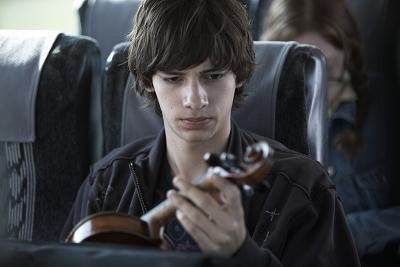
 It's not just the interesting themes -- terrorism as an extension of personal neuroses, the parallel world of the internet, prejudice towards the ‘other’ -- at play that make this film worth seeing. Adoration is a tremendously made, beautiful film to look at and to listen to; it's a film you get lost in. The editing, as it usually is in an Egoyan film, is top notch; keeping the viewer at arms length without ever being to convoluted or needlessly confusing, but always holding my interest so I couldn't wait to see what mystery or family secret would be revealed next. The acting is top notch all across the board as Speedman gives a great performance and young Devon Bostick as Simon more than holds his own as he carries the bulk of the films emotional weight. Also, Arsinée Khanjian rarely gets the public praise she deserves for her work. She is so good as Sabine, a woman who at first seems weird, whose interest in Simon seems a tad unsettling, but as we learn more about her and her intentions, and everything is revealed, it all makes sense and makes Khanjian's performance all the more powerful.
A crucial element to filmmaking that I always appreciate, and that often goes unrecognized and unrequited, is a good musical score. A good score can act as another character and move the viewer along seamlessly from to scene. David Gordon Green and Paul Thomas Anderson both use this in their films to great effect, it almost always heightens the intensity in films that are by no means, conventionally speaking, thrillers -- but I'm always on the edge of my seat during their movies. So too does Egoyan use a great soundtrack. Just as he did with his masterpiece The Sweet Hereafter, here he employs a score that consists of haunting strings.
The ominous score of violins throughout -- itself another character in the film --seems to be pulling you further into the abyss of mistruths and made up stories. There’s a great shot where Simon is sitting on a grassy knoll with his laptop, already engulfed by the cityscape in the background, and Egoyan’s camera continues to pan down, and further down until we feel like we’re being sucked up by the earth; pulled in, too deep, by the lies of the story.
Adoration, at its core, is about how lies -- and the ease of creating and perpetuating those lies -- can mar how you view the truth and the people they are about, how the memories of loved ones can be changed with the click of a button, and how if we let them, the voices of the internet -- the select few who just happen to scream the loudest -- can shape the way major issues are thought of. All of these important and global issues swirl around Egoyan's more personal narrative: Simon wants to know who is parents are; a teacher, perhaps with ulterior motives, offers the opportunity to explore those question; and an on-the-fence uncle comes to terms with how things really are, and the way they are probably going to be from now on. Adoration is easily one of the ten best films of 2009.
Egoyan's film begins with a flashback, like most of his films, as we are introduced to the principal characters of the story. There's Simon, a techno-saavy teenager who had an Arab father and White, blond-haired mother. We're introduced to Simon's mother as we see her being asked questions at an airport about her purpose for flying to Israel. We come to find out that she is pregnant with Simon, and apparently is meeting her husband's family in Nazareth, but he did not make the flight. It is suspected that he has planted a bomb in her suitcase so that he could blow up the plane mid-flight.
Back to the characters: Simon is being raised by his uncle Tom (the wonderful Scott Speedman) who now lives in his dead sisters house. He is a man of black and white beliefs; simplicity is his credo. Finally, there is Simon's French teacher Sabine (Egoyan regular, and wife, Arsinée Khanjian) who uses a recent news story about a terrorist plot to blow up a plane mid-flight for a translation assignment. There's also Simon's racist grandfather who is dying, and relays misinformation to Simon about how his father was a killer. This is a common occurrence in Egoyan's films as he loves to bring communities together (The Sweet Hereafter it was a bus crash, Exotica it was a missing child) and show these fragmented bits of information from different sources eventually lead to an epiphianic ending.Once Simon beings work on his translation assignment for Sabine's class it all starts making sense as she learns of Simon's past, and interest in the story, she encourages him to flub the truth -- placing his parents in the roles of the husband and wife from the news article they are interpreting for class. We come to find that the flashbacks in the beginning of the film are nothing mroe than fabrications from Simon's assignment. His parents actually died in a car accident, but that doesn't stop Simon's Grandfather from telling him "you have to believe me, your father was a killer."
This "exercise" leads to Simon making the story personal, and thus starting a firestorm of controversy within the school and within his community of friends. He becomes hounded by his friends in face-to-face chat rooms and wacko nut jobs that frequent political blogs. All of these members collide in Simon's life, frequently pontificating if what his parents "did" was right or wrong or just a case of us not understanding because we live in such a different society.Simon begins to wonder about things himself; he's having fun doing the exercise (no doubt he feels a certain kind of power conjuring up his own global morality tale), but is it healthy for what little he remembers about his parents, and the kind of father he actually had. He has so many different sources telling him what to believe, that he almost feels more secure in making up his own truths and histories. And this is what makes Egoyan's film so poignant and memorable. Do we allow others to fill in our histories for us, or do we explore the past, no matter how ugly it may be, in order to know the truth? The way Simon tries to piece together the puzzle of his dead parents, and his subsequent decision is one of the more powerful moments I've seen in film this (relatively short) year.
The film is not just about Simon and his questions, though, but it also focuses a lot of attention on Sabine and Tom and their relationship. Tom does not get along with his father who thinks Simon's father killed his wife (Tom's sister) on purpose. There is an event that takes place at a dinner party where the truth is revealed. It's a powerful moment that Egoyan wisely shows us parts of, he never discloses his full hand at first, and it reminded me of the scene in The Sweet Hereafter where we learn the extent of Ian Holm's love for his daughter when he tells a story about what he was willing to do to save his daughters life. This moment in Adoration reminded me of the power and poignancy found in the flashback of Egoyan's 1997 film, because as is the case with a lot of Egoyan's work, if you jump to conclusions about the characters and their intentions or feelings, you are bound to be misguided by the time the whole truth is revealed.There's another scene that shows the fragmentation or "sectioning off" of cultures that Tom is comfortable with. Tom is confronted one night while putting up a nativity scene by a masked Arab woman. She informs him and Simon, who is helping Tom, that she is fond of their nativity scene and the fact that they so publicly display their faith. She then speaks about something that rubs Tom the wrong way, and this leads to a semi-confrontation where Simon catches a glimpse into what kind of man his uncle is. But it's never that simple, and there is a second moment where the masked woman comes to Tom's door and asks to explain herself. It's a fascinating conversation and Scott Speedman as Tom nails every scene.Tom and Sabine eventually meet, too, setting off a series of events that can do nothing but allow the truth to bubble up in all of their lives. The way Egoyan links all of these primary characters together is ingenious. And when we find out just why Sabin is interested in explicating Tom's hidden secrets, and why she is interested in pushing Simon to explore the assignment further than the other students, it doesn't seem like a cheat at all. It adds another layer of sadness to a beautifully elegiac and poignant film.
I dare not give away how all of these characters are linked, or the hidden truths that lie beneath all the lies; or the layers upon layers of commentary about a multi-cultured Canada, or how nothing has really changed post September 11th. Egoyan has a lot to say, and it's to his credit that he does it all through such an entertaining jigsaw puzzle. When the truth finally is revealed and all the layers have been unwrapped, it's an emotional roundhouse that knocks you silly.
It's not just the interesting themes -- terrorism as an extension of personal neuroses, the parallel world of the internet, prejudice towards the ‘other’ -- at play that make this film worth seeing. Adoration is a tremendously made, beautiful film to look at and to listen to; it's a film you get lost in. The editing, as it usually is in an Egoyan film, is top notch; keeping the viewer at arms length without ever being to convoluted or needlessly confusing, but always holding my interest so I couldn't wait to see what mystery or family secret would be revealed next. The acting is top notch all across the board as Speedman gives a great performance and young Devon Bostick as Simon more than holds his own as he carries the bulk of the films emotional weight. Also, Arsinée Khanjian rarely gets the public praise she deserves for her work. She is so good as Sabine, a woman who at first seems weird, whose interest in Simon seems a tad unsettling, but as we learn more about her and her intentions, and everything is revealed, it all makes sense and makes Khanjian's performance all the more powerful.A crucial element to filmmaking that I always appreciate, and that often goes unrecognized and unrequited, is a good musical score. A good score can act as another character and move the viewer along seamlessly from to scene. David Gordon Green and Paul Thomas Anderson both use this in their films to great effect, it almost always heightens the intensity in films that are by no means, conventionally speaking, thrillers -- but I'm always on the edge of my seat during their movies. So too does Egoyan use a great soundtrack. Just as he did with his masterpiece The Sweet Hereafter, here he employs a score that consists of haunting strings.
The ominous score of violins throughout -- itself another character in the film --seems to be pulling you further into the abyss of mistruths and made up stories. There’s a great shot where Simon is sitting on a grassy knoll with his laptop, already engulfed by the cityscape in the background, and Egoyan’s camera continues to pan down, and further down until we feel like we’re being sucked up by the earth; pulled in, too deep, by the lies of the story.
Adoration, at its core, is about how lies -- and the ease of creating and perpetuating those lies -- can mar how you view the truth and the people they are about, how the memories of loved ones can be changed with the click of a button, and how if we let them, the voices of the internet -- the select few who just happen to scream the loudest -- can shape the way major issues are thought of. All of these important and global issues swirl around Egoyan's more personal narrative: Simon wants to know who is parents are; a teacher, perhaps with ulterior motives, offers the opportunity to explore those question; and an on-the-fence uncle comes to terms with how things really are, and the way they are probably going to be from now on. Adoration is easily one of the ten best films of 2009.
 Opening night I went and saw the film Once More with Feeling starring Chaz Palminteri and Linda Fiorentino. The film, directed by indie stalwart Jeff Lipski, is about a psychiatrist named Frank Gregorio(Palminteri) who once had a passion for singing. As he prepares to sing a song for his daughter’s wedding, his fire is rekindled and the only appropriate outlet is through a karaoke bar located in the local bowling alley. This creates problems with the family as they wish they had more of their father around – he sees it as his family not taking an interest in what he’s doing and what he’s passionate about, and thus it inevitably leads to a romantic interest with Fiorentino, a quiet lurker in the bowling alley bar who sees talent in Palminteri. There are hidden secrets and truths and something else lurking behind the intentions of Fiorentino, but nothing every overtly sexual; the film is too smart for that and doesn’t rely on Hollywood conventions. The film parallels the story of the father with a story about his daughter (the wonderful Drea de Matteo) who is also considering an affair with a local policeman. Lipsky’s film is touching and warm and had me smiling from beginning to end. There are moments that come from real life situational humor, moments that evoke genuine laughter – a kind of been there, done that tone to the punch line. The film also (wisely) sidesteps the siren song of sitcom humor or drama – there are no false moments of mistaken intentions, there are no wacky moments of sexual advances, and most importantly, the characters don’t act like their actions don’t have consequences. It’s irrelevant whether or not the main characters do or do not have affairs, but what is important is that Lipsky’s film actually shows them weighing the pros and cons of said affairs. Rarely do you get a film or a filmmaker that has the patience to show that. The only minus for the film was the way it was filmed; filmed in digital some of the film was a little murky and in some scenes I definitely noticed the digital photography more than the story, but those are nitpicks. Lipsky was in attendance for a Q and A afterwards and mentioned that filming on digital was something that he didn’t want to do, and it’s something he’ll never do again.
 After the seminar I had a few minutes to prepare for the one film I was most looking forward to, Atom Egoyan’s Adoration. This is a powerful film about the thin line between truth and reality and how we remember things. Like any good Egoyan film, Adoration begins in flashback and then works its way towards a conclusion via more flash backs, until finally the major epiphany happens and Egoyan unravels the final layer. I admit I am a huge fan of his films and probably an apologetic one at that, but this is a film of tremendous power that ranks right up there with Egoyan’s own masterpiece The Sweet Hereafter. I felt lucky to see the movie as we were informed before the film began that it probably won’t be released until July or August.
 Later that night I watched the Japanese film Kabei: Our Mother which is a deliberate and poignant WWII melodrama. There is a shot at the end of the film that shows post war Japan in a small rural village, it’s an unexpected punch to the gut as most of the film is quite tame aesthetically. This is your typical Japanese film, slow, methodical in its melodrama, and wonderfully acted. The director Yoji Yamada has apparently been around a long time as I researched him prior to seeing the film and found that this was the man’s 80th film (!). At certain points I felt the films length, but then to the films credit I was sucked right back in for another 45 or 50 minutes. A really nice film.
 The final film of the night was the real surprise, and I think ultimate winner, of the festival. Jeffery Goodman: The Last Lullaby. Tom Sizemore stars as a “retired” and weary hitman who can’t sleep, stumbles upon an opportunity to make some money which dominoes into events that get him more and more involved with someone he is supposed to kill. The film is a highly affective small town neo-noir in the vein of Blood Simple, Red Rock West, and 2007’s The Lookout. There's also a nice homage to John Boorman's noir classic Point Blank. Sizemore still has the chops to act, and the look of the film is gorgeous as we were treated to a pristine 35mm print made solely for the Salem Film Festival. The film doesn’t rely on the clichés of the thriller; rather, it has fun with the conventions and motifs of noir: the weary protagonist, the man who gets in too deep, ambiguity, etc. There’s a great shootout scene that is intelligent and relies on silence and smarts, rather than guns blazing. It’s films like this that get me excited about the fact there are still filmmakers out there who realize that, when making a film like this, subdued and classical film techniques are always going to trump the “in-the-moment” action style found in most movies containing shootouts. The violence in The Last Lullaby is shocking, not because it’s ultra violent, but because the loudness of gun bursts always breaks the comforts of silence. It's an amazing film that succeeds in existing in that kind of no man's land found in sorta-commerical, sorta-indie films like In Bruges and the aforementioned The Lookout.
 I wrapped my weekend by seeing a touching Chinese/American film called Children of Invention. The film was made before the market crashed and millions of people lost their jobs, but it has come at an appropriate time. The film concerns a mother who is trying to make ends meet after her husband has left her to go back to Hong Kong. Elaine Chang and her two young kids live just outside of Boston in an abandon new construction condo (the owner is out of town for five months, so their friend allows them to stay there). Elaine is constantly looking for the next “get rich quick” idea as she spends most of her day replying to ads in the newspaper. Eventually she is conned into a pyramid scheme and the bad goes to worse as events unfold that leave her kids vying for themselves. There are moments of real joy that are cut with moments of intense anxiety as Elaine struggles to figure out how she will get food on the table. The title comes into play at the end, something I dare not spoil, but I will say this: when the kids’ moment of reverie is interrupted by the harsh realities of the world they have to live it, well, it was one of the most poignant moments of any film I saw at the festival. The film is doubly remarkable by the fact that the two young young actors carry the film, and kudos to writer/director Tze Chun for not making the kids sugary-sweet and going the conventional route where the audience’s emotions are manipulated; which is usually the case with films concerning small children.


