Showing posts with label Summer of Slash. Show all posts

Wednesday, August 7, 2013

Summer of Slash: Silent Rage

Silent_rage_poster
No one was immune to the slasher craze happening between 1980-1982. Not even Chuck Norris. Therefore, in 1982 at the height of the slasher craze, we got Silent Rage, an odd amalgam of Chuck Norris actioner and Halloween rip-off (I always found Wikipedia’s classification of the film as a “action/romance/science fiction/horror movie” pretty amusing). This is a movie that makes no bones about how blatantly it is ripping off other popular ideas of the time (you’d think this were an Italian genre movie) — it also has a bit of The Terminator in it and even makes time for a little “Dukes of Hazzard” hillbilly hijinks with the obligatory fat deputy character — which, I have to say, makes for a pretty entertaining 100 minutes.
 
The film concerns itself with a former mental patient, John Kirby (Brian Libby), who we’re introduced to on a hectic morning filled with telephones ringing, children screaming, and all sorts of little annoyances that would cause Kirby to further lose his grip on reality. As he wanders around the noise-filled house, he places a phone call to his doctor informing him that he’s “losing it,” and doesn’t think he can keep it together much longer. Well, “much longer” is about two minutes. After failing to distract himself with cutting wood and gathering some chickens, Kirby just decides to take an axe inside and murder two people.

Enter Sheriff Dan Stevens (Norris), who with no help from his incompetent and chubby deputy Charlie (Stephen Furst), takes out Kirby who is transported to the hospital where he is expected to die from his wounds. However, in a secret experimental wing of the hospital, three doctors work on Kirby using powerful drugs that regenerate cells. The head doctor, Spires (Steven Keats), utters lines like, “As beautiful a creature created by nature” so that we know he’s the evil doctor who has no problem experimenting on humans as long as it gets him his Pulitzer Nobel! While Doctor Halman (Ron Silver) says things like, “And as grotesque as anything created by man” so that we know he’s the humane doctor. All of this leads to the inevitable: Kirby’s wounds heal at a rapid pace, turning him into an indestructible monster a la Michael Myers or the T-800. So what could possibly bring down this indestructible monster, you ask? Well, some tight-jeaned roundhouse kicks from Chuck Norris, of course!

And that’s essentially what Silent Rage has up its sleeve: it pits Chuck Norris versus Michael Myers. All of the film’s stalking scenes are just rehashed bits from Halloween and Halloween II; all of the film’s action scenes are just rehashed bits from previous Chuck Norris movies like Breaker, Breaker; and the film’s ending is just The Terminator with its take on the indestructible monster. There’s even a scene at the end — after Norris has hip-tossed the Kirby a well stating that "it's over" so that we know that it for sure isn't over — where the film can't help but milk one last cliche as the camera pans over to the well and then down into the well, and...yeah, you know where this is going. The monster emerges from the waters of the well, springing up into frame before the shot freezes. End credits. It wouldn't be a slasher in 1982 without a retread of the Friday the 13th ending (itself a retread of the Carrie ending...I love horror movies).

Silent Rage is goofy, harmless cheese (I mean just look at that poster...how can you not have at least a little affection for this movie), and it should be seen as nothing more than that. There’s absolutely nothing offensively awful about the film. It’s kind of hilarious to watch the film stumble its way through so many genres (especially the Halloween “dead bodies arranged in a room” scene). The film shoehorns in so many awkward scenes in the hopes that it will appeal to both Chuck Norris fans and slasher fans. Between the typical hillbilly sheriff/deputy interactions, the stupid barroom brawl that feels like it’s from a totally different movie, the hilariously anti-climactic ending, the late Ron Silver's glorious overacting, and the bizarre interlude where Norris seduces an ex-girlfriend (I suppose this is where Wikipedia gets off calling the film a “romance” movie), Silent Rage goes down easily enough. And for a slasher flick, let alone a Chuck Norris slasher flick, that’s all I ask for.


Tuesday, July 30, 2013

Summer of Slash: Boogeyman II (aka Revenge of the Boogeyman)

347065.1020.A
Two summers ago when I reviewed The Boogeyman, I failed to mention who wrote and directed it. Perhaps I was so in awe of the film’s wackiness that it just totally slipped my mind, but don't you worry, dear reader, I won’t forget to mention the name of this brilliant auteur this time around. For, you see, Ulli Lommel is the man responsible for not one, not two, but three versions of The Boogeyman! Yes, there is Boogeyman II (more commonly referred to as Revenge of the Boogeyman), a film which ended up on the Video Nasties list right alongside the original for the sole reason of using about 40% of the footage from the first film. But there is also another version of Revenge of the Boogeyman that Lommel released in the early 2000s: Revenge of the Boogeyman: Redux. Think on this for a moment...

...

...It takes a special kind of person to make a Revenge of the Boogeyman: Redux, so let’s talk about this person. Ulli Lommel is kind of an interesting story. He was an AD for Rainer Fassbeinder, worked with Warhol, and then went to America and made the first Boogeyman, which was at least wacky and weird that it went down easily enough as an off-the-wall horror entry. He seemed to be paving the way for at least a semi-interesting career in the horror genre. But then he either got lazy or just wanted to be someone that worked a bunch because his career doesn’t mirror at all someone that worked with such unique and eccentric creators, nor does his career after The Boogeyman even suggest a filmmaker that was capable of making that movie. He’s somewhat of a known thing — a lesser Uwe Boll, if you will — on Netflix; he’s known for making awful modern horror movies that center around serial killers like Richard Ramirez and the BTK Killer, and almost all of his films come with reviews that bear the warning: “Beware: this is a Ulli Lommel film!”

Much like the later-released and favorite amongst horror fans (for all the wrong reasons), Silent Night, Deadly Night 2, Revenge of the Boogeyman is essentially a rehashing of the first film, using a lot of the footage from the first film to pad out its already short 79 minute runtime. That premise: the shard of glass from the broken mirror (the cause of all the havoc in the original Hallo...oh, sorry, The Boogeyman) returns...this time to Hollywood! Lommel pops up as the director of a horror film whose wife keeps nagging him to make commercial films because his experimental, arthouse films just aren’t bringin’ home the bacon. So he sets off to make a horror movie (which according to this film, making a movie in Hollywood amounts to nothing more than a pool party).

The movie crew in Hollywood is now being stalked by the shard of glass as they try to make a film about the events of the first Boogeyman movie. So there’s lots of exposition about how making horror movies affects people, and there’s all kinds of attempts made to make Revenge of the Boogeyman some kind heady, postmodern horror picture (points for pre-dating more popular self-reflexive horror films like In the Mouth of Madness and New Nightmare...I guess). There’s also just tons of scenes of these wannabe Hollywood-ites sitting by the pool pontificating about random shit like the leaves changing in Autumn or the types of things that are only interesting to people who live in LA (my favorite being two aspiring actors talking about the roles they're up for, and the male actor mentions that he’s being considered for a role in the a film that’s a combination of Smokey and the Bandit and Star Wars, which sounds a million times more interesting than anything going on in this movie). But it doesn't take long for the viewer to figure out what’s really going on here: padding. And lot’s of it. I think after the first Boogeyman, Lommel genuinely was frustrated that he couldn't make weird, experimental films like his mentors, but his attempts here at horror are just beyond lazy.

Most of the film is lit so shoddily that it’s almost impossible to make out what’s happening on screen —  not that it matters though since most of the film is just rehashed footage from the first film. But I will say this for the sequel: they chose the best parts of the original film to showcase once again. The original Boogeyman was such an odd mix of supernatural horror, mean-spirited slasher, and wacky dead teenager slasher movie— and it seemed to gleefully content to allow all of these scenes to bounce from one to another, coming off as nothing more than bizarre non sequitur after bizarre non sequitur.

Unfortunately, we're subjected to the horribly cruel violence-to-children opening from the original (a scene I really disliked, and the primary reason the film ended up on the radar of the DPP), but thankfully we get the original film's cheesier scenes: the death-by-medicine-cabinet scene pops up again, and, best of all, we once again get the brilliant hot dog cooking scene! The latter which, as I mentioned in my initial review, seems so out of place with the rest of the film because it introduces four teenagers that do all of the things they're supposed to do as teenagers in a slasher movie — but nothing about The Boogeyman suggests that it’s going to be that kind of slasher movie. But there it is, a type of mini-Bay of Blood smack in the middle of a random supernatural horror movie that begins with an opening setpiece that is nothing more than an extremely cruel ripoff of the opening of Halloween.

So there ya go. And if it seems like I'm reviewing the first film all over again when I'm supposed to be talking about the sequel...well, it's because most of the sequel is the first film. All of the best scenes of the first film inserted into the second, so there's really no reason to see the original, I guess. Once the sequel’s story truly kicks off, there are about 20  minutes of the film left, and the setpieces are just as asinine as they were in the first film: shaving cream, electric toothbrushes, corkscrews, and ice tongs all become instruments of death in Revenge of the Boogeyman. And it’s all made more horrible because of how awful and lazy it all comes across as — a cop out, for sure, by Lommel who is certainly trying to pass it off as some kind of heady, meta take on making movies (horror movies in particular) by having his characters talking about how stupid it all is, and that horror movies are only good for “making money.” Ugh.

But it doesn’t stop there. 20 years later, Lommel and his handheld camera returned to re-edit Revenge of the Boogeyman as a kind of director-gone-insane version of the film. So instead of a story surrounding the making of a horror movie, Lommel essentially takes key bits of dialogue and plot and attaches them to himself, claiming that he went mad making that movie (which was about the making of the first movie), and that all of the deaths from the second film (shown in fast forward all Benny Hill like...I’m not joking) were the cause of him going mad. Or maybe he was the one doing the killing. I honestly couldn't keep it straight. What I do remember is that we’re supposed to believe that Lommel, in 2002 (still wearing a horribly dated purple ‘90s Starter brand cap), is being interviewed by the police (the set is just him at a desk in what his probably his house) about some murders that have happened. So we get re-edited footage of the first film again. Only this time it’s about 80% of the first film, 10% of the second film (which maybe is less because it's all in fast forward), and the final 10% is of Lommel sitting in front of the camera being “interrogated.”

Basically, Lommel lifts some elements of the story from the second film as he talks about how he and his wife were in bed one evening, and she told him he needed to start making money due to the fact that his arthouse films weren’t making the kind of money she needed to live on.  He was hesitant to do this, but he agreed with his wife that they did need some money coming in. That’s pretty much all I get out of the Redux version: his wife drove him to make the movie which in turn caused him to murder a bunch of people. So is money bad? Are we to blame his wife? The movie industry? Violence in horror films? Nothing is made clear, and that's what is so hilariously awful about the Redux version (if you're insane and curious like I am, this version of the film is, I believe, available on Youtube).

Of course, in the hands of a legitimate filmmaker, this kind of material could turn into an interesting horror movie (again, I’ll invoke the titles In the Mouth of Madness and New Nightmare), but Lommel isn’t interested in any of that. In fact, Paramount wanted to make the sequel with Lommel, giving him a bigger budget to work with (the first film was profitable as it had the fortune of coming out the same year as Friday the 13th), but Lommel declined, stating that he didn't want to work for a major studio. Because, you know, artistic integrity and all. In fact, he underlines, bolds, and puts into italics this point about not wanting to work with a studio budget with a moment of dialogue in Revenge of the Boogeyman that sticks out like a sore thumb; it goes something like this: one of the characters rips into Brian De Palma’s Blow Out because De Palma spent 17 million on making the movie, but audiences hated it, to which Lommel's character responds, “You could make 17 movies for that price!” I don't know what ultimate point he's trying to make, but it made me laugh; I felt compelled to share with all of you one example of the things that are inside the mind of Ulli Lommel.

Nothing about this man’s subsequent career suggests that he’s capable of making anything other than a quick buck on recycled footage. Both The Boogeyman and Revenge of the Boogeyman are decent pizza and beer movies if you’re with the right group of people, but be warned: stay away from the Redux version. It’s so bad it makes the editing of Silent Night, Deadly Night 2 look like inspired filmmaking.  There is an interview on the Hysteria Lives site where Lommel talks about how anyone can use footage from his Boogeyman films as long as they pay, and that the payment could be as little as a dollar depending on his financial situation. I don’t know whether to laugh or cry at that statement. Oh, he also mentions that as he gets older he wants to leave a legacy and aspires to make great, memorable films that are not safe or mediocre or part of the status quo, citing the likes of Buñuel and Pasolini as examples of filmmakers that were making “subversive” and “rebellious” films late into their careers. And that he hopes to be making those kinds of films well into his 90s. Okay, I think I’ll laugh now.

Friday, July 26, 2013

Summer of Slash: Satan’s Little Helper

Poster_of_the_movie_Satan's_Little_Helper
Fans of the slasher film will recognize the name Jeff Lieberman. Director of the fun and goofy Squirm (notable for being featured on MST3K, which Lieberman was none too pleased with) and the really great (and not goofy) Blue Sunshine and Just Before Dawn (the best of the backwoods slashers), Lieberman disappeared from the horror genre, claiming that the right project never came up. After Just Before Dawn in 1981, he made only one film (Remote Control in 1988) before finally returning to filmmaking and to the horror genre with 2004’s oddball black comedy slasher Satan’s Little Helper. No, this direct to DVD release is not nearly as cheap looking or awful as its horribly executed cover art would have you believe (just look at that poster. Awful.). I’m tempted to say that the film is even good. But then I would have to ignore the horribly conventional final 20 minutes of the film and the fact that Lieberman's pretty interesting idea loses steam rather quickly. A shame, too, since the first 1/3 of the film is evidence that Lieberman still has a knack for taking banal slasher premises and fashioning them into something much more interesting.


Wednesday, July 10, 2013

Summer of Slash: Night Warning (aka Butcher, Baker. Nightmare Maker)

Butcher_Baker_Nightmare_Maker

Also known under the much more intriguing title Butcher, Baker, Nightmare Maker William Asher’s Night Warning is a frustrating experience, for there is a good — even buried-treasure-kind-of-great — movie in there somewhere. However, the filmmaker’s compete lack of interest in genre aesthetics results in some horrifyingly dull sequences and bizarre choices that stick out like a sore thumb (the primary one being a squirm-inducing homophobic character). Night Warning boasts a few interesting setpieces, a helluva lead performance, and remains an incredibly flawed but intriguing enough curio that, if you’re a Video Nasties completist like myself, you should still check out.

Wednesday, July 3, 2013

Summer of Slash: Capsule Reviews

Bloody_Birthday_poster

Every year I do this Summer of Slash series, I watch more than I end up writing about. This is mostly because I only want to write about the slasher films that I either enjoy enough to write more than two paragraphs on or lend themselves to be written about. And let’s be honest, taking the entire slasher subgenre into consideration, there aren’t too many that fit that criteria. A lot of the movies I watch for this summer series lend themselves better to the capsule format than the essay, so I figured rather than just scraping the notes I had written for these films, I would just present to you a very rough paragraph or two for each film in capsule format. It’s safe to say that the bulk of the movies that get capsule reviews fall into that “for slasher fans only” category. Enjoy.

Wednesday, June 26, 2013

Summer of Slash: Dark Night of the Scarecrow

dark-night-4
Every now and then the slasher subgenre can blindside you. I would say that 80% of the time what you’re going to get is garbage that should just remain in oblivion for ever, but every now and then you’ll find a little-seen film that’s just begging to be discovered by a larger audience. Now, even some of the garbage that is found within that 80% of garbage I still find enjoyable and worth seeking out, for I can usually tolerate even the worst of slasher films if they’re cheesy enough (or if I have enough beer on hand, which helped me with last week’s entry Bloody Moon). However, somewhere in-between the worst offenders and the most polished of the popular slashers, and despite knowing what every slasher movie is going to do before I even press play, I am amazed by the fact that this subgenre can still offer up these little gems that surprise me. Network television might seem like an unlikely place to come across such a discovery, but in October of 1981, CBS premiered a TV movie that was part slasher and part ghost story, the eerie, atmospheric, and surprisingly effective Dark Night of the Scarecrow — it’s certainly in the upper echelon of slashers released in that oh-so-important (and overstuffed) year of horror, 1981

Wednesday, June 19, 2013

Summer of Slash: Bloody Moon

Bloody-moon-poster
I knew as far back as last summer that I wanted to kick this year’s Summer of Slash series off with Jess Franco’s Bloody Moon. One reason is that I have yet to review a Franco film on the blog; the second reason: it was just too fun to pass up. Bloody Moon is the perfect example of a European horror film from this era — a German production of an American slasher that has elements of the Italian giallo all while directed by the Spanish Franco; it reminded me a lot of Pieces. And if you’re the kind of horror fan that is familiar with that film, then perhaps that is enough to pique your interest in Bloody Moon.

Tuesday, June 18, 2013

Summer nights filled with horror


Hey, everyone! The Summer of Slash returns tomorrow. I've got some good ones lined up for this year. To get you in the appropriate mood (and to tease what I'll be posting tomorrow), please enjoy the following trailer...

Monday, August 6, 2012

Summer of Slash: Happy Birthday to Me


Note: This is the final entry for this summer’s Summer of Slash series. Thanks for following along and reading! More horror reviews will return in October with the 3rd Annual Italian Horror Blogathon. Until then…

Before I begin with the review proper, allow me to give a brief history of the Canadian slasher: Canadian slashers are a different animal – they favor character development and plot over grimy aesthetics and gore effects – so it’s no surprise when one sits down to watch Happy Birthday to Me that not only do we get a slasher that nearly clocks in at two hours (!), but we get a film that is interested in following through on all of the plot points it introduces instead of just rushing through The Meat with bloody killing after bloody killing. In fact, Happy Birthday to Me boasts "SIX OF THE MOST BIZZARE MURDERS YOU WILL EVER SEE!” on its poster, and it’s true, they are quite creative (the coverbox has always been a favorite of mine), but they’re very tame in contrast to what people were seeing from slashers thanks to the work that Tom Savini was doing in the early ‘80s. So then, it seems that the biggest difference between Canadian slashers and American slashers is the preference for tone and pacing and character development over gore and gratuitous nudity. 

Wednesday, July 25, 2012

Summer of Slash: Evilspeak


Like The Bogeyman and Superstition, Evilspeak was another example of the popular tendency around the early ‘80s to mix slasher elements with supernatural horror – thanks in part to the financial success of films like The Exorcist and Carrie as well as the advent of the commercially successful slasher template created by Halloween and taken to new heights by Friday the 13th. This was an interesting time to be a horror fan because you would get odd little hybrid movies like Evilspeak; yeah, it might be a bit of a cheat to feature this film in a series on the slasher film, but as I’ve stated numerous times: if I weren’t able play fast and loose with the format of this series, I’d probably go crazy. So it is with Evilspeak: a film that is mostly a knock-off of Carrie that has some of the clichés made famous by the slasher subgenre.

Monday, July 23, 2012

Summer of Slash: Communion (AKA Alice, Sweet Alice)


More like a Hitchcock film or the British exploitation film Frightmare, Communion is nothing like what I’m sure those coming to the film late – with the idea in their head about what a slasher movie is supposed to be – think it is. In fact, the best way to describe Alfred Sole’s horror film (which is very good, by the way) is that it’s probably the closest thing America ever got to an honest-to-goodness giallo. The reason it feels more like giallo – which were essentially Italian slasher movies before we knew what slashers were (or, more specifically, before John Carpenter decided that it’s more effective – and more profitable – if teens are in peril instead of grown women) – is due to the tone and the pacing of the film which is very much of its time and perfectly encapsulates ‘70s, pre-Black Christmas/Halloween horror). Communion may not be as influential as Bob Clark’s film or John Carpenter’s film (or, if you want, Tobe Hooper’s Texas Chainsaw Massacre), but it’s one of the true hidden gems of 1970’s American horror and arguably (and it’s an argument I would be willing to make) deserves to have a spot at the table of those two giants of the subgenre.

Friday, July 13, 2012

Summer of Slash: Friday the 13th Wrap-up


Frequent commenter Michael Grover has graciously offered to write up more in-depth reviews at his blog Filmiliarity, so click on that link and check for updates on his blog if you’re interested in more than the pithy way I blitzed through these final six entries in the series.

In my last edition of this series on the Friday films, I mentioned that after The Final Chapter was released in 1984 the series took on a different gimmick with each subsequent film. The series would never be the same; it would never look like what we thought slashers were supposed to look like. After 1984, the slasher genre changed thanks to upstart New Line Cinema and the movie that revived horror maven Wes Craven’s career, A Nightmare on Elm Street. Because of this shift in the subgenre, the likes of Jason just didn’t seem to cut it anymore. Sure, people were still paying money to see these movies (they would always be profitable, even until the horrible tenth installment which just barely made its budget back, a first for a series that usually had no problem making three-to-six times what they put into it), but it seemed that the slasher landscape had changed. Part of this is due to New Line’s popularizing of Freddy Krueger by turning him from a scary boogeyman to a murderous quipster. Obviously Jason Voorhees couldn’t compete with this (nor could Michael Myers, probably the most inert of all slasher series), so the producers decided to try and keep with the times by placing him in wacky situations.

As I think about the subsequent films, only one stands out. The series devolved into an even more frustrating template and malaise than the first three sequels. Whereas the early sequels (2-4) seem somewhat of a piece (interestingly, Part 2 and Part 3 were the only sequels not assigned a subtitle) since they were rooted (or, they were supposed to be, but Part 3 seems to exist in a vacuum) in exploitation, the subsequent films adopt the feel of the more postmodern, detached slasher film of the post-1985 horror era – a slasher that is too self-reflexive and almost mocking the audience paying money to watch it. It was an interesting era for the slasher because so much nothing came from it; the only thing worthwhile being released that even resembled the early slashers were coming out of Italy. It was not the best time to be a horror fan, and I think that people tend to forget just how close the slasher subgenre was to being completely dead by the time Jason took Manhattan and Paramount sold the rights to their most profitable film series to New Line.

Here are my thoughts on the rest of the series (I will not be including the abomination that is Freddy vs. Jason or the 2009 remake of Friday):

Wednesday, July 11, 2012

Summer of Slash: Friday the 13th: The Final Chapter


1984 was probably the year most agree that the slasher died. It had an amazingly productive and successful (financially more than artistically) run for studios as they pumped out slasher after slasher with little to no budget. Despite these miniscule budgets, the films still made a good amount of money for the studios. As we’ve talked about already, Friday the 13th was the first film to really kick of the idea of the must-have sequel, and what followed was a torrent of films that adhered to the tested and true template laid out by the original Friday and its sequels (most specifically Part 2). Feeling that the subgenre was nearing its end, the producers of the Friday films felt they needed one last hook to bring in the waning audiences: in Part 3 it was the tired, old 3-D gimmick, and for the fourth entry in the series, the producers decided to name it The Final Chapter. Yep, they were going to kill Jason. That was their promise. Friday the 13th: The Final Chapter isn’t as gimmicky as the Friday films that follow, but it’s the most apathetic of the first four films; a film so blatantly and lazily adhering to a template without a care for its characters or its audience. The filmmakers present the Meat, they present Jason, and then there’s a whole lot of killing, and then there is the most goddamn annoying ending that would be repeated ad nausea in subsequent Friday films.


Monday, July 9, 2012

Summer of Slash: Friday the 13th, Part 3


By 1983, “the template” – that which the original Friday the 13th helped create and, more importantly, make profitable – had pretty much been sucked dry. We knew the score: psycho killer seeks revenge, group of sex-hungry teens meets somewhere remote for the weekend, and psycho killer finds group of sex-hungry teens and quickly dispatches of them in ways that in 1983 were beginning to feel rather ordinary. And that’s the thing with the third entry in the Friday series: it (being the producers) knows that simply offering up another tale of teenagers being slashed might not be enough (even though they would continue, familiarity be damned, for TEN more movies), so how do they try to make this already old chestnut seem like a fresh and new entry? 3-D, of course! In what has to be one of the most laughable of all 3-D films to be released during that weird era in the ‘80s, Friday the 13th, Part 3 (no I will not say Part 3-D, I have standards here) is one of the more laughably bad of the lot (and this is a lot that contains Jaws 3 and Freddy’s Dead). Friday the 13th, Part 3 is bad, bad, bad; however, it’s cheesy and harmless enough that if you watch the film with a group of friends, you can get yourself through it. But make no mistake, aside from Part 5 and maybe Part 8, Part 3 is arguably the worst of the series.


Wednesday, July 4, 2012

Summer of Slash: Friday the 13th, Part 2


A few things right out of the gate: Friday the 13th, Part 2 is not only better than any other films in the series – including the much beloved but horribly dull original – but it’s one of the best slashers to come during the subgenre's peak period (1981-1984); the reason for that is because Steve Miner is a better director than Sean Cunningham, the villain is a lot more effective (duh, we’re introduced to Jason), and the film contains one of the very best Final Girl sequence I’ve seen in any slasher film. The film is not without its faults (what slasher film doesn’t have faults?), but I will gladly look over those faults and sing the praises of Part 2 because it is, in almost every conceivable way (with the exception of the missing Tom Savini), better than the first film.

Monday, July 2, 2012

Summer of Slash: Friday the 13th (1980)


Since we have a Friday the 13th coming up next week, I thought I would, gulp, look at the series for the Summer of Slash series. Here we go...

I don’t really want to be that guy, so let me just get this out of the way: Friday the 13th took everything from other, better, movies. Setting, kills, style, everything. It’s only as famous as it is because it was the first American film to make a shit-ton of money using such a low-budget, exploitation-y premise; it’s not famous because it’s a good horror movie. There. This way I don’t have to spend tons of time invoking Bava’s Bay of Blood or other films of its ilk that American audiences didn’t know about yet, but that Friday the 13th cribbed from. Now that we’ve got that out of the way, let’s talk about these Friday movies, shall we. I’ve spent a lot of time this year and last talking about all of the films that were influenced by Sean Cunningham’s Friday the 13th (primarily by the fact that thanks to all the money Friday made, more and more studios were willing to bankroll what would become known as the slasher film), but I haven’t taken the time to actually cover the film. Friday the 13th is probably the only film of its kind; meaning, it’s probably the only film ever to be this influential and spawn better movies of its ilk. Oh, don’t get me wrong, during the glut of slasher films (1981 – 1984) there were some doozies – some of the worst films ever made no matter the subgenre – but the good ones really showed what the subgenre was capable of stylistically and allowed for filmmakers to be creative with a subgenre of film where, all of a sudden (thanks to Cunningham’s film), all bets were off.


Thursday, June 28, 2012

Summer of Slash: Superstition


Watching nothing but straight forward slasher movies for an entire summer can be a bit of a slog; this is why I prefer mixing it up by finding different kinds of horror movies with elements of the slasher. Earlier in this series I covered the sci-fi/slasher hybrid Without Warning, and last year I tackled The Boogeyman – a weird mix of supernatural horror that often detoured into slasher tropes. That brings us to Superstition; a film very similar in tone to The Boogeyman in that it mixes (not nearly as well, unfortunately) the supernatural horror film with the slasher. 

Monday, June 25, 2012

Summer of Slash: Nightmares in a Damaged Brain


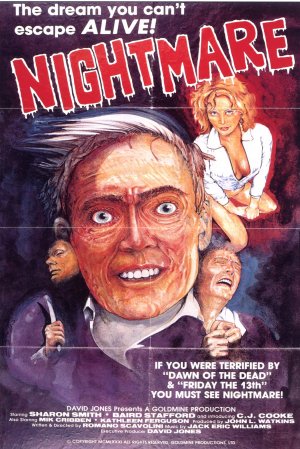
Released as Nightmare in America, Nightmares in a Damaged Brain (a title I like much, much better; therefore, I will refer to it by this title throughout this piece) is arguably one of the two or three most infamous titles to appear on the Video Nasties list (I'm going to assume, as I have in the past, that most reading this understand by this point what a Video Nasty is; if not, a simple web search on the subject yields hours of reading material). The director, Romano Scavolini, UK distributor actually released a slightly longer version than the approved cut by the DPP, and so he spent 18 months in jail because of it – the only filmmaker distributor during that ridiculous era of censorship to actually do jail time. Unfortunately, the film itself is pretty bad – coming off often as nothing more than a bad Halloween (at one point the killer dons a mask for no other apparent reason than to cash in on the The Shape) and Maniac (the film’s seedy New York setting) rip-off – only briefly showing glimpses of some kind of coherent filmmaking and coalescing tone and theme. There are times when it is conceivable to see just what Scavolini was going for, and by God, Nightmares in a Damaged Brain seems like a coherent horror film; however, as soon as those thoughts creep into the viewer’s head, Nightmares in a Damaged Brain does something – or cuts to something so random – so inane that it just proves what’s really going on here: schlock. Even with all of the film’s problems, the die-hard slasher fan will probably find something to enjoy here, and the film certainly needs to be seen for its historical importance during the era of the video nasty.

Wednesday, June 20, 2012

Summer of Slash: The Burning


I wrote about The Burning when I first started my blog four years ago. The review – which was really short – sucked. I believe it’s still on here somewhere, so if you’re so inclined to search for it – all-the-while seeing what a horribly inept writer I was when I started this thing in 2008 – do so at your own risk (I believe it was part of the first Halloween-themed series I did for the blog, and I unfairly attached my review of the film to the sort-of-similar, but annoyingly tongue-in-cheek, Hatchet). So this is to say that I don’t think I’ve ever given The Burning – certainly one of the most important slasher movies to come out in that oh-so-fruitful year of 1981 – a fair shake on this blog. I’ve seen the film about five times now (so really how bad can it be?) and each viewing improved on the one before. After my most recent viewing, I think I’ve come around quite a bit on The Burning; a film that certainly stands out as one of the best examples of the early ‘80s slasher film. 

Tuesday, June 19, 2012

Summer of Slash: Without Warning


In light of Ridley Scott’s Prometheus – and whether or not it is or isn’t a good/faithful extension to his horror/sci-fi/slasher Alien – I figured I’d kick off the Summer of Slash this year with a film obviously influenced by Scott’s seminal film. Greydon Clark’s Without Warning (also known by its more apropos drive-in title It Came Without Warning) has very much in common in with Alien (and what horror/sci-fi hybrid post-1979 didn’t) in that it plays more like a slasher than a straight science fiction film about alien invaders. As I like to point out often in these Summer of Slash entries, there are a lot of films that pre-date Friday the 13th that give us a sense of what the commercialized slasher film would eventually become. Without Warning is interesting not because it’s necessarily an effective slasher movie (or even a good sci-fi movie – it is, though, an extremely likeable, goofy lark), but because it was made around the same time Friday the 13th was (Without Warning, then it would seem, just as Friday, would owe a great deal to Bava’s Bay of Blood) and predates by seven years Predator, the film it most obviously reminds the viewer of with its alien hunter throwing killer Frisbees around for sport (an interesting link to Predator is found in Kevin Peter Hall who also plays the alien here).