Showing posts with label zombies. Show all posts

Tuesday, October 16, 2012

Italian Horror: A Primer


Now that I’m on my third year of hosting this-here blogathon, I figured now would be as good a time as any to write up a proper introduction to the subgenre I love so much. I have invited many people to participate in this humble project the last couple of years, and one of the things I love hearing most is that people were introduce to Italian horror through this blogathon. I hear quite often that people were always apprehensive to try out Italian horror because they knew so little about it (aside from the fact that narrative structure was meaningless). Inevitably, whenever I hear from or read something by someone that encounters Italian horror for the first time, it’s almost always in the vein of, “Wow, that looked really great – it was illogical and frustrating at times – but it sure was nice to look at.” So, on the week before the blogathon, I thought I would throw up on the blog this little primer about the history of Italian horror, where one might want to start, what one should expect from an Italian horror film, and some of its major contributors. Remember, the blogathon begins next week on October 24, so if you’re still on the fence about contributing or what to write about, maybe this will help.


Sunday, October 30, 2011

Italian Horror Blogathon: Cannibal Apocalypse (aka Apocalypse domani)


Released a year after Cannibal Holocaust and a year before Cannibal Ferox (Jess Franco’s Cannibals was in there, too) it’s safe to say that the‘70s and early ‘80s belonged to the cannibal subgenre. Antonio Margheriti – working under the oft-used pseudonym Anthony Dawson – never had much use for the horror genre as this was his only foray into visceral, exploitation horror film. He was more of a Gothic horror filmmaker with one of his most well known films being the 1964 film Castle of Blood (It's also much rumored that he directed Andy Warhol's Frankenstein and not Paul Morrisey). He was more of a genre filmmaker who specialized in those great Italian action films that were just knockoffs of more popular American films. Marghertiti – who cut his teeth working as an assistant with Sergio Leone – isn’t up to the tricks that Deodato and Lenzi used in their cannibal films; in fact, the word ‘cannibal’ in the title is a bit of misnomer as Cannibal Apocalypse doesn’t contain any of the racial insensitivity or cruelty to animals (or gut munching) that those infamous cannibal film have. It’s a nice, underrated film, and one that I am completely baffled by the DPP’s inclusion of it on their Video Nasty list.  Cannibal Apocalypse is an interesting amalgam of cannibal movie, Vietnam movie (its Italian title translates to “Apocalypse Tomorrow”), and Euro crime picture; it’s a sneaky-good Italian horror movie that more people need to see.  

Thursday, October 27, 2011

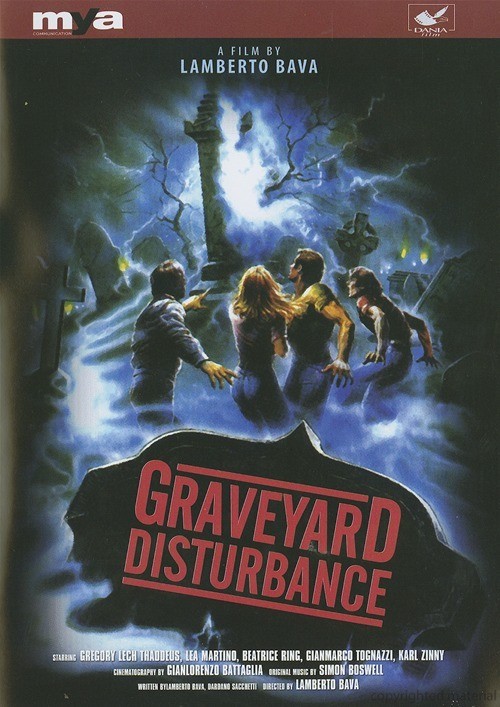
Italian Horror Blogathon: Graveyard Disturbance (aka A Night in a Cemetery, Una notte al cimitero)


Lamberto Bava’s Graveyard Disturbance is an interesting film in the history of Italian horror. Oh, not because it’s any good, but because it marks the death of quality, theatrical Italian horror films.  1987’s Graveyard Disturbance marked the first of four films that Lamberto Bava made (with the help of veteran genre screenwriter Dardano Sacchetti) for the Italian television series “Brivido Giallo.” What’s significant about this really, quite honestly, has nothing to do with Bava. Oh, Bava was a decent talent – a filmmaker who could obviously never live up to his father’s name – who worked early in his career as an apprentice (alongside Michele Soavi) for Dario Argento. Bava’s best film was the 1980 giallo Macabre; his Demons is a lot of fun, too. But back to what I was talking about: Italian horror circa 1987. Graveyard Disturbance came out the same year as Michele Soavi’s Stagefright and Dario Aregento’s Opera; two films that are wonderful examples of just what good Italian horror can accomplish; however, they also weren’t big success financially, and with the increasing popularity of television, the floundering Italian film business (American horror movies were making a ton more than the homemade products), and how cheap one could produce a movie for television, there would only be a couple more movies like them before we started getting more and more movies like Graveyard Disturbance.


Wednesday, July 21, 2010

Summer of Slash: Capsule Reviews, Part 4


Back with some capsule reviews.  These have been in the can for a while, but a mixture of grad school, work, and the hard drive for my desktop computer blowing up it's been a bugger of a time getting some new horror posts up.  I have a review for Maniac ready to go, too, but I'm still waiting for my computer to get fixed so I can get some screencaps up (my Netbook doesn't have a disc drive). In these capsule reviews you'll find brief thoughts on the Ozploitation version of Rear Window, a zombie movie penned by the man who came up with the idea for Alien, One of the best worst movies I've ever seen (one that would make Umberto Lenzi proud), and possibly one of the worst horror sequels I've ever seen.  Reviews after the jump...


Sunday, May 23, 2010

Summer of Slash: City of the Living Dead (aka The Gates of Hell, aka Fear in the City of the Living Dead)


[This is a re-post of something I wrote back in October for the Italian Horror Blog-a-thon I hosted.  Today I am re-posting it because the invaluable and unmatchable horror blog Final Girl has selected this for her May entry for her Final Girl Film Club. And I figured I would use that as an excuse to post it again for my summer horror series.  Enjoy.]

City of the Living Dead is typical 80's Fulci as the plot is one nonsensical moment after another; however, in typical Italian horror fashion (and Fulci was one of the best) these nonsensical moments seem purposeful, they lead to ethereal, displacing scenes that are heavy on atmosphere and style and empty of all logic. That’s okay, though…we know that’s we get with post giallo Fulci – films that exist for the moment.


Wednesday, October 28, 2009

Italian Horror Blog-a-thon: Nightmare City (aka City of the Walking Dead, aka Invasion of the Atomic Zombies)


[Dusting off another old review for today. If you've never had the pleasure of seeing an Umberto Lenzi movie...this is one to see. I'll update the links later today as I had two wonderful submissions sent to me yesterday, one from Tim of Antagony & Ecstasy and the other by Roderick Heath of Ferdy on Films...if you're familiar with either of those blogs than you know the quality of those submissions is going to be at a high level. Enjoy.]

Umberto Lenzi’s Nightmare City is a masterpiece. No seriously, hear me out. The film is the Italian horror equivalent of the greatest of all 1980’s so-bad-it’s-good-movies, Commando. It is one of those films that is so awful in every aspect that the more you watch it, the more you appreciate every frame of the film. Not only is the film awesomely awful, but it inspired Robert Rodriguez’ Planet Terror and Danny Boyle’s 28 Days Later. Lenzi’s film contains a plethora of 1980’s European horror film clichés. It’s the classic example of Italy churning out whatever was popular at the time and employing a hack director to just make sure the film makes money (this happened with cannibal films which stole from the Mondo films, and it happened with supernatural films like The Exorcist rip off Beyond the Door, etc. – basically they knew they were going to make a profit before the movie was even released, so they didn’t care about the quality). The result of all this is Lenzi and co. creating one of the funniest horror films ever made, and one of the truly great grindhouse experiences you are likely to have.


The film opens with Hugo Stiglitz as Dean Miller (great generic American name), a reporter who is headed to an airstrip to meet with a prominent scientist for an interview. However, an unmarked military plane lands on the airstrip and as Miller instructs his cameraman to shoot the action, nothing can prepare our hero for what he is about to see: oatmeal-faced, turtleneck/sports coat wearing zombies who rush off the plane and partake in an orgy of stabbing, biting, drinking blood, and missing a lot of their cues from Lenzi. These aren’t your ordinary zombies, though. In fact, they are more like what we’re used to seeing in American zombie films today; as Miller’s wife the good doctor Anna explains, they’re “infected.” Hmm, sound familiar?

The infected run around the city killing lots of people (looking suave while doing it), and in a surreal scene at the television station that Miller is employed by, the zombies rush in on what appears to be a daytime disco/aerobics show. If you have ever been curious as to why it is I love Italian zombie films so much, this scene helps explain a lot. They proceed to eat up all the dancers (some dancers, ever the performers, keep dancing while the mayhem ensues), and look to take over the station. Miller is at the station desperately trying to get a message out to the people about the infected…but his boss says no dice. A disgusted Miller retreats to his office, but he’s intercepted by a horde of infected trying to kill him. This is great because it causes Hugo Stiglitz to overact (like only Hugo can) and show just how wimpy he is as he resorts to throwing monitors and other various office supplies at the zombies as they try to break into his office and kill him. One monitor even explodes as cheesy looking sparks and smoke bomb effects go off. God bless you, Lenzi.

The rest of the film is some nonsense about how the zombies are not undead, but they are infected from a radiation spill and how they need blood to survive. The hospital where Anna works gets overrun soon enough (with a wonderful scene by a doctor who is performing surgery, and without hesitation when one of the infected walk in, he throws his scalpel at him, and of course does nothing to prevent the inevitable), but luckily our hero Hugo is there to rescue his wife and get her the hell out of there.

There’s also some stuff about how there is a national emergency and some military people have to figure out how they want to handle the situation. Miller and wife try to warn people about what is happening, but that crusty old veteran General Murchison (ably played by Mel Ferrer) won’t allow it to happen. Damn him! There must be something else to why this plane was allowed to land? Ah, but Lenzi is not interested in an even more convoluted storyline involving military conspiracy; no, he’d rather focus on bad make-up, inane goings-on like a lawnmower that pushes itself across the lawn of the good General’s wife, or the sculpture she is working on that randomly breaks and drips blood, which of course leads to her death (how these things are relevant to the film, I still haven’t figured out – it’s as if Lenzi was desperate to mix in some Beyond-esque supernatural weirdness).

The film ends with a showdown in an amusement park where the Miller’s climb a Ferris wheel to load a helicopter, but then…bad things happen including a nasty fall by Anna. But who cares, right? I mean look at Hugo with the gun! He just mows down the infected looking as wimpy as someone can holding a gigantic automatic weapon like that. Then the film does something way ahead of its time. Circular plot, baby! Just when we think the film is over as Dean is in trouble and his wife has just died Lenzi hits us with this…


Brilliant! Brilliant, I say!

Nightmare City is a film that even the most casual of horror fans would enjoy. It’s campy enough to be entertaining and has the so-bad-it’s-good quality that makes for a good party movie. It’s also fun to see zombies that aren’t boring. These zombies are fast (and dress nicely), and it’s fun to watch the film and see its imprint on tongue-in-cheek fair like Planet Terror (which lifted the entire hospital scene from Nightmare City) to better and more eerie horror films like 28 Days Later. At one point in Nightmare City one of the zombies picks up a gun and uses it…if you ask me this shows that Lenzi was way ahead of his time and a true auteur of the zombie genre, preceding Romero’s Land of the Dead (where zombies also use guns). Okay, Lenzi isn’t an auteur at all, but it is fun to watch him hack his way through this material and supply enough originality to the genre to keep us entertained, while also supplying enough crap that will make you laugh out loud and want to hit the rewind button.

I mentioned Commando at the beginning of this review, and although Nightmare City is not as quotable (“Let off some steam, Bennett”) it is just as memorable as far as awful 80’s movies go. The wonderful Italian touches separate it from a purely American film like Commando, which is why I love Nightmare City so much more than other “good” bad movies. I have an unabashed love for all things Italian horror and the weird nonsensical things these filmmakers add to their films (also kick ass synth soundtracks). It is because of these things that Nightmare City stands shoulders above all other bad Italian zombie movies, even the soundtrack and classic Italian horror motifs are horribly ripped off here. Everything in the film is a failure, which more often than not in this subgenre means the film is a success in being a guilty pleasure.

Compared to a good zombie movie, Nightmare City is a joke, but isn’t that really the point. No one rents a film like this expecting something good. The wardrobe and the make-up and the nonsensical storyline easily make this one of the most enjoyable pieces of crap to come out of the 1980’s Italian horror era. Lenzi would go on and do what most Italian hack directors do: rip off more material. His next film Cannibal Feroux was just a rehashing of the cannibal genre’s most influential film Cannibal Holocaust, and the films that preceded Nightmare City were just the same old tired gialli; however, with Nightmare City and its oatmeal covered, sport coat wearing zombies (and of course Hugo Stiglitz) I always find myself smiling at this wonderfully awful and hilarious Italian horror film that should be atop every horror buffs must see list.

Monday, July 6, 2009

Final Girl Film Club: Burial Ground (AKA The Nights of Terror)


This is part of the Final Girl Film Club -- this month tackles my favorite subgenre and focuses on one of the weirdest films to ever come out of the Italian zombie movement. Head on over to Final Girl to check out all of the other great entries.

Some connoisseurs of Italian horror really find this film to have profound statements about the class struggle in Italy at the time. They claim that the zombies rising from the dirt and attacking the castle is an ideal metaphor for the bourgeois rising up and attacking the wealthy social class. Okay…not really, but Andrea Bianchi’s Burial Ground (AKA The Nights of Terror) is one of the most infamous so-bad-it’s-good type horror movies ever to come out of the Italian Zombie subgenre. It's hilarious and horrible, and sure to be one of the most surreal movie-going experiences you’ll ever have.

The story is about some rich swingers who meet up at an old castle/mansion to have a discussion with a professor friend of theirs. Only what they don't know is that the professor stumbled upon “a great secret” that “must be true”. He heads outside and into a crypt to chisel away at some stone when some zombies are like “what’s up? Why did you have to bring us back from the dead?” The viewer is left to think that the poor professor knew these zombies before they were donned with skeleton masks covered in oatmeal and rubber cement, because when the zombies approach him he utters one of the films many hilarious lines: “stand back! I’m your friend.” Best not to barter with the walking dead because his “friends” don’t listen to him and poor Professor (who looks a lot like Alan Moore) supplies his "friends" with some easy dinner, and I mean easy; he just stands there and lets them chomp away, and thus kicks off Andrea Bianchi's Burial Ground.

Bianchi was a hack who mostly worked in soft-core porn or the giallo, moving around like most Italian horror directors, to whatever idea made him the most money. Some of his films include: Maniac Killer, Cry of a Prostitute, Strip Nude for your Killer, and The Malicious Whore. So really his only attempt at a zombie movie was with Burial Ground and even then the entire first act of the film is nothing more than Cinemax quality porn.

Once the gettin' busy commences we cut outside to two people making love in the garden. They soon realize something is wrong when a zombie rises up from the ground just as they're getting hot and heavy (oh what a hilarious metaphor!) in scene that is directly taken from Zombi 2. Perhaps that is why in Europe Burial Ground was actually referred to as Zombi 3. The zombies don't even look great as I mentioned before and really it appears that they only took the time with a select few that they showcase throughout the film, all of the extras were just given oatmeal and rubber cement to put on their cheap Halloween masks.

The fight scenes with the zombies and the swingers are some of the most hilarious in an y zombie movie. Our mustache-clad swingers find anything they can use to stave off the zombies (some even look like Christopher Llyod…see above). During one horribly long scene we get a POV of one of the characters holding a pitchfork (Hey, it’s Italian Zombie Doom!) just starring at the zombies while the rip-off Goblin music plays in the background. After a horribly long and awkward fight scene the zombies are finished off by, get this, a planting pot...yeeeeeah. This leads to the ever popular head-as-paper mache-being-destroyed scene that shows maggots escaping from the "brain."

The zombies in Bianchi’s film are up to the task though as they are more than capable of throwing knives and wielding farming tools themselves. In one hilarious scene the chamber maid wisely looks out the window to see what’s going on…and of course as she does this a zombie (who must have had some knife throwing practice at one time in his life) hurls a knife at her hand. Now stuck, the maid has no other option but to sit there as the zombies get a scythe and slooooooowly chop off her head. Pretty awesome. The zombies are also more resourceful than most as in one scene they show signs of great team work as the work together to make a battering ram so that they can knock down the door to the estate.

One of the main reasons why this film is so infamous is because of the creepy little mutant kid Michael. Here is what looks like a middle-aged little person playing a ten year old boy who has a weird obsession with his mother. He's always walking in on her while she's getting her groove back with some slimy looking Italian dude (the best line is "you're getting a rise out of me" all the while zombies are rising from the grave – insert “boing” noise here), and none of his creepiness is helped out by the horrible dubbing job.

The most famous scene of the film – and the one scene that when you explain it to others they say “oh yeah, I’ve seen that movie, I had forgotten what that movie was called” – is when Michael's mother slaps him after he gets himself a handful of his mom's goodies "just like when he was a boy" he says...yuck...but that's not the worst of it: Michael runs away and is bitten by a zombie. We are supposed to forget about creepy little Michael but when two of the survivors and Michael's mom are the only people left and they retreat to a church (with flesh eating monks and all!) there's little Michael emerging from a door (how he got to the church I have no idea) and his mother full of guilt for slapping her boy, and so pleased to see her boy alive, does the most disgusting thing in any movie...she lets her "boy" get some milk just like when he was a baby. Gross. And stupid...because as the other two look disgusted (hey something did gross out Italian swingers, amazing!) it is clear that Michael is a zombie, and sure enough, mommy gets the worlds worst tittie twister as Michael takes a big 'ol bite out of his moms breast. Ouch!

There are some classic Italian horror moments in the film like the pacing of the action, the horrible dubbing, the synth soundtrack, and especially how the zombies die. When the zombies are trying to find their way to the second floor of the mansion one of the swinger dudes who looks like Buzz on "Baywatch" grabs a gun and proceeds to shoot all of the zombies in the head. This leads to the always popular Italian shot of the zombie head with a completely black backdrop, exploding, looking more like a watermelon being hit by a shotgun blast than a head. This "isolated" head shot was popular in a lot of Italian horror films as the directors wanted to get as close to the gruesomeness as possible. The only problem was it makes it even more obvious how stupid and cheap the effects and make-up are.

This is still somewhat of a forgotten zombie film even though it has a cult following (not as big as Zombi 2 of course). This film is a perfect example of how the Italian's began ripping off their own stuff, and showed just what kind of hacks these directors were. Whether it was the giallo film, the cannibal film, or the zombie film, it was guaranteed that you would see all three of those genres on an Italian horror directors resume. The film is good for a lot of laughs as it produces some of the cheapest looking zombies, and ends in ridiculous fashion with a quote from The Profecy (that’s how they spelled it) of the Black Spider. See if you can spot the spelling error in the quote – and somehow that seems entirely appropriate for this film.

The violence is mild and predictable after if you’re familiar with this subgenre, especially the more popular Zombi 2 and The Beyond, but with its campy and hilarious characters and surreal moments Burial Ground is one of the better Italian zombie films. It deserves to be in the canon of Italian zombie movies. In the words of Kenny Banya: "It's gold Jerry...gold!"

Saturday, June 6, 2009

MapQuesting a Meme


Rick Olson of the superb Coosa Creek Cinema has tagged me for a meme. Here's the Q 'n D of it all:

1.) Think of a place (real or fictional) and time (past, present, future) portrayed in a movie (or a few) that you would love to visit.
2.) List the setting, period, applicable movie, and year of the applicable movie’s release (for reference).
3.) Explain why, however you’d like (bullet points, list, essay form, screenshots, etc.). If this is a time and place that you have intimate knowledge of, feel free to describe what was done well and what wasn’t done well in portraying it.
4.) If possible, list and provide links to any related movies, websites, books, and/or articles that relate to your choice (s).
5.) Modify Rules #1-4 to your liking. And come up with a better name for this meme.
6.) Link back to this Getafilm post in your post, please.
7.) Tag at least five others to participate!


That's from the GetaFilm site hosted by Daniel Getahun who is the originator of this meme. I had to think about this for a little bit. I don't mind the whole meme thing, it's just sometimes it's hard for me to follow the rules. So I'll do my best. I started thinking about what places I would like to visit and oddly enough almost all of my conclusions came to some form of a director's alternate universe. These films, with the exception of one title, exist in the years they were released. As is the case with any of these lists, this is in no way a definitive culmination of my brainstorming...but it's the best I could come up with for now, so let's get to it...


I'm going to do this by chronological order of when the film came out (Oh, and all of my DVD's are boxed up in storage right now, so all screen caps are coming from the net and some of them aren't as specific as I would be had I access to my own collection):


Duck Soup (1933, directed by Leo McCarey)

Ah yes, what a maddening euphoria it would have been to exist in Freedonia. Duck Soup is a film that takes place in an alternate universe, sure, but it seems eerily absurd like The United States of America. There are a lot of parallels to Freedonia's problems and the problems we face in America today, so how great would it be to have lived in Freedonia with a president who (gasps) tells the truth. Oh how we could have used someone like Rufus T. Firefly in our previous administration to just tell it like it is...if only there was a song...

"If any form of pleasure is exhibited, report to me and it will be prohibited! I'll put my foot down, so shall it be... this is the land of the free! The last man nearly ruined this place he didn't know what to do with it. If you think this country's bad off now, just wait till I get through with it! The country's taxes must be fixed, and I know what to do with it. If you think you're paying too much now, just wait till I get through with it!"

Anyway, that's just part of the fun of this film. It's one of the all time great comedies, and I think it would have been a hell of a ride going through what we went through for eight years (and are still feeling the effects of) with someone as blunt and rudely honest as Firefly. Hey, at least we would get the truth.


The Alternate Universe that is 1970's Italian Horror (1970's, directors: Lucio Fulci, Umberto Lenzi, and Dario Argento)

Whenever I talk about Italian Horror on this blog I almost always throw around the word ethereal. These films displace the viewer creating alternate realities that are unlike anything in the genre. Sometimes that's a good thing, but more often than not it's a bad thing. Take for instance the place I would love to visit from all of these 1970 Italian Horror films: "New York City". This "NYC" is actually Rome posing as the Big Apple (except for a few of the exteriors in Fulci's Zombi 2), and often times (like Kubrick's "New York" in Eyes Wide Shut) it does create an eerie feeling (usually if in the hands of Argento or a motivated Fulci, not hacks like Lenzi) that displaces the viewer. It's also the backdrop for what are some of the craziest goings-on I've seen in any horror film. The "city" is also often the catalyst for sending our protagonists in jungles of the Amazon where they are killed by cannibals. I think I'd like to go there to tell these characters that you don't have to stand there and watch them eat your friend...you can run and get the hell out of there!


More than anything the "New York" and other alternate realities of Italian Horror (especially "Louisiana" from Fulci's The Beyond) are home to sport coat wearing zombies; killer spiders (some real, some not so much) that hiss like snakes, and chew off people's faces; and among other things, an all Jazzercise channel that gets interrupted by tons of infected, blood-thirsty scientists. Come on! Who wouldn't want to be a part of that swingin' "city".


The Talented Mr. Ripley (1999, directed by Anthony Minghella)

The Rome of Minghella's masterpiece (I must really want to visit Italy) is the most realistic out of all of these places that compile this list. The Rome I want to visit exists in the 1950's, specifically the Rome as experience by rich, easy-going playboy Dickie Greenleaf, his fiance Marge, and a mysterious "friend", Tom Ripley. Before the horrifying events unfold that really set this brilliant film in motion, the viewer is treated to a bevy of luscious scenery and stunning on-location cinematography that made me want to, for the only time in my life, wish I were rich. To be rich and to be in Dickie's position -- to drive around Rome on a Vespa with a beautiful woman, drink expensive alcohol while laying on the beach, sitting in cafes all day, have no responsibilities -- and to have it all in beautiful 1950's Rome...well sign me up. I could live there forever. Especially when Tom and Dickie go out on the boat and are surrounded by nothing but beauty and an eerie silence, a man could definitely be inspired there. Well until...you know...that thing happens...


American Movie (1999, directed by Chris Smith)

You can kind of call this an alternate reality because really I don't think amateur horror filmmaker Mark Borchardt has any idea what reality means. But man is he passionate about getting his film made, and that passion is infectious. The specific place I would want to be is in Milwaukee with Mark, all the time, talking about horror film (it's no secret what a fan I am of the genre), and hoping that just maybe, someday, I could be as passionate about something as he is about getting his film Coven made. The specific scene I'm thinking of is when he's editing late into the night at the local university, splicing together scenes at the last second, mulling over every decision like Scorsese would with his films. It's a scene that shows the drive (even though often he appears to have no drive) this man has. It's kind of like the Coens' Fargo: these people are etched out of a specific geography, and I wouldn't mind being there, because really, there's a character on every corner.


Apatown, U.S.A. (2000's, directors: Judd Apatow, Greg Mottola, and Akiva Schaffer)

This is another one of the alternate realities that I would love to live in where guys like Steve Carrell, Jonah Hill, and Seth Rogen are hooking up with beautiful women. I'm like those guys...and I guess this alternate universe isn't so far fetched since I am getting married this summer to a beautiful woman...so hey, us nerds do get lucky sometimes (for the record I don't know how I fooled my fiance...). Films like Superbad and The 40 Year-Old Virgin and Knocked Up exist in that bizarre Apatow realm where geek is chic and it doesn't matter what you look like, what your social status is, or any of that crap: it's your individuality (and weirdness...or read: geekiness) that sets apart from everyone else and makes you attractive.


I threw Akiva Schaffer's name on there, too, because he's obviously indebted to Apatow's style, plus I've been obsessed with Hot Rod lately: it's a brisk 80 minute comedy starring Andy Samberg that also exists in the same retro, thrift store habilimented (thank you Thesauras iPhone app!) universe where the dork gets the extremely beautiful girl (Isla Fisher) because they don't change who they are. By the way, the movie actually is pretty funny and I can't convince myself to stop watching whenever I come across it on Direct TV.


Well, there ya have it. I proabbly flubbed the rules a bit, but these are the places in film I would most like to visit. So...it's taggin' time:

Troy, Sam, Ed, Andrew, and Ali.

Wednesday, May 20, 2009

DVD Review: Cemetery Man & Zombie Holocaust


Sunday night I decided to have myself an Italian zombie double feature: the first film, Cemetery Man, directed by Michele Soavi, is considered one of the best zombie films ever made; the other film, Zombie Holocaust, written by Fabrizio de Angelis, the creator of the seminal Italian zombie film Zombi 2, is notorious for, well I don't know if it's notorious for anything, but it's one of the few Italian zombie movies I've yet to see. My affinity for all things Italian horror, specifically Italian zombie films, is no secret -- the blog's namesake gives that away -- just click on some of the tags to see how much writing I've done on Italian horror, and specifically the zombie subgenre; but it's been a long time since I've been able to wax poetic about the genre I love so much so I went ahead and myself a double feature. Thoughts after the jump...


Cemetery Man:

Michele Soavi is one of the forgotten greats of Italian horror. Perhaps that's because he came in a little late, not making his first film well into the 80's. However, Soavi, Aregento's top apprentice, has made some of the best horror films, American or Italian, that I've ever seen. His Stage Fright is a classic hybrid of Italian giallo and American slasher (not to mention one of my favorite horror films), and his eerie The Church is a beautiful looking film with a set design and classical Italian nonsensical ethereal mood throughout. The Church, as a supernatural horror story, excelled in areas that only Argento laid claim to. Soavi then went on a hiatus from film to care for his ailing son. He returned, however, to make mobster films for Italian television (which are supposed to be really good, I'm working on getting those to review). Despite all of the kudos I've showered on the man I hadn't yet seen what was probably his most famous film, sandwiched in between Stage Fright and the mobster films is what many zombie gurus consider one of the premier zombie films, Cemetery Man.

The hype was warranted as Soavi creates a weird hybrid of comedy and classical Italian zombie elements that fans are looking for. The film isn't a gut-muncher like some of the films of Lucio Fulci; it relies more on bizarre scenarios, beautifully shot scenes, and comic violence in the vein of Sam Raimi's Evil Dead 2: Dead by Dawn.

The story concerns Francis Delamorte (Francis of Death he tells us through narration) played by Rupert Everett who must guard a cemetery so that the "returners" (or what we would call zombies), who rise from the grave after being a dead one week, don't get out of the cemetery and into the city. Delamorte meets a beautiful woman during a funeral and tells the audience "she was the most beautiful living woman I had ever seen." It's lines like those that make Cemetery Man such a treat. Here's a film that doesn't take itself seriously at all, it has a lot of fun with the premise of zombie flick and the conventions the viewers expect; however, it flips those expectations by taking none of what happens seriously.

Soavi's film does get all meta with the major plot twist that occurs, and it's at this point that the film plays more like fairy tale. Delamorte utters this doozy of a line in his narration: "The living dead and the dying living are all the same; cut from the same cloth"; and thus kicks off his killing spree of not just zombies, but of living people as well. It's a funny take on society and how the killing spree by Delamorte and the zombies are no big deal. The joke does tend to overstay its welcome, but it's such a fun ride, not to mention beautifully shot, that I didn't quite mind that the film is kind of monotonous in the middle.

Delamorte is like Ash from the Evil Dead films: witty, weary, and always on his toes no matter how ridiculous the situation. Delamorte is joined by one of the more bizarre sidekicks I've seen, his name is Gnaghi, which is essentially the only sound he makes. Delamorte tells us that he has "a real passion for dead leaves", so we always see Gnaghi raking leaves. The slapstick element he provides is also pretty amusing as there is a great scene when Delamorte is shocked to find that the "returners" are rising well before their normal one-week time. He's outside struggling with a zombie, runs into Gnaghi's room, continues to fight the zombie without him noticing at all; he just continues eating his meal and watching television. The way the scene is blocked and executed is wonderful, and it's clear to see the influence of Soavi's film on the hilarious Shaun of the Dead. I also love how Soavi plays with the conventions of Italian zombie flicks. There's a great scene where Delamorte walks in on someone being eaten by a zombie -- he's about to put an end to the business when it seems like the girl getting eaten is kind of enjoying it as she says: "please don't, he's only eating me." There's something about that scene that got a huge laugh out of me; in fact the entire film has a wry undertone to it that is often omitted in horror. People often forget that one of the reasons you watch a horror movie is to (gasp) have a good time.

As I've mentioned already, the film is beautiful to look at; Cemetery Man,like a lot of good Italian horror, has style to spare. One thing Soavi does extremely well is light his scenes. The graveyard is a perfect setting for Soavi to work his magic, and there is rarely a scene in the film that doesn't make you realize that Cemetery Man is not your average horror film. There are some truly bizarre moments in the film that will probably turn off the most casual of horror fans (like Delamorte having some serious sex with a woman right by the grave of her ex-husband), but if you're familiar with Italian zombie subgenre, and can enjoy just a classic, cheesy, fun horror film, then this your film. Soavi's film is what I think Sam Raimi's new picture, Drag Me to Hell, will be like: nothing overly gruesome, just a fun horror movie. We need more of those as the genre as turned way too serious. The other amazing thing about Cemetery Man is that it came about 10 years after the last successful Italian zombie film. Italian horror was being phased out, and it was rare to see such a good film produced in a time when horror was middling. This is the exact same thing that happened with his slasher/giallo film Stage Fright.

Soavi is a director who you must acquaint yourself with if you are a fan of horror films. He has an amazing way of integrating haunting sets with hilarious situations without ever compromising either aspect of his film. There's a moment in the film where a motorcycle rider is killed. His friends bury him on his motorcycle, so when the week is up, and it's time for his to rise from the grave, he does so on his motorcycle; he even leaps over a tombstone and Soavi shoots the scene against the moon so all you see is a motorcycle driving zombie silhouetted against the night sky. It's a scene that is both hilarious (especially if you've seen other Italian horror films like Demons that have goofy elements like that in them, only they're played straight) and aesthetically beautiful. It's rare to find a horror director who can balance those two elements with such ease. Soavi often goes unrecognized when people speak about the great Italian horror directors like Bava, Argento, and Fulci; but he deserves mention right along side those giants of Italian horror.


Zombie Holocaust:

Crazy things happen in the jungle...that's what I've learned from Italian horror films. Also, don't mess with the natives, man. Let them do their thing -- so what if you're freaked out by them munching on your dead buddy, just get the hell out of there, don't worry about taking your stupid pictures for the newspaper! Also, if you're a doctor performing "studies" on the natives, you may want to re-think your vocation, because well, the jungle, man...it'll drive you crazy -- and then a zombie is bound to find you. This is what I've learned from Italian zombie movies that require their characters leave the comforts of the city to go find out what's going on in the jungle.

This film is nothing special, just your typical drive-in movie from the 80's that really doesn't even contain that many zombies. The film stars Ian McCullough as a doctor and Delli Colli as a journalist who unearth the horrifying mysteries about "zombies" in "New York City" (Italian horror directors never filmed on location). This leads the two to a mysterious island where the characters are relegated to a lot of sight seeing so all sorts of Italian horror staples can occur: stock footage, funky synth music, gratuitous nudity, cannibalism, etc.

The film is good for a laugh as you get a good sense of the type of film you're getting into from the onset. The film opens with a mysterious figure hack-sawing off limbs from a cadaver that's to be used for an Anatomy class that Dr. Butcher (yes his name is Dr. Butcher) teaches. Butcher is amazingly portrayed by Donald O'Brien who is like a low(er) rent Mel Ferrer. This allows the film to immediately begin with the usual close-ups of intestines. I swear, watching these old Italian zombie movies is like watching Discovery Health; they thought it was so neat to show you the insides of people.

This leads to Peter (McCullough) and Lori (Delli Colli) inquiring about such and such (seriously these generic zombie plots all run together) and wanting to see what Dr. Butcher is up to when they hear he is on an island "helping" the natives. The convoluted plot, the backwards logic, the amazing justification for the good doctor's "life work" -- they're all the classic bad movie elements that make these 80 minute affairs tolerable. However, they are a lot more fun to watch with a group of people than by yourself.

The film was obviously shot at the same time as writer Fabrizio de Angelis' other film Zombi 2 was. It contains two of the same actors,essentially the same storyline, and all of the same locations; however, the film is lacking in the creative gore found in Zombi 2. The gore in this film looks more like the leftovers from Lucio Fulci's famous zombie film. Most of the shots are of scalpels going through cadavers and it is some of the most laughable effects I've as it's pretty clear it's just a scalpel going through a bed sheet; the "skin" even bunches up as the scalpel goes through it. Pretty funny stuff that definitely fall under the so-bad-it's-good category.

If you're bored, and have about 80 minutes to kill, Zombie Holocaust isn't bad for a laugh. There are plenty of moments that I could go into detail about, but really, they're just the same as the moments found in much better, and funnier, Italian zombie flicks like Nightmare City, Burial Ground, and The House by the Cemetery. There's some decent enough gore effects once they get on the island, but the film really only has zombie in the title so that they could cash in on the successes of Romero's Dawn of the Dead (entitled Zombi in Italy) and Fulci's "sequel" to that film Zombi 2 that were sweeping Italy at the time. If you're a completest like me, though, then definitely check this out as there's something kind of charming about the familiarity of it all.

Thursday, May 14, 2009

DVD Review: [Rec]


The Blair Witch Project is, whether you like it or not (and I have come to not really care for it as much as I once did, although that ending still gets me), a seminal horror film. It reminded horror fans, and low-budget filmmakers, that you could still subscribe to the Val Lewton philosophy of horror: what you can’t see is still what’s scariest. Jaume Balaguero’s [Rec] is a good example of what The Blair Witch Project did well, using an “on the scene” hand held camera aesthetic to heighten the panic, and a brilliant, creepy sound mix that, when you see that ending, will give you goose bumps long after the film is over. The scares are genuine; the sound mixing is great as the thuds, whooshes, splats, and other icky noises are what’s most jarring, not the gore; and clocking it at a brisk, albeit extremely intense, 75 minutes it’s a rare horror film that doesn’t overstay its welcome.


[Rec] begins with a plucky reporter Angela Vidal making the rounds at a local fire station interviewing various people on the job. She is reporting for the entire night for TV special, and when the firefighters get a call to tend to an apartment building…well that’s where the fun begins. It’s an “infected” movie, so if you’ve seen films of this ilk then you get a sense of what’s in store for you (be careful standing next to windows!); however, what you may not be prepared for is how Balaguero executes it all. Angela, the firefighters, the police, and all the tenants end up being quarantined (hey that would make a good title for a really crappy American remake!) off from society. What follows are your usual freak outs, gross outs, and crazy goings-on where people run for their life while being trapped in a building together.

The film is masterful at gradually building towards its tense moments. Moment after moment I found myself clenching tighter and tighter to whatever was around me: a pillow, a blanket, or just clinching my fist until my knuckles turned white. The compounding of such tense moments, until it is unleashed on the viewer like a rabid dog, is one of the great things about the film and what makes it such a unique experience. Horror is meant to scare you, yes, but it’s not just the act of jumping because something comes at you unrepentantly, it also is meant to exhilarate and thrill you, so that you don’t even realize you’ve been breathing until the very.

The ending is ridiculously scary; in fact, it’s one of the creepiest and most intense moments I’ve seen in any horror film. It reminded me of the way my stomach tightens during the ending of Alien. The ending is a brilliant mixture of the creepiest parts of the endings of The Silence of the Lambs and The Blair Witch Project; and when the big reveal comes out to shock you (and boy does it ever) it doesn’t seem tacked on or superfluous at all…it’s genuinely scary.

I also appreciated that the “on the scene” camera never became a contrivance. Despite the bit of exposition where Angela tells her cameraman Pablo that they must film everything no matter what, the camera never becomes a distraction. And by that I mean there are moments when bad things happen to people, and we see them, so obviously the cameraman from the news station is just sitting their watching and filming, right? Nope. Balaguero wisely has the camera being set down on the floor in multiple situations so that the cameraman is a character, not just a non-existent entity documenting the carnage. The filmmakers execute the “camera as character” trope perfectly as I never found myself being pulled out of the moment by saying: ‘why doesn’t the camera man just help them?’

Balaguero’s film is one of the great horror experiences, ranking along side Neil Marshall’s The Descent, as the definitive blueprint for how to do modern horror. Marshall’s film had the budget and élan, not to mention the seemingly endless supply of visual nods to past great horror films, that aren’t quite on display in [Rec]; but one thing they do share in common is not relying completely on gore, but rather relying on the use of darkness and sound to create a truly unnerving experience. Another good example of how sound is used brilliantly in modern horror is the first 45 minutes of The Strangers. That film totally botched its ending, but it was a perfect example of how when you strip your film of every horror gimmick and torture porn mentality – when raps on the door and giggles in the night are the creepiest parts of your movie – that’s when you know you’re onto something that’s truly scary and unnerving. Unfortunately, The Strangers flubbed its ending and turned into torture porn, but the point remains: these two modern examples, along with [Rec], show signs of hope for the future of horror. I think [Rec] is a masterpiece of the horror genre, and I’m just mad that I waited this long to see it. There is a sequel in the works, with all of the original filmmakers behind it, so we’ll see how that goes. Anything this good deserves to be seen multiple times; no matter how many sequels or bad American interpretations it spawns.

Sunday, October 26, 2008

Halloween Week 2008: I Walked With a Zombie


While watching Jacques Tourneur's I Walked With a Zombie I couldn't help but think of a different a film, a completely different film in both genre and context. The film that kept popping up in my head was the Vincente Minnelli's The Bad and the Beautiful. The film stars Kurt Douglas as a ruthless producer in the vein of David O. Selznick; however there is one scene where Douglas' character reminds me more of producer Val Lewton, producer of I Walked With a Zombie. The scene I am speaking of is where Douglas and his friend, a director, are working on their first film, a cheap B-level horror film called Curse of the Cat People. They are stuck with cheap looking cat suits that don't fit a lot of the actors who are supposed to be wearing them. When they ask themselves the question: "what do you have when you have a bunch of actors in cat suits....a bunch of actors who look like they're in cat costumes.", they come to the realization that showing the cats is a mistake, and then they ask a better question that hints at the success to these kinds of horror pictures: "what are people most afraid of? The dark! Let's say the audience never sees the cats....". I can't help but think that this is similar to the types of conversation that producer Lewton and director Tourneur had on their sets for similar B-level horror pictures. This moment from a completely unrelated film is key to understanding the success of Tourneur and Lewton's horror pictures, especially I Walked With a Zombie.

Tourneur and Lewton are successful in taking a non-horror book for its source material (Bronte's Jane Eyre) and turning it into an atmospheric spook-fest. There is nothing that is overtly scary or even nerve-jarring about I Walked With a Zombie, but there are many unsettling moments that rely on what we don't see; a formula for success found in later horror films like The Blair Witch Project.

Shadows are always in play in these kinds of films, and in I Walked With a Zombie some of the best moments come from creepy imagery silhouetted or mysterious figures lurking in the shadows. The story is your basic voodoo horror plot where a naive Canadian nurse goes to the West Indies where mysterious voodoo medicine is practiced. Betsy has been contracted out by a wealthy man to try and figure out what ails his wife (he's tried everything of course....but there's always something more), and early on she tries not to let her optimism and naivete get the best of her, but she presses on, sure that she can save her employers wife, which leads to some odd encounters as she dabbles in the locals medicinal philosophies.

Despite the films title, the plot of the story has little to do with "gotcha" moments, and more to do with uncertainty; the old stand by of a "stranger in a strange place" horror formula. A lot of it works, especially the creepy scene where Betsy takes the woman she is caring for through a maze-like field marked with various voodoo emblems. The lack of cheesy, foreboding music or easy scares are what make this scene so memorable. All you hear is the wind and the gasps of Betsy; like her we too are making this uncertain journey through the voodoo maze. The scene has an eeriness and unsettling nature rarely found in today's horror films. Tourneur did the same thing in his other horror films, most famously Cat People and Night of the Demon, and by only showing certain amounts of what was around the corner, and by using shadows and eerie sound without cheesy music, he was able to create a unique horror film that relied more on your senses than the usual monster type film that was popular at the time.

It's not the kind of horror film for everybody; there's no blood or scary monsters or jump-out-of-your-seat moments, but there is a tremendous amount of style in how Tourneur and Lewton get the audience to believe something bad is going to happen when really, nothing is happening on screen. These two thought that the sound of shuffling feet waking you up in the middle of the night was a lot scarier than zombies trying to eat you in your cottage, and you know what, if you watch this film you'll understand why the sound of feet shuffling across pavement is more unsettling than seeing someone getting their guts ripped out by rabid zombies. A truly unique and clever B-level horror film, and a pleasant change of pace from the Saw movies, or the usual Halloween fodder found on video store shelves.

I Walked With a Zombie showing on Turner Classic Movies Thursday October, 30 at 9:00 AM