Showing posts with label The Best Films of the 2000's. Show all posts

Wednesday, August 4, 2010

In Defense of Miami Vice
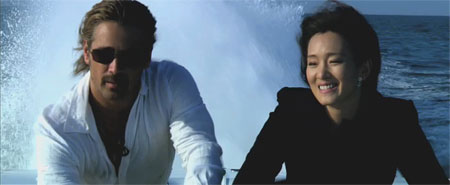

Head on over to Wonders in the Dark where they've been kind of enough to let me ramble on about why I think Miami Vice is one of the best film's of the decade (in their recent poll on the subject I placed it number two). Here's a sample:

There’s nothing more cliché than an action film about two cops who go undercover and infiltrate a drug cartel; and that, while undercover, one of the cops will no doubt get in too deep while the other cop can only question his partner’s commitment to the case. Such clichés are evident in almost all of Michael Mann’s films; however, he always sidesteps the banal inevitability of said clichés by taking a fresh look at the men who lead such lives through an introspective and microscopic lens. 2006 brought Miami Vice, a film popping with beautifully filmed colors, meticulously framed skylines, and, most importantly, the type of scrupulous itemization Mann loves to display for his audiences (just watch the way his characters create sing-songy dialogue with insider jargon). For Mann, it isn’t so much about the action, but about the duty, the inner turmoil (which is always aided by beautifully shot and framed visual correlatives); they’re about why these people are driven by what they’re driven by, and how they function in the world they live in. A lot of people find Mann’s brand of “action” film boring – too much ethereal wandering that result in long, lingering takes on unnecessary close-ups or establishing shots – with not enough shoot ‘em up; I find them misunderstood, refreshing takes on tired genre tropes; existential tone poems of the crime genre that are narratively akin to the French master Jean-Pierre Melville in how the filmmaker is more concerned with the inner dilemma than the external action. If Mann’s crime films are narratively akin to Melville then surely they are visually akin to his American contemporary visual poet Terence Malick in how the film has an ease about its tone; it’s almost as if it wafts from scene to scene as if in a dream.   Miami Vice is a masterpiece of the crime genre that isn’t just the most misunderstood film of Mann’s oeuvre, but also the most misunderstood masterpiece of the last decade.

Wednesday, April 21, 2010

Quick Thoughts on John Hillcoat's The Proposition


It's been a while since I've posted anything on here...so I offer up these random thoughts I had while watching The Proposition today on HD OnDemand.  It appears that the film will be on through the end of the month and into May. Check it out if you haven't seen it yet...now back to more boring Education classes...

John Hillcoat’s down under western The Proposition shares a lot in common with the novels of Cormac McCarthy. Both artists are interested in the stark, uncompromising – almost primitive – way violence affects their characters (and their viewers/readers); both artists are interested in placing this violence in the realm of the western; and both of these artists succeed at taking a genre that is wholly American – traditionally easily digestible and altogether satisfying because of the tidiness the genre lends itself to – and turning it into something more existential and ambiguous. It’s no wonder Hillcoat went on to make McCarthy’s The Road in 2009, because watching The Proposition one cannot help but think of not just the brusque violence found in McCarthy’s Blood Meridian or The Crossing, but the mood of McCarthy is evident here, too. The Proposition is a film that deserves mention next to McCarthy’s novels as that kind of film that can evoke what the great American author so often accomplishes (especially with “The Border Trilogy”): a kind of assaying of violence in the west as seen through a mythological lens.

The Proposition’s violence is juxtaposed with the beautiful and vast Australian backdrop (almost too big for cinematographer Benoit Delhomme’s camera) and the punk-country western music by Nick Cave (who also wrote the screenplay) fits in perfectly with the kind of anarchistic and unpredictable nature of the violence and the kind of spirit the film emits. The cast is superb here as Guy Pierce and Danny Houston have never been better, and the always reliable vest Emily Watson and Ray Winstone really make the final moments of horror palpable. The film is beautiful to look at (except for when that beauty is interrupted, and sometime splattered, with the film’s austere violence); the music, especially that haunting opening song, is appropriate in evoking the appropriate mood of this alien western; the performances are all top notch; and most amazing is Hillcoat’s ability to take the western genre, make it violent and brutal, and turn it into an experience that is akin to reading a McCarthy novel. That is about the highest praise I think one can bestow on this film.

Friday, March 26, 2010

Top 50 Films of the Decade: # 1 - 10


10.) Undertow (2004)
Directed by David Gordon Green

It’s no surprise Terrence Malick produced David Gordon Green's mythological road picture, about two brothers on the run from a greed-obsessed uncle (who may be their father, too), Undertow. His influences are just as evident here as the influence of Night of the Hunter, and it’s refreshing to see another filmmaker, who like Malick, doesn’t just film something beautiful for beauty’s sake. There is a purpose to cinematographer Tim Orr’s shots, and even though they are beautifully framed and conceived, they aren’t showy, blow-away shots that exist only to draw attention to how good the filmmakers are. These are shots that are designed to evoke mood – visually-poetic conceits that conjure up the danger and horrors found in the original Brothers Grimm stories – shots that always tell us something about the narrative, and help move the story along. Undertow is a refreshing thriller that embraces the ethereal qualities found in myths or fables, giving the viewer great locations (the opening six minuets of the film, the junkyard where Chris (Jaime Bell) and his brothers seek refuge) that are feasts for the eyes, and scenes of surprising warmth (the scene where Chris finds out that two waifish girls have tried to steal his coins, and instead of lunging at them in anger, he looks upon them with empathy as if to say: “we come from the same place”.) that showcase Green’s narrative skills in addition to his extremely creative and poetic eye. Undertow is David Gordon Green’s masterpiece.


Thursday, March 25, 2010

Top 50 Films of the Decade: # 11 - 20


20.) Me and You and Everyone We Know (2005)
Directed by Miranda July

Miranda July's whimsical fairy tale about fractured romance and oddity being sexy is probably the most memorable Sundance darling to be released this decade.  It's just quirky enough to be interesting without being grating, and it's just dark enough to delve into some humorous situations that are only funny because they're handled without vulgarity.  The film's opening, a father (the great John Hawkes...why doesn't he get more film roles?) trying to get the attention of his kids by lighting his hand on fire as some kind of parlor trick (only he uses gasoline, not alcohol), is one of the weirdest and most jarring openings to any film this past decade.  There's also a great moment when a character played by writer/director July walks down a street with Hawkes.  The two converse and as they continue their walk July pretends that they are married, and that the street is their timeline of events as a married couple.  As they stop to consider this half way through their walk she quips that their life is half over.  It doesn't do any kind of justice to explain the scene, but if you've seen it then you know why it works.  It's moments like that stand out and make this oddball film so memorable. 

Wednesday, March 24, 2010

Top 50 Films of the Decade: #21 - 30


30.) Ghost Dog: The Way of the Samurai (2000)
Directed by Jim Jarmusch

As he did with his oddball western Dead Man, Jim Jarmusch mashes up another genre and produces an esoteric look at the gangster film as seen through the eyes of a hitman who lives by the ancient code of the samurai. It's a bizarre film (especially the moments of dialogue between our protagonist and a French ice-cream salesman) that I think is meant to be seen as more a cartoon than something super serious (characters are frequently seen throughout watching cartoons); Jarmusch even has one of the gangsters die in such a cartoonish way that he seems to call a spade a spade and just cop to it as the same thing happens in a cartoon a character is watching prior to the gangster's death.  This is Forrest Whitaker's best performance, and it's one of Jarmusch's masterpieces as he satirizes the gangster genre while simultaneously paying homage to it.  That's what makes Ghost Dog work so well is the serious matter in which Jarmusch treats his main character...this isn't some kind of eccentricity, this is a way of like for our hitman, and Jarmusch never condescends; rather, his film is a contemplative genre picture (again, much like Dead Man) as a lot of the film is sans dialogue as The Rza's fantastic soundtrack guides us through the action.

Tuesday, March 23, 2010

Top 50 Films of the Decade: #31 - 40


40.) Eastern Promises (2007)
Directed by David Cronenberg

David Cronenberg re-teams with Viggo Mortensen to create one of the darkest, most bleak, and yes, interesting movies about the criminal underworld (I will refrain from the term organized crime, because these Russian mobsters don't seem all that organized). Family members kill important people without consulting their father (the head of the family) and alliances are made behind peoples back. Booze is not stolen, but purchased cheap, but possibly it could have been purchased even cheaper, and when they get the booze they don't sell it for profit they drink it. These quirks and undercutting of the traditional mobster film make this one of the better films on the subject to come along since Miller's Crossing. The film has the appropriate cold aesthetic to it, and when we become privy to a key plot point that turns the entire film on its ear, we stop to think about what might happen to these characters after the film cuts to black. The film doesn't contain the family oriented scenes of the Corleone family of The Godfather, it doesn't contain the appealing mobsters from a film like Goodfellas; however, the film is spot on in recognizing that for these mobsters – who inhabit a world extremely different than the Italian mobsters we're used to seeing in film – their bodies belong to someone else (there's a great scene where Mortensen's character must strip before the heads of the Russian mob and prove, based on his tattoos, that he is fully committed), and that's what makes the film so fascinating: Yes it has all of the typical themes of a Cronenberg film (the decaying of body/soul, the mixture of extreme violence and sex, and the idea that the choices made by these characters have dire circumstances), but it feels fresh for its genre, it's appropriately ambiguous, and it's certainly proof of one of the best director/actor collaborations of the last decade. Oh, and that knife fight in the shower room is something to behold.

Monday, March 22, 2010

Top 50 Films of the Decade: #41 - 50

Before I get started with this I just wanted to point you all towards a great review by Tony Dayoub of Cinema Viewfinder. He reviews Nicholas Ray's Johnny Guitar, one of my favorite cult westerns, over at our western blog Decisions at Sundown. Check it out. Onto the countdown...


50.) The Claim (2000)
Directed by Michael Winterbottom

Michael Winterbottom's western is completely indebted to its great cinematography by Alwin H. Kuchler which evokes the greatness of the film's most obvious influence, Altman's McCabe & Mrs. Miller.  The narrative is similar to the Altman film, too, as Winterbottom metes out the information on a need-to-know basis.  He often drops the viewer in the middle of conversations and keeps a lot of the information between the characters.  It's another Altman trope that Winterbottom employs, but he does so brilliantly.  Winterbottom was one of the most prolific filmmakers of the last decade, and despite The Claim's troubled production and bloated budget (mirroring another film it owes something to, Heaven's Gate) it's Winterbottom's magnum opus.  It's a beautiful and elegiac western that any fan of McCabe & Mrs. Miller should see.


Friday, March 19, 2010

Top 50 Films of the Decade: Introduction (and the other 50)


In what I hope will be something that I can complete before I go back to school and work here is the first entry in my 'best of the decade' series. I'll unveil a new top ten with each entry. Here are my initial thoughts and 50 other films that make the back-end of a top 100. Remember, these exercises are entirely arbitrary, and I could probably find a good enough reason to reposition a lot of these choices. Feel free to discuss in the comments. Enjoy.


I don't feel like I can put some of my favorite films of the last ten years in here that were released during an entirely different decade. I'm speaking specifically here to Apocalypse Now Redux and Army of Shadows, both of which got theatrical releases the last ten years; also, I can't seem to find a place for Russian Ark or Grindhouse. Two very different films, sure, but they both qualify more as experiences than anything else, and they both have very distinct and different feels to them than all of the other 50 films on this list. Russian Ark with its single take is definitely more than a gimmick, and Grindhouse was one of the most surreal experiences for this fan of grindhouse cinema. Certainly the two films within Grndhouse Planet Terror and Death Proof – can be separated and reviewed as singular films, but I think doing that is to miss the point of what Tarantino and Rodriguez were going for here, and the only way I can certainly review the film is as the experience in the theater – fake trailers and all – that it was meant to be. So, these four films (I'm sure there are others, but I wanted to single these out) deserve special mention as I unveil my list.


This list was a lot of fun to compile. I hope it sparks some debate. This was a good decade for American film, and you're going to see a lot of it on here, but I also have to admit that I was extremely out of the loop of world cinema for the early part of this decade. If you don't see a film on this list there's a good chance that I haven't seen it…or I just didn't like it. Discuss…

Monday, March 15, 2010

Punch-Drunk Love


Barry Egan is an isolated man who sits alone at a desk, dwarfed by the interiors of a giant warehouse he works at selling novelty toiletries, wearing a blue suit that seems out of place for his business setting. We are introduced to Barry in long shot as he is talking to someone on the phone about a loophole in a frequent flyer mileage promotion. After hanging up the phone we follow Barry out of the blasé warehouse and into shadows before we hear the sound of a steel door opening, and we're left wincing – like Barry – at the initial harshness of the daylight. Barry squints and reluctantly makes his way to the street where he finds a harmonium. After this weird discovery there is a car crash that sends Barry running back to the safety of his cold, empty and dark interior. Barry is a complex, socially inept person whose social skills seem completely utilitarian (he's not a bad salesman when he wants to be, and he can channel his inner rage at opportune times); he's also deeply disturbed and alien in a world that is inhabited by seven sisters that constantly nag him –needling him about remembering embarrassing past stories until his rage boils over – and wonder why he always wears the same blue suit. This is a tricky character, always on the verge of exploding yet delicate and in desperate need of some reciprocated love. So, who does writer/director Paul Thomas Anderson get to play such a character? Why, Adam Sandler, of course! In one of the most ingenious bits of casting in the past decade Anderson creates one of the most idiosyncratic and engrossing oddball love stories I've ever seen.