Showing posts with label Film Noir. Show all posts

Wednesday, February 16, 2011

For the Love of Film (Noir) Blogathon: Force of Evil


This is my contribution to the For the Love of Film (Noir) Blogathon hosted by Ferdy on Films and The Self-Styled Siren. Please visit their sites for more great posts, and please consider donating to an extremely worthwhile cause by clicking here.

Even in 2011, Force of Evil is a relevant cautionary tale against the ambiguities of Capitalism and how certain individuals can manipulate that system for personal gain at the expense of others – in particular how the banking system in America can be compromised. It's not just that the film is an expertly crafted noir that plumbs the depths of moral ambiguity like all good noir pictures do; no, writer/director Abraham Polonsky was interested in making a film that was much more socially conscience than that. As we all know, film-noir was always a subgenre that allowed the freedom for certain iconoclasts to voice their displeasure with minor issues (the Hollywood studio system) or bigger issues (Capitalism and government). The best film-noir employs a voiceover to usher us through the murky, moral dilemmas our protagonist must face; however, the best noir employ striking visuals, too, to make us feel what the protagonist is feeling: like the world is crashing down on them. Perhaps no moment in Force of Evil better articulates this than the film's final moments where both narration and amazing visuals put us in the shoes of our protagonist Joe (John Garfield) whose world is, quite literally, spiraling down to the very nadir of his existence as he looks for his missing brother, Leo (Thomas Gomez), who has been taken by the very criminals Joe has been helping.

It is here that Polonsky's film doesn't quite give itself over to the nihilistic and pessimistic tendencies of noir (I dare say a little idealism and optimism creep in at the end) as Joe finds the horrifying results of his actions: his brother's dead body washed up on the rocks. This doesn't lead him – as most noirs would – to take the ill-gained money and run off with the girl; no, instead he leaves with girl to go turn himself into the police. It's an idealistic ending to an otherwise cynical movie; an ending that suggests we think about one more time in terms of Biblical allegory as Joe tries to atone for his sins by turning himself in.


Thursday, November 5, 2009

DVD Review: The Last Lullaby


Jeffrey Goodman’s The Last Lullaby is one of those rare debut films that is so assured in its style that it becomes clearer and clearer as we watch the film unfold that we’re dealing with a major up and coming talent. So rare is it these days to find a thriller that is willing to slow things down – to exist in silence and push aside all the needless noise that clutters modern thrillers. Here is a film that understands the essentials of filmmaking, and why we go to see movies like this. The Last Lullaby is a classic noir existing in a 21st century film – it may not be the most original story (but what noir claims to be wholly original?), but it’s a breath of fresh air; it reminded me of Paul Thomas Anderson’s first film Hard Eight…not in plot, but in how good of a debut film The Last Lullaby is.

Thursday, August 6, 2009

Lazy Blogger Repost: Neo, Cyber, and Postmodern Noir: A Look at Film Noir as an Evolving Genre


Here is the final Lazy Blogger Re-post that I will toss up here. I'm really proud of this piece, which I published a few years ago for a film class and then posted it on the blog in February of last year. I love film noir, and this project gave me the opportunity to really look closely at some of my favorite neo-noir films and the particular elements that make the following films under examination neo, cyber, or postmodern noir. When I initially posted this piece on my blog I received a lot of linkage, however, I feel like I have a lot of new readers now who were never introduced to it, so I thought I would toss it up here again. I hope you enjoy reading this as much as I enjoyed writing it.

Many critics suggest that Touch of Evil (1958) was the last true noir, not because the studios stopped making hard-boiled noir films, but because it seemed that as a society, as a culture, America was moving towards something different and was unable to associate themselves with the ambiguous morals of the genre (it’s ironic that postmodernism would base itself on this idea). However, the genre has actually evolved – it has elevated itself – into new, more controversial, more sophisticated realms. Beginning in the uncertain times of post-war America in the 1970’s (Chinatown), moving towards Reagan’s America in the 1980’s with films like Blue Velvet and Blade Runner there seemed to be a new kind of noir that was being labeled as “neo-noir.” These films were representations of how the genre was moving outside the boundaries of noir only being films about seedy gangsters, femme fatales, and cops and robbers; these classic elements of the genre were now being replaced by greedy water companies, and corrupt politicians or policemen who were representations of the evil America never thought could exist in the people they trusted.

Fredric Jameson states that neo-noir represents some kind of nostalgic look into the past, it attempts to “see the present as (past) history; the classical nostalgia film, while evading its present altogether, registered its historicist deficiency by losing itself in mesmerized fascination in lavish images of specific generational pasts” . This idea is especially evident through the films Chinatown, Blue Velvet, and Blade Runner, films that show how the genre has evolved and adopted the themes of postmodernism to make smart, creative comments about the state of the present by looking into the past.

The modern noir (Chinatown and beyond), uses the genre differently as a means to comment on the instability and ambiguity of the modern world. Not all modern noir films can be classified as “neo-noir” or “postmodern-noir,” they are labeled that in the sense that they came after what many refer to as the last true film noir, Touch of Evil. After Touch of Evil was released in 1958, the genre was reduced to an “at home viewing” type of entertainment, as the studios felt they had to do something to rival the convenience of television. This meant the creation of cinemascope and the widescreen film, which meant bigger budgets, lots of sets, and even more extras. The film-going experience now was merely an excuse to see just how much money the studious were willing to spend to show the average moviegoer just why cinema was better than television. So, just like the characters in film noir, the genre was marginalized, living on television and existing within a medium that many people did not take seriously. Critics saw the genre as nothing more than cops and robbers, gangsters, and femme fatales, located in world that the general public was not interested in seeing anymore. Filmmakers saw it as a way to make serious films for little money, with big themes that lay underneath its style.


--------------------------------------------------

Touch of Evil

In Orson Welles’ last great film he constructed an influential crime film with all of the greatest elements of noir thrown in. We have the corrupt and seedy Sheriff Quinlan (played by Welles) and Vargas (Charlton Heston), the DEA agent who is committed to bringing the corruption of Quinlan’s town to an end. The interesting thing about Touch of Evil is that is doesn’t simply rest on its beautiful cinematography for it to warrant serious consideration as a great film, it is in the obtrusive and effective framing and blocking techniques, and the way the cinematography acts as dialogue that Welles best explains the themes of the film. The best example is in the virtuoso opening tracking shot that lasts for minutes. It is not as if Welles and his cinematographer, Russell Metty, are showing off, this is not style for style’s sake; it’s that Welles is saying this film (and his filmmaking style; Welles never made another film for the Hollywood machine) does not move in the traditional, linear sense. As Roger Ebert states in his brilliant essay , the film “is a series of loops and coils”. The film is edited together in a jarring, sometimes disruptive fashion (in particular the torment scene of Janet Leigh in a hotel room) suggesting that the film and its characters and morals also do not move in a linear fashion. Rather, as the opening shot suggests, the film moves in loops and coils, and Welles and Metty trap their characters within the same shot. The effect is two-fold: we, as the audience, are introduced to all of the characters, and all of the characters intertwined in the scene to show how jumbled and disjointed things are going to be in this town. Like the picture of Vargas above, we are strangers in this town, and ironically Vargas, a Mexican, is a stranger too, in his homeland. The theme of displacement and disorientation fit perfectly with what Welles is trying to visually say with his famous opening shot.

Quinlan is a nasty character who embodies many of the traditional stereotypes and clichés that are attributed to Mexican lawmen, while Vargas has many of the attributes of the stereotypical gringo. This ironical flip is another way we feel like Vargas is lost in his hometown. In one scene Vargas tails Quinlan with a radio as his partner is asking him questions. Now, watching this one cannot help but think that there had to be an easier way to go about doing this, but what is suggested again through the brilliant blocking and set design is a sense of uncertainty: things are askew. Vargas weaves his way through the tangled metal of oil rigs and scrap yards and as the angles take us from high-up, from Vargas’ view suggesting authority and righteousness, to low-down angles, in which we see from Quinlan’s point of view, giving us the visual affirmation that he is the dirtiest of cops. The “tailing” scene is almost as masterful as the opening tracking shot. It is here that Welles has tremendous fun with dutch angles, obtrusive blocking and framing, set design, and lighting. Welles is using the camera to tell us what we cannot hear from Quinlan as Vargas is following him. The audio is so bad on the wire that Vargas’ partner is wearing that we have to rely on the visual language of the film to let us know what is going on. And how perfect, that the scene end with Quinlan in the mud.

And then there is Welles himself, playing Quinlan like a director of a movie. Orchestrating the investigation like a director orchestrates the filming of his movie. Roger Ebert makes the same correlations about Welles playing Quinlan like a director (but he says it much better) in his essay:

Much of Welles’ work was autobiographical, and the characters he chose to play (Kane, Macbeth, Othello) were giants destroyed by hubris. Now consider Quinlan, who nurses old hurts and tries to orchestrate this scenario like a director, assigning dialogue and roles. There is a sense in which Quinlan wants final cut in the plot of this movie, and doesn’t get it. He’s running down after years of indulgence and self-abuse, and his ego leads him into trouble.


There is a sense, as Ebert states, that with most of Welles’ characters, that this role is autobiographical. This is where Touch of Evil becomes something more than a beautifully shot, stylish film noir. It is in this character that we catch a glimpse of Welles himself. When one sees Quinlan the sheriff as Welles the filmmaker, the film takes on a whole new self-reflexive meaning. Welles was not that fat when he made the film; he donned tons of make-up and put pillows in his suit to make him appear bigger than he was. When Quinlan enters a room, you are aware of it because of how obtrusive his presence is – and it is not just his presence, but also his attitude – which is all captured beautifully by the framing of every shot Quinlan appears in. He is larger than life. He is the only, and often the loudest, authoritative voice in the room. Much like Welles, he is often misunderstood as a brute, and this is seen through the sympathetic loyalties of Quinlan’s cronies. Yes, maybe he is doing things the wrong way, but the result in Touch of Evil is always ambiguous. You are never quite sure if Quinlan was on to something or not, regardless of how unconventional his methods were (again used to show how he clashed with the culture of Vargas) he just might have been right.

Welles often called himself an actor of kings, an apt description for roles he chose to play; larger than life characters that, again invoking Ebert, were brought down by hubris. In Touch of Evil we see Welles portray Quinlan as a once brilliant detective, who is haunted by his past and has allowed his ego to bring him down. And that could be said about Welles himself.


--------------------------------------------------

Chinatown

Loneliness is at the heart of Roman Polanski’s Chinatown. At one point Detective J.J. Gittes (Jack Nicholson) is asked “Are you alone?” by a voice on the phone; “aren’t we all?” he replies. Chinatown is a film noir in the traditional sense (the nostalgic opening credit sequence reminds you of that fact) with its private eye, femme fatale, hidden truths, and shadow lands; however Polanski takes these classic noir tropes and plays with them. The shadows of alleyways and seedy locations have been replaced by stark, glossy 1940 Los Angeles business buildings -- seedlings for what would grow into the metropolis we recognize today. Polanski also removes the traditional femme fatale role from his film, as Evelyn Mulwray (Faye Dunaway) is the victim, not the seductive siren. Gittes is a private detective, but Polanski has some fun with this particular trope as he has his Tec’s nose sliced in half. Gittes even says at one point that he is a snoop, and what good is a snoop with only half a nose.

But what makes Chinatown stand apart from the “traditional” noir film is its study of human isolation. It didn’t mark the dawn of what we now call “neo-noir” (that distinction goes to John Boorman’s more cynical, hard-boiled noir Point Blank), but it did popularize it, and again elevated the genre into a higher art form. It was the first film to take the limitations studios wanted to place on the genre and break through them. So, if Touch of Evil was the last classic noir to be made, then Chinatown is definitely the first “neo-noir”.

If someone were to ask me what the film represents, I would simply say: loneliness. Loneliness for the J.J. Gittes character, and loneliness as seen through the lens of the camera as it pans across the empty spaces of Los Angeles with almost a weeping eye, as it knows what is about to come: the industrialization of the desert area. The loneliness at the heart of a lot of noir heroes from the 40’s, is represented by the private detective, the idea of the loneliest of men rummaging though the despair and secrets of others lives while running away from their own problems. Like Sam Spade and the characters of Raymond Chandler stories, Chinatown reintroduces the audience to a fundamental film type – the private detective – a man who occupies human tragedy for a living. But this is different, Gittes hates his job, and through the eye of Polanski and his cinematographer John Alonzo, we see a desolate Los Angeles landscape that is the perfect representation of how Gittes feels: empty. After the nostalgic and traditional opening credit sequence, Chinatown turns into an existential noir, a subject that seeks to understand and wrestle with the very idea of loneliness.

We also see Polanski using lighting, colors, and the vastness of what once was Los Angeles to show that he too is aware of the influence of noir on his film. His framing of shots is also a call back to the classic noir films, especially Touch of Evil, and how each shot is framed to give one the sense of claustrophobia, this is juxtaposed with the widescreen cinematography of the landscape of Los Angeles: “L.A. is a small town,” Gittes says at one point, and Chinatown is very much concerned with the process by which Los Angeles was transformed from desert community to giant metropolis. Claustrophobia is a hallmark of any classic film noir. Polanski and Alonzo are embracing the widescreen format, unlike earlier noir that was pushed to the side for bigger epics and cinemascope, Chinatown is using the widescreen to comment on the vastness that once was L.A. It creates a landscape that reminds the viewer of something out of Camus, an existential void where Gittes pans across the desert community, from Los Angeles until the Pacific, pondering his loneliness. The film creates an almost unbearable tension between the width of its frame and the ways in which the camera seems to be bearing down on the characters and their environment. Joe McElhaney states that the film:

Is intensified by the shallow sense of space, activities placed front and slightly off center, occasionally broken by shots of extreme and narrow depth […] The dominant colors of Chinatown are brown, gray, and black — barely colors at all, an indication of the film’s debt to the noir tradition of black-and-white, and of its attempts to render this drought-ridden environment as completely closed in on itself. The various hues of brown and gold (associated with the parched, sunbeaten desert earth surrounding Los Angeles) seep into every corner of the characters' lives, from clothing to homes to work environments. Evelyn’s clothing often represents her state of mind.


Yet, behind it all is the investigation of the drought. The screenplay explains, "Either you bring the water to L.A. or you bring L.A. to the water." Alonzo's cinematography evokes the L.A. you can glimpse in the backgrounds of old movies, where the sun beats down on streets that are too wide, and buildings seem more defiant than proud. (Notice the shot where the bright sun falls on the fedoras of Gittes and two cops, casting their eyes into shadows like black masks.) Tim Dirks in his essay hits on one of the key ideas behind the film being “neo-noir”

The film's claustrophobic, cyclical, bleak mood surrounding the heroic quest of the detective struck a responsive chord after the scandalous Watergate era of the early 1970s. The film's two puzzling mysteries and tragedies – family-related and water-related – are beautifully interwoven together. The water-rights scandal at the heart of the film expresses how ecological rape of the land has occurred in outrageous land-development schemes that redirect the water's flow. It reminds viewers that the days of abundant natural resources (and life-giving water that turns a forbidden wilderness into a plentiful garden) are past - the land has become barren due to the selfish manipulations of rich and powerful businessmen.


The businessman has replaced the goon with a fedora and gun; men in suits who work in skyscrapers and work for the government have replaced these classic noir villains. This fed the uncertainty of the time that Dirks talks about, and this is where I invoke Jameson once again: Polanski is using the “nostalgic” to represent his issues with the present. There’s a scene in Chinatown that gets to the very core of this idea -- when Gittes asks Noah Cross (John Huston) what more he could possibly want, Cross replies: “The future, Mr. Gittes.” Gone are the villains who are looking to rob banks or pull off heists, Chinatown is the seminal “neo-noir” film where the villains look for something much more than money, they want control. This can be seen in later noir pictures like Blade Runner and Dark City, futuristic or cyber-punk versions of the same themes. By the end of Chinatown, when the mystery is finally solved, the metaphor is clear enough: America is not the innocent place it once was. Like Polanski’s vision of Los Angeles, it too has been transformed into something much bigger, creating more places for the seediness to hide. These thoughts were becoming more permanent in the 1970’s. Polanski sets up these themes, but it is Ridley Scott and David Lynch who slam them home in 1980’s with Blade Runner and Blue Velvet.


--------------------------------------------------

Blade Runner

Ridley Scott’s Blade Runner reverses this notion I have been discussing with Chinatown, the idea of what Jameson introduces that to look into the past, filmmakers are saying something about the present. With Blade Runner, we get the opposite, a look into the future to show the over consumerism and consumption of mass commercialism. Scott’s version of L.A. is filled with digitized billboards, and skyscrapers with advertisements being projected onto them, and the constant advertising heard over a loud speaker (the film is based on a Philip K. Dick story, and this is seen in another one of his stories, “Minority Report” where the advertisements address you personally), it’s a carnivalesque atmosphere, like that of Vegas; characters going about their business in a dehumanized city. This Los Angeles is nothing more than an absent center, something that Fredric Jameson touches on in his book Postmodernism: Or the Culture Logic of Late Capitalism when he mentions the Bonaventure Hotel in Los Angeles:

[B]uilt in the new Los Angeles downtown by the architect and developer John Portman, whose other works include the various Hyatt Regencies, the Peachtree Center in Atlanta, and the Renaissance Center in Detroit….they [these postmodern buildings] no longer attempt, as did the masterworks and monuments of high modernism, to insert a difference, a distinct, an elevated, a new Utopian language into the tawdry and commercial sign system if the surrounding city, but rather they seek to speak that very language, using the lexicon and syntax as that has been emblematically “learned from Las Vegas”.

The aping of Las Vegas in modern day Los Angeles is eerily similar to Scott’s take on the giant metropolis lacking distinction, following the rules of the commercialized game. When Jameson reports in further detail about his journey through the hotel it’s as if he’s describing a labyrinth of compartmentalization; shops and various merchants are displayed in a dizzying array of high-class advertisement all offering a better life within so that you don’t have to think about the dirty Los Angeles that’s outside of the reflective glass walls (the hotel reflects the image of the streets so that one can not see inside the hotel, the inside acts as its own sheltered world, truly a Utopia or Disneyland, which I’ll explain later). This correlates with a theme that Scott broaches quite early in the film, the idea of the “off world” existence; but more on that later.

So is Blade Runner a film noir? I would call it a cyber-noir, or postmodern-noir, with stylish elements that allow the viewer to think deeper about some of postmodernism's key ideas. Many critics like Roger Ebert, simply say that it is all style and no substance, a film that is only interested in its grandiose set design, and not in explaining or elaborating on the rich and complex storyline created by Philip K. Dick. I disagree with Ebert though; I think that if one looks at the film hard enough they can see the noir elements that are there as well as the ideas of one of postmodernism’s most influential thinkers, Jean Baudrillard. Baudrillard introduces in his book Simulations the idea of a “hyperreality” (2) and the “loss of the real” (25), copies become what we associate with real and Blade Runner seeks to explore these deep questions in two ways: one is through the idea of escaping this world and living a better life on the “off world” a kind of hyperreal existence, it also examines the characters of Roy (Rutger Hauer) and Pris (Daryl Hannah) replicants created by the Tyrell Corporation, to see if we as a society can rise up against the corporations that look to control us through commercialism. The other way which the film explores Baudrillard’s thinking is through the relationship between Deckard and Rachel. Baudrillard’s claim can best represent all of the films discussed when he says: “when the real is no longer what it used to be, nostalgia assumes its full meaning” (12).

One of the first shots of the film, and one of its most famous, is of the city with its towering digitized billboards and a voice that can be heard telling people to escape to the “off world” where there are no problems and you can start you life over, away from “reality.” This is a place where your “dreams can come true.” These are the sounds of an, “easy money,” get rich quick mentality that was rampant in the 1980’s. All of life’s problems go away if you run away from them. The voice is head over the city, a city that has turned into a large scale, run-down Chinatown. This “off world” idea is what Baudrillard is getting at with his idea of the simulacrum, the copy without an original: life is good and life is easy if you leave the “real” world for your own that you can create. This “reality” is the idea behind Baudrillard’s mention (and what Jameson is getting at with his summation of the Bonaventure Hotel) of the “reality” of Disneyland:

Disneyland is there to conceal the fact that it is the ‘real’ country, all of ‘real’ America, which is Disneyland (just as prisons are there to conceal the fact that it is the social in its entirety, in its banal omnipresence, which is carceral). Disneyland is presented as imaginary in order to make us believe that the rest is real, when in fact all of Los Angeles and the America surrounding it are no longer real, but of the order of the hyperreal and of simulation.


So, this “off world” vacation that is offered to those who live in the Los Angeles of 2012, is the same that is being offered to those who live in the present of 1982. This loss of the real, and the hyperreality, shows how Blade Runner is unlike any other noir; it is dealing with the questions of consumerism through the realm of cyber-noir. And even though the noirish qualities of the film best represent the relationship between Deckard and Rachel one cannot ignore the films main point: that through commercialism and over-consumption we can alleviate all of our problems, we can let the replicants, or Others, that look so much like us, “expire” while we buy and consume anything we can to make ourselves feel more like men or women, and we equate this commercialism to happiness, when in reality we are just as the replicants are, products off an assembly line. The film asks us if we can be like Roy and Pris and rebel against the Tyrell corporations of our lives, if we can rebel against the commercialism that plagues our society that is turning humans into indefinite, unidentifiable consumerist robots. This leads me to my next point about the film, the “reality” of its characters, especially as it is seen through the relationship between Deckard and Rachel.

When the film was initially released in 1982 it had Ford’s narration guiding the viewer through the story, also providing a traditional nostalgic homage to the great noir films of 40’s and 50’s. Whether or not Deckard was a replicant was left ambiguous, creating an even bigger dilemma with him having to “expire” Roy and Rachel and the other replicants; however, in the 1982 version there was a completely superfluous happy ending tacked on. When the film was released years later in a “Director’s Cut” the narration was axed and the ambiguity was gone with the addition of the famous “unicorn dream” sequence – which more than suggests that Deckard is a replicant. The ending, though, was much improved upon as the happy ending was axed. The Director’s Cut really neuters the ambiguity of Deckard and Rachel’s relationship and the uncertainty surrounding Deckard’s status as a blade runner. Does he not want to kill them because he is one? He is just as much a slave to his boss as the androids to the Tyrell Corporation. It is this reason that the original 1982 version (the newest “Final Cut” version is pretty good too, much better than the Director’s Cut) stands as the best example of the film as “neo-noir”.

I’d like to talk about the scene where Deckard kisses Rachel -- before this moment happens he keeps her from leaving his apartment and traps her by the window. The way Deckard moves is robotic, and when they kiss, Rachel shows more emotion than Deckard. In another scene we see Rachel crying, where Deckard, it seems, is incapable of emoting anything. Of course the problematic 'signs' of humanity are the crux of the film, built into the very images used to forward the story. I think it very telling that it was the aspects of Blade Runner that most challenged ideas of humanity that were cut or altered. With the Director’s Cut version you no longer get the great line from Deckard's voice-over telling us "Rachel was special - no termination date”. This omission changes the impact of Gaff's final line: "Too bad she won't live. But then again, who does?” In the original release Gaff is seen as outsmarted, as opposed to philosophically correct in the Director's Cut. I think these changes give the film less impact at the end. The themes/meaning behind the film changes, the ambiguity is gone, and all of the mystery of the replicant/human dilemma seems to be removed. That haunting last line loses all of its power.

In the newest cut of the film (the version Scott supposedly wanted to release to begin with) the ending is perfect. Rachel and Deckard are leaving his apartment, Deckard scared that someone might be there not just terminate Rachel, but him also for not getting the job done. As they leave, Deckard sees one of Graff’s origami animals (a unicorn, suggesting that they know about Deckard's implanted dreams, that he is indeed a replicant), he picks it up, hears the final line echo in his memory (“It’s too bad she won’t live. But then again, who does?”), clinches the origami in his hand, and gets onto the elevator with Rachel. The end. No happy ending to the off world, no final showdown either, but the viewer gets the sense that Deckard knows Graff is now after them both and they will always be hunted; further evidence that Deckard himself may in fact be a replicant.

Regardless of which version you are watching, the form/techniques used to introduce these themes are as strong as ever. Especially the lighting in the film, the heavy use of backlighting, hard lighting and light coming through moving objects (like fans) make the film's grim future alive. The lighting also adds to the feeling of film noir. Many science fiction movies are shot in an unnaturally hard light, as if they were shot in a hospital (for example Stanley Kubrick's 2001: Space Odyssey). In Blade Runner we have a vivid feeling of dark alleys, sinister rooms and chambers, which is essential to old detective stories. These lighting techniques also introduce us to the ambiguous love affair between Deckard and Rachel. Notice how Rachel and Ray are usually lit in bright light, and how Deckard and the other humans are always in darkness. The opposite is used in most film noir. Ridley Scott’s idea to light the film this way is brilliant as one can see in the picture above; Deckard looks no more “alive” than Rachel.

By looking into the future, the film questions the state of the world in 1982, a time when this kind of postmodern thinking was starting to be embraced. Simulations was published a year after this film was released, but already the short stories of Philip K. Dick were introducing people to these postmodern ideas. All of this to say: Blade Runner is the quintessential neo-noir. It has been called neo-noir, cyber-punk, and postmodern, but it is the perfect example of how a filmmaker can take a genre like film noir, and create something completely new, something that is completely elevated above every other kind of noir picture. As was the case with Chinatown, Blade Runner and David Lynch’s Blue Velvet succeed in taking noir elements and breaking free from the confines of genre labeling to create films that aren’t just simply noir, but noir as high art.


--------------------------------------------------

Blue Velvet

If Chinatown uses the style of noir to create an atmosphere of loneliness and despair – revealing the corrupt truths of America the way Gittes reveals the corruption of the Cross case; and if Blade Runner uses noir's style to look into the future to raise the level of awareness about a kind of hyperreality we live in; then David Lynch’s Blue Velvet is an attack on the ideological nostalgic 1950’s America filtered through Lynch's twisted, microscopic lens. Lynch’s film peers into the secrecy of our lives in order to see what lies underneath the façade of “everytown” USA. Blue Velvet involves families, strokes, teenagers in love, severed ears, murder, drugs, and yes, sadomasochism. And yet Lynch does in deed bring all of these elements together in noir fashion to create an ethereal experience, something so surreal and so bizarre, it is as if the viewer is taking hits from Frank Booth's gas tank.

What Lynch does so brilliantly, and the reason why people refer to Blue Velvet as a neo or postmodern-noir, is through an ideological lens he paints a picture of how we wished the small American town actually were so squeaky-clean and upheld the ideals of Americana. At the time Lynch was making the film, 1986, this was a powerful response to Reagan’s America. The film has two kinds of scenes: (1) The everyday small-town scenes, in which people go out on dates to the soda fountain and drive around town in shiny cars, and (2) the subterranean scenes in which the most unspeakable acts take place behind closed doors (i.e. the reasoning for the severed ear…not only are we blind to such things existing around us, now we have become deaf). We see this common thread running through both Chinatown and Blade Runner but something new comes into play with Blue Velvet: The theme of exhibitionism, and how no matter how badly we may want to turn away, we cannot help but look; and that if we look hard enough there is corruption and perversion underneath every seemingly perfect small town.

Lynch offers two key visuals to guide the viewer as they wade through these troublesome postmodern waters. The first symbol is at the beginning of the film in the form of a severed ear. We come to find later that the ear does indeed belong to someone important to the story; however, more than mere foreshadowing and plot device, Lynch is asking the audience to remember the visual throughout the film. It is a reminder that drugs and sadomasochism are protruding this small quiet town and that if you look hard enough, you can find just about anything in your seemingly contented existence. The other meaning behind the ear seems to be more politically charged. Through Lynch’s own warped and darkly comedic way (Blue Velvet is both comedy and noir) he is reminding us that we have turned a deaf ear to the things we choose not to listen or look for in our own small town America’s. Notice how the films opening is in slow motion, people smiling, white picket fences, firemen, dogs, and friendly neighbors waving at the camera. Lynch juxtaposes this ideological world with the ear, the representation of the outside world that is about to assault this small town.

The other key visual is more of a technique, and one that is crucial to any good noir film: lighting. Lynch uses many of the techniques of noir, but the film isn’t as toned down with drab colors or shadows like those in Chinatown and Blade Runner. Lynch uses specific, vibrant colors, focusing them on one part of the screen creating an almost uber-glossy rendition of noir, with its night clubs and nightmare sequences being drenched in spotlight, where the lighting seems non-existent – this is a dark world where there is rarely any room for light to enter – there is also an emphasis on disorientating color schemes (Lynch is a painter in addition to a filmmaker) to create a world of both illusion and allusion. The film is both dreamy and grotesquely real, there is almost a hazy feel throughout the film, the feeling between being asleep and being awake throughout the nightclub scenes and especially the nightmarish scene where Jeffery and Dorothy are taken to the strange house of Ben (Dean Stockwell), the man holding Dorothy’s child. And yet, the film is beautiful to look at, an allusion to some of the great noir films like Double Indemnity, T-Men, White Heat, and Touch of Evil; Lynch is obviously aware that pastiche is the ultimate postmodern trope.

Even some of the films most uncomfortable scenes (i.e. Frank coming by for his “required” sex with Dorothy) are lit with beautiful soft light and framed with a kind of innocence that would exist in the 1940’s era Lynch is definitely mimicking (or mocking). For example, the scene where Jeffery is witnessing Frank torture Dorothy is seen through his point of through the blinds of a closet. The scene is framed and portrayed in way where Jeffery is almost like a child, witnessing for the first time the uncertainties of sexuality. He’s peering through the blinds of the closet, what he is witnessing is cut-up, fragmented. Lynch uses this visual to create a sense of confusion. Is what he’s seeing erotic or unlawful? Jeffery’s thoughts are ambiguous at first, but when he is caught the scene plays out like that of twelve-year-old boys being caught “experimenting” with their mother's Cosmo magazines. Thus begins the journey of Blue Velvet, it is from that point on that Jeffery just keeps going down, further and further into the abyss bringing everyone “innocent” with him.

Another way Lynch comments on the small town is through the visitation of Jeffery. Jeffery used to live in the town and is visiting from college because his father had a stroke. Once he left for college, one can see how Lynch suggests that he became “wise” to the world, he is no longer deaf or blind to what is happening around him. This is why in one of the films most uncomfortable scenes, when Dorothy stands on Jeffery’s front lawn naked, he is seemingly unfazed by the event and hurries to cover her up and save her, leaving his girlfriend Sandy (Laura Dern) to wonder what is happening. She doesn’t understand and begins crying, storming home angry at Jeffery. The next scene, Jeffery has taken Dorothy home and is seen speaking with the angered Sandy on the phone, and to hammer the point home, Lynch has Jeffery say very little and has Sandy forgiving him for everything, even though Jeffery has in fact continuously rendezvoused with Dorothy for sex. Sandy, still blinded by teenage romance and unable to see the big picture because she is trapped by the ideals of her small town, is willing to exculpate the problems of her and Jeffery’s relationship caused by Dorothy. She is blind to the possibilities of Jeffery even having a sexual relationship with Dorothy. This is another reason why in the first scene that we are introduced to Frank and Dorothy (the closet scene mentioned earlier), Lynch has Jeffery in the closet and not Sandy. He represents that outer world; he’s rightly placed amidst the other outsiders of the story.

And finally Lynch’s film is cyclical, it ends the same way it begins, minus the stroke victim, but added is the reconciliation of Dorothy and her son. Throughout the film, as is the case with Blade Runner, there is a plot revolving around an absent center. Lynch gives us this de-centered, de-stabilized universe while keeping the main themes circling around this absent center; this is the vortex that Jeffery finds himself pulled down into the more he discovers about Dorothy and her situation. The last shot of the film suggests that even though we see Dorothy with her son, the film remains cyclical in the sense that there will always be corruption (in our towns, in politics, etc.) and that even though there may be these outsiders that invade these small towns – invaders that come in and try to help the ideological small town open their eyes to the “real” world – there is no point, there will always be corruption (this is the nihilistic Lynch kicking in, here) and America will forever remain deaf to the cries of the Dorothy’s of America.

Why is Blue Velvet considered a great neo-noir? Because it takes some of the classic elements of the genre, just as the other films have, and Lynch makes it his own. In film noir ordinary people find out that evil lurks just beneath the surfaces of their lives; they inevitably get caught up in the shadow worlds, they find themselves capable of committing unspeakable acts. A proper film noir is, contrary to the limitations of genre labeling, not usually a gangster or crime film, but the story of how evil enters everyday lives. The genre is profoundly pessimistic; it does not show bad people doing bad things, but average people doing bad things. This complicates things and makes it all the more ambiguous because the implication is that we are all capable of evil.


--------------------------------------------------

Misc. Films and End Notes

Film noir is still being used effectively today. I have given three examples of how the genre has been elevated to heights it was unable to reach in the past. This is not to say that the genre is bad. I love film noir, and some of my favorite films are the classic noir’s of the 40’s and 50’s (Scarlet Street, Detour, Kiss Me Deadly, T-Men, and White Heat are just a few of my favorites), but with the addition of cyber and postmodern elements to the genre, one can see how these “neo-noir” films (Chinatown, Blade Runner, and Blue Velvet) are noir at the highest form. They have elevated the genre to high art by dealing with issues of the absent center (Blue Velvet) and the dehumanized (Blade Runner); by using the style of the classic film noir seen in Touch of Evil and Chinatown. These three films were all influenced by Touch of Evil and even more films since are emulating the successes of Welles’ vision by using the noir genre themselves to speak about the depravity of society (Blood Simple); the lust the government has for control of our thoughts (Dark City); how through the medium of celebrity magazines, hookers are “replicated” to look like movie stars (a kind of simulacra) where nothing is what it seems in “La La Land” (L.A. Confidential); and the use of classic postmodern tropes like pastiche and the unreliable narrator (Memento).

The truth is that the genre is still full of great ideas in addition to the genre being more than capable of still churning out stylish films. The point remains the same: Many films could qualify as “noir:” films by such great filmmakers as David Mamet (The Spanish Prisoner, Glengarry Glen Ross), Quentin Tarantino (Pulp Fiction, Reservoir Dogs, and True Romance), Martin Scorsese (Taxi Driver, Goodfellas), and films like Heat or Collateral by Michael Mann. Below are what I think represents decent companion lists for some of the quintessential films and texts that will give the viewer (and reader) a sense of what “neo-noir” is. Just because a film has cops and robbers and an ambiguous “good” guy versus “bad” guy storyline doesn’t immediately make it a “noir” film. In fact the best noir films are usually not gangster films, they are films about the evil that creeps into our daily lives and causes us to either: do the evil we never thought we were capable of, or witness such an evil we never thought could exist in our comfortable lifestyles.


Recommended Neo-Noir Viewing:

• Samuel Fuller’s, The Naked Kiss (1964)
• John Boorman’s hilariously violent, Point Blank (1967)
• Robert Altman’s, The Long Goodbye (1973)
• Arthur Penn’s, Night Moves (1974)
• Lawrence Kasdan’s, Body Heat (1981)
• Brian DePalma’s homage to Hitchcock, Body Double (1984)
• The Coen Brothers’, Blood Simple (1985)
• David Mamet’s masterpiece, House of Games (1987)
• Stephen Frears’, The Grifters (1990)
• John Dahl’s, The Last Seduction (1993)
• Kathryn Bigelow’s extremely underrated, Strange Days (1995)
• Curtis Hanson’s masterful look at the seedy side of L.A., L.A. Confidential (1997)
• Alex Proyas’ brilliant mix of German Expressionism and Noir, Dark City (1997)
• The Coen’s again with, The Man Who Wasn’t There (2001)
• Christopher Nolan’s postmodern noir, Memento (2001)
• David Lynch’s beautiful, labyrinthine, Mulholland Drive (2001)
• Steven Spielberg’s masterful adaptation of Philip Dick’s, Minority Report (2002)
• Robert Rodriguez and Frank Miller’s “green screen” noir, Sin City (2005)


Books and Essays I’ve cited throughout:

You can take a look at a number of the essays by clicking on the authors’ name, which I hyperlinked, throughout my piece.

For Fredric Jameson’s thoughts read, Postmodernism: Or the Culture Logic of Late Capitalism

For essential postmodern reading check out Jean Baudrillard’s, Simulations

Also recommended is the fantastic book that takes a philosophical approach to the genre, The Philosophy of Neo-Noir, edited by Mark T. Conrad.

Thursday, May 14, 2009

Lazy Blogger Repost: Dark City (Alex Proyas)


I'm busy with work right now, and I just don't have the energy to type up the DVD review for [Rec] that I've been meaning to put up for awhile now. So, I thought I would dust off an old favorite of mine (this is an old post that I put up when I started my blog last year in honor of the Director's Cut DVD, but this is something I had written well before, so I took the liberty of cleaning up any glaring errors) and give some always-deserved credit to one of my favorite films Dark City. I plan on seeing Che this weekend (both parts) so I'll be back with some thoughts there, and some more DVD reviews.

The first 15 minutes of Dark City are unlike anything I've seen in Science Fiction. Right away director Alex Proyas is showing us his interest in using Film Noir elements to mix with the Science Fiction genre to create a neo-noir film. Most of Film Noir is based on the innocent man being in the wrong place at the wrong time. These men are anti-heroes, usually privy to some kind of information they didn’t want to begin with; they're flawed individuals who would prefer to have the authorities figure things out, rather then risking their own life, . That is how Dark City begins. Murdoch (Rufus Sewell) awakens from a bath tab -- a rebirth of sorts, as he emerges naked and from water -- in an old hotel as an overhead light swings back and forth (we find out why later) and as he frantically searches the hotel for any remnants of who he is. Then, for the first 15+ minuets of the film he begins to attempt to piece the clues together quickly.

Technically Proyas and his editor Dov Hoenig are cutting this together at a rapid pace, like a comic book it is storyboarded for us with sharp jump cuts from static shots in order for the viewer to witness the clues in a startling manner much like Murdoch discovers them. The viewer is disoriented from the onset as Proyas begins the film in medias res, compounding the confusion and allowing the viewer to feel just as lost as Murdoch. The entire opening sequence is one of the most visually brilliant I've seen in film. It is all visual exposition as very little weight is given to dialogue to help guide the viewer towards certain truths. Proyas and cinematographer Dariusz Wolski (and don’t forget the brilliant art direction by Richard Hobbs and Michelle McGahey and the production design by George Liddle and Patrick Tatopoulos) create a world filled with allusions from German Expressionism and Film Noir, as well as evoking imagery from Edward Hopper’s “Nighthawks”; it helps if one is well versed in these visual allusions to understand what Proyas is trying to say about his characters. This is a classic neo-noir (or postmodern noir) film where the entire world the characters inhabit is nothing more than a simulacrum, a pastiche consisting, as one character explains, of architecture and clothing from different eras and the collected memories of the humans who live within the city. The film is German Expressionism, Science Fiction, Film Noir and Cyberpunk all rolled into one, and deserves mention along side such classics as Metropolis and Blade Runner
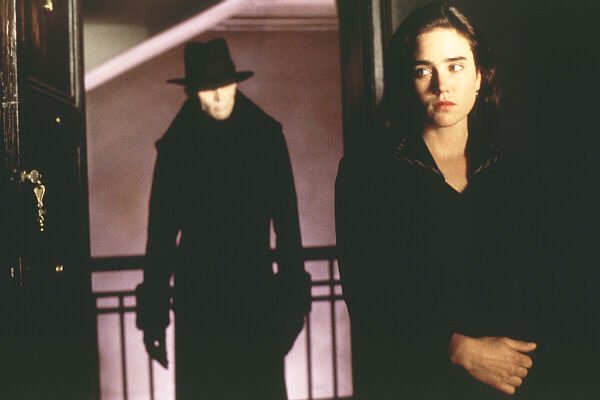

Like many science-fiction/noir hybrids Dark City is concerned with a race of artificial intelligence or some form of alien race -- here called the Strangers who don fedoras and trench coats like henchmen from a 1940’s Noir -- who are interested in the make up of the human soul. The Strangers have a method they call “tuning” where they can manipulate the city architecture at midnight and insert new memories into the sleeping humans. When they “tune” they stop time at midnight and proceed with their business. Here they have enlisted the aide of the only human to understand (besides Murdoch, who we come to learn can also “tune”) what is going on, Dr. Daniel J. Schreber played wonderfully by Kiefer Sutherland (who is doing his best Peter Lorre). Schreber is the one that was injecting Murdoch with his new memories when Murdoch woke and scared the good doctor away. We learn that Murdoch is apparently being pursued not only by the Strangers, but also by the police who are after him for the murder of six prostitutes. That’s about all the set up there is to this film as the rest is like a jigsaw puzzle where the pieces are laid out in front of the viewer at exactly the same time they are given to Murdoch. The Film Noir theme continues as the first shot we get of Emma Murdoch (John’s “wife”) is in cigarette smoked filled night club. She is right out of the 1940’s with her green dress, sultry voice (I mean it is Jennifer Connelly we’re talking about) and bright red lipstick. The image belongs more in a film like Out of the Past than in a Science Fiction film, but that’s what the neo-noir genre seeks, a pastiche of visual styles from the 1920’s and German Expressionism, to the Noir films of the 40’s to the stylized vision of Kubrick’s 2001, films like Dark City and Blade Runner look to create a disjointed universe by melding these genres together to create a setting that is ambiguous; therefore we are just as confused and disoriented as the characters.
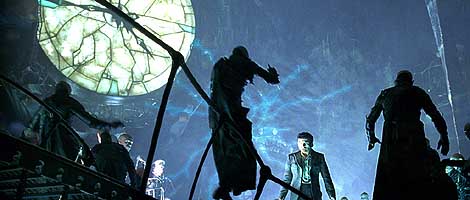
Not only is the film one of the great visionary films of all time (watch some of the scenes frame by frame and you will see how meticulously it was put together), but it is also a great entertainment. As mentioned before, the film just starts right up with very little verbal exposition. The viewer is given the clues in the first 15 minutes and then must decipher what is going on. But again, Proyas is interested in the viewer being just as disoriented as the characters, so right when we think we have the pieces in place, Proyas throws a curve ball and everyone (including the characters) is confused again. This invitation for the viewer to get involved is shown through the character of Inspector Bumstead (the always entertaining William Hurt) when he explains (I’ll paraphrase) “I have all of the pieces to this jigsaw puzzle in front of me, and when I go to rearrange the pieces, nothing makes sense.”

I think what I liked most about the film was that it wasn’t interested in the pseudo philosophical dialogue that The Matrix made so popular. Dark City was released a year prior to The Matrix (which used some of the same sets as Dark City), but that film was much more interested in its own ideas and enjoyed listening to itself talk and talk and talk and then masked its lame philosophic and pseudo religious allegories with special effects and wall to wall action. As a genre picture, The Matrix works extremely well, but it doesn’t even begin to approach the greatness of Dark City. The amazing thing is that Dark City almost does it all in visuals, like Stanley Kubrick did with 2001. Proyas is a great visionary who prefers the poetry of the camera, instead of needless exposition, to further the story along.

Don’t get me wrong, there are great moments of dialogue written by David S. Goyer (Batman Begins) and Lem Dobbs (The Limey). For instance, when Murdoch tells Mr. Hand, one of the Strangers, that they went looking in the wrong place (as he points to his head) to find what makes humans human. What’s nice about this scene is that he doesn’t expand further into some cliché ridden diatribe about how the heart is where they should have looked and if you have enough heart you can do anything and then you will find what makes humans tick. Nope, Goyer and Dobbs do the right thing (along with Proyas’ direction) and leave it at Murdoch pointing to his head as he walks away. After all, like Metropolis, the film is about the heart of the cities inhabitants bringing down the ‘machine’ that lurks underground and controls their thoughts. The metaphor is clear, but it’s subtle touches like that scene with Murdoch and Mr. Hand that work so well in conveying this message without bludgeoning the viewer of the head with it; where one year later The Matrix would just continue to talk and talk and talk (I think Laurence Fishbourne is still talking) about what the film was about, rather than showing us. Also, consider this short little break in the film as Schreber takes Murdoch and Bumstead to the elusive Shell Beach (one of the clues in the film, I dare not give anything more away) and as they rowing their way down a river Schreber tells them about The Strangers and the cities mysteries:

I call them the strangers; they abducted us and brought us here. This city, everyone in it, is their experiment. They mix and match our memories as they see fit, trying to divine what makes us unique. One day a man might be an inspector, the next, someone entirely different. When they want to study a murder, for instance, they simply imprint one of their citizens with a new personality. Arrange a family for him, friends, an entire history, even a lost wallet. Then they observe the results. Will a man, given the history of a killer, continue in that vein, or are we, in fact, more than the mere sum of our memories? This business of you being a killer was an unhappy coincidence. You have had dozens of lives before now. You just happened to wake up while I was imprinting you with this one.

When they first brought us here they extracted what was in us, so they could store them information, remix it like so much paint, and give us back new memories of their choosing. But they still needed an artist to help them. I understood the intricacies of the human mind better than they ever could. So they allowed me to keep my skills as a scientist because they needed them. They made me delete everything else.


This artificial city with its false memories is of course a simulacrum, a dark world occupied by jagged construction that almost tears through the frames that try to contain them. Proyas is of course using elements of German Expressionism to visually tell us these things. Tilted shots, or Dutch angles, create an uneasy feeling. The viewer, like Murdoch, is not quite sure where this mystery is leading to. Another element of German Expressionism is the use of obtrusive and over exaggerated set pieces. This again plays to the idea that they are almost bursting through the frame, trying to break free, much like Murdoch and Bumstead when they peel back the Shell Beach poster and hammer away at the brick wall that lies behind it, they are trying to break through the barrier of the dark city.

Another crucial moment is this piece of exposition later in the film, which ends up being the turning point for Bumstead as he talks with a retired inspector named Walenski, who was the investigator of the prostitute murders prior to Bumstead:

Walenski: Well, nothing happened Frank. I’ve just been spending time in the subway, riding in circles, thinking in circles. There’s no way out. I’ve been over every inch of this city.
Bumstead: You’re scaring your wife to death, Eddie.
Walenski: She’s not my wife. I don’t know who she is. I don’t know who any of us are.
Bumstead: What makes you say that?
Walenski: Do you think about the past much, Frank?
Bumstead: As much as the next guy.
Walenski: See? I’ve been trying to remember things, clearly remember things from my past. But the more I try to think back, the more it all starts to unravel. None of it seem real. It’s like I’ve just been dreaming this life and when I finally wake up I’ll be somebody else. Somebody totally different.
Bumstead: You saw something, didn’t you Eddie? Something to do with the case?
Walenski: There is no case, there never was! It’s all just a big joke! It’s a joke!


These little moments of dialogue are nice compliments to the frantic and kinetic chase that occupies most of the film. They offer insight into the films larger themes by being concise moments of insight that allow the audience to think about the questions, rather than having the characters hammer home the point. But it is still the visuals that will always be remembered. The special effects add to the film rather than overshadow it, and the constant use of obtrusive angles and exaggerated set designs creates a world of chaos (like the spiral imagery throughout the film, which thanks to the DVD commentary by Roger Ebert, I was able to learn that the symbol of the spiral is associated with chaos theory) and disorientation, a simulacra, or hyperreality where nothing is as it seems. The character of Bumstead runs in circles, and circular logic, trying to explain away what is happening rather than pursuing a form of action and finding out what is going on, when he is invited by Murdoch to find Shell Beach and he helps Murdoch ‘break down the wall’, the Inspector crosses an important threshold. In order to find out who he was, he had to act. Bumstead and others break from the spiral and the circles to become human, it is in the breaking out of the spiral (look at the shot where there is an overhead view of the city, it is spiral in nature) where the inhabitants of this artificial city cease to be artificial themselves, and become fully realized, fleshed out people.
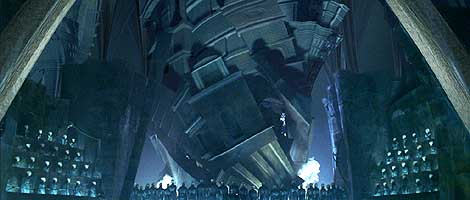
For the astute film watcher there are numerous allusions to Metropolis (the underground lair), M (where all you see are the anemic faces underground, like in the trial scene), Blade Runner, and 2001. You can also see allusions to Carol Reed’s brilliant The Third Man whose images of bombed out postwar Vienna streets creep into Dark City’s imagery as Murdoch spends much of his mystery searching through dark alleys and shadowy corridors. It is a film few can match in its visual splendor.

I will end with this excerpt from Roger Ebert’s essay on Dark City:

Notice an opening shot that approaches the hotel window behind which we meet Murdoch. The window is a circular dome in a rectangular frame. As clearly as possible, it looks like the "face" of Hal 9000 in 2001. Hal was a computer that understood everything, except what it was to be human and have emotions. Dark City considers the same theme in a film that creates a completely artificial world in which humans teach themselves to be themselves.


The humans that occupy Dark City are the toys for the Strangers, cadavers used for scientific purposes. As Murdoch explains (and I mentioned earlier) they were poking and prodding the wrong place, it is the heart that can teach you about humanity, and we can talk and talk and talk about it all we want, we can sound wise like Neo and Morpheus, but it is in action where we find humanity, and Murdoch and Emma and Bumstead and even Schreber understand that they have to “teach themselves to be themselves” by acting on what their heart wants, not trying to put the jigsaw puzzle together, pontificating all day (or night in this case), only then will Murdoch and Emma (and all of us) truly be alive -- otherwise we're just running in circles.

Dark City
is one of my favorite films, and I think it easily ranks in the top 10 of the 90's. There hasn't been a science-fiction film released since that rivals it, and visually, few films, no matter what genre, have matched Proyas' visionary opus. It's a shame that Proyas has pretty much disappeared. He made the incredibly dull, but financially successful, I, Robot, which looked good enough, but lacked the emotional punch of his previous films (hell, even The Crow had more of an emotional arc than I, Robot); five years after that film he released the ridiculous looking Knowing starring Nicolas Cage. Roger Ebert gave the film four stars, and that coupled with the fact that I will always be interested in what Proyas produces, has my interest piqued enough to where I can ignore the rest of the negative reviews surrounding the film. However, nothing will match what he did with Dark City, and sadly his career has been akin to a Wellseian type fall -- Proays made his best film when he was 35 in what was only his second American film; but what a film it is, and really, most directors wish their entire oeuvre were as good as Dark City.

Tuesday, February 10, 2009

Neo, Cyber, and Postmodern Noir: A Look at Film Noir as an Evolving Genre


Many critics suggest that Touch of Evil (1958) was the last true noir film, not because the studios stopped making hard-boiled noir films, but because it seemed that as a society, as a culture, America was moving towards something different and was unable to associate themselves with the ambiguous morals of the genre (it’s ironic that postmodernism would base itself on this idea). However, the genre has actually evolved – it has elevated itself – into new, more controversial, more sophisticated realms. Beginning in the uncertain times of post-war America in the 1970’s (Chinatown), moving towards Reagan’s America in the 1980’s with films like Blue Velvet and Blade Runner there seemed to be a new kind of noir that was being labeled as “neo-noir.” These films were representations of how the genre was moving outside the boundaries of noir only being films about seedy gangsters, femme fatales, and cops and robbers; these classic elements of the genre were now being replaced by greedy water companies, and corrupt politicians or policemen who were representations of the evil America never thought could exist in the people they trusted.


Fredric Jameson states that neo-noir represents some kind of nostalgic look into the past, it attempts to “see the present as (past) history; the classical nostalgia film, while evading its present altogether, registered its historicist deficiency by losing itself in mesmerized fascination in lavish images of specific generational pasts” . This idea is especially evident through the films Chinatown, Blue Velvet, and Blade Runner, films that show how the genre has evolved and adopted the themes of postmodernism to make smart, creative comments about the state of the present by looking into the past .

The modern noir (Chinatown and beyond), uses the genre differently as a means to comment on the instability and ambiguity of the modern world. Not all modern noir films can be classified as “neo-noir” or “postmodern-noir,” they are labeled that in the sense that they came after what many refer to as the last true film noir, Touch of Evil. After Touch of Evil was released in 1958, the genre was reduced to an “at home viewing” type of entertainment, as the studios felt they had to do something to rival the convenience of television. This meant the creation of cinemascope and the widescreen film, which meant bigger budgets, lots of sets, and even more extras. The film-going experience now was merely an excuse to see just how much money the studious were willing to spend to show the average moviegoer just why cinema was better than television. So, just like the characters in film noir, the genre was pushed to the outside, living on television and existing within a medium that many people did not take seriously. Critics saw the genre as nothing more than cops and robbers, gangsters, and femme fatales, located in world that the general public was not interested in seeing anymore. Filmmakers saw it as a way to make serious films for little money, with big themes that lay underneath its style.


--------------------


Touch of Evil

In Orson Welles’ last great film he constructed an influential crime film with all of the greatest elements of noir thrown in. We have the corrupt and seedy Sheriff Quinlan (played by Welles) and Vargas (Charlton Heston), the DEA agent who is committed to bringing the corruption of Quinlan’s town to an end. The interesting thing about Touch of Evil is that is doesn’t simply rest on its beautiful cinematography for it to warrant serious consideration as a great film, it is in the obtrusive and effective framing and blocking techniques, and the way the cinematography acts as dialogue that Welles best explains the themes of the film. The best example is in the virtuoso opening tracking shot that lasts for minutes. It is not as if Welles and his cinematographer, Russell Metty, are showing off, this is not style for style’s sake; it’s that Welles is saying this film (and his filmmaking style; Welles never made another film for the Hollywood machine) does not move in the traditional, linear sense. As Roger Ebert states in his brilliant essay , the film “is a series of loops and coils”. The film is edited together in a jarring, sometimes disruptive fashion (in particular the torment scene of Janet Leigh in a hotel room) suggesting that the film and its characters and morals also do not move in a linear fashion. Rather, as the opening shot suggests, the film moves in loops and coils, and Welles and Metty trap their characters within the same shot. The effect is two-fold: we, as the audience, are introduced to all of the characters, and all of the characters intertwined in the scene to show how jumbled and disjointed things are going to be in this town. Like the picture of Vargas above, we are strangers in this town, and ironically Vargas, a Mexican, is a stranger too, in his homeland. The theme of displacement and disorientation fit perfectly with what Welles is trying to visually say with his famous opening shot.

Quinlan is a nasty character who embodies many of the traditional stereotypes and clichés that are attributed to Mexican lawmen, while Vargas has many of the attributes of the stereotypical gringo. This ironical flip is another way we feel like Vargas is lost in his hometown. In one scene Vargas tails Quinlan with a radio as his partner is asking him questions. Now, watching this one cannot help but think that there had to be an easier way to go about doing this, but what is suggested again through the brilliant blocking and set design is a sense of uncertainty: things are askew. Vargas weaves his way through the tangled metal of oil rigs and scrap yards and as the angles take us from high-up, from Vargas’ view suggesting authority and righteousness, to low-down angles, in which we see from Quinlan’s point of view, giving us the visual affirmation that he is the dirtiest of cops. The “tailing” scene is almost as masterful as the opening tracking shot. It is here that Welles has tremendous fun with dutch angles, obtrusive blocking and framing, set design, and lighting. Welles is using the camera to tell us what we cannot hear from Quinlan as Vargas is following him. The audio is so bad on the wire that Vargas’ partner is wearing that we have to rely on the visual language of the film to let us know what is going on. And how perfect, that the scene end with Quinlan in the mud.

And then there is Welles himself, playing Quinlan like a director of a movie.
Orchestrating the investigation like a director orchestrates the filming of his movie. Roger Ebert makes the same correlations about Welles playing Quinlan like a director (but he says it much better) in his essay:

Much of Welles’ work was autobiographical, and the characters he chose to play (Kane, Macbeth, Othello) were giants destroyed by hubris. Now consider Quinlan, who nurses old hurts and tries to orchestrate this scenario like a director, assigning dialogue and roles. There is a sense in which Quinlan wants final cut in the plot of this movie, and doesn’t get it. He’s running down after years of indulgence and self-abuse, and his ego leads him into trouble.
There is a sense, as Ebert states, that with most of Welles’ characters, that this role is autobiographical. This is where Touch of Evil becomes something more than a beautifully shot, stylish film noir. It is in this character that we catch a glimpse of Welles himself. When one sees Quinlan the sheriff as Welles the filmmaker, the film takes on a whole new self-reflexive meaning. Welles was not that fat when he made the film, he donned tons of make-up and put pillows in his suit to make him appear bigger than he was. When Quinlan enters a room, you are aware of it because of how obtrusive his presence is – and it is not just his presence, but also his attitude – which is all captured beautifully by the framing of every shot Quinlan appears in. He is larger than life. He is the only, and often the loudest, authoritative voice in the room. Much like Welles, he is often misunderstood as a brute, and this is seen through the sympathetic loyalties of Quinlan’s cronies. Yes, maybe he is doing things the wrong way, but the result in Touch of Evil is always ambiguous. You are never quite sure if Quinlan was on to something or not, regardless of how unconventional his methods were (again used to show how he clashed with the culture of Vargas) he just might have been right.

Welles often called himself an actor of kings, an apt description for roles he chose to play; larger than life characters who, again invoking Ebert, were brought down by hubris. In Touch of Evil we see Welles portray Quinlan as a once brilliant detective, who is haunted by his past and has allowed his ego to bring him down. And that could be said about Welles himself.


--------------------


Chinatown

Loneliness is at the heart of Roman Polanski’s Chinatown. At one point Detective J.J. Gittes (Jack Nicholson) is asked “Are you alone?” by a voice on the phone; “aren’t we all?” he replies. Chinatown is a film noir in the traditional sense (the nostalgic opening credit sequence reminds you of that fact) with its private eye, femme fatale, hidden truths, and shadow lands; however Polanski takes these classic noir tropes and plays with them. The shadows of alleyways and seedy locations have been replaced by stark, glossy 1940 Los Angeles business buildings -- seedlings for what would grow into the metropolis we recognize today. Polanski also removes the traditional femme fatale role from his film, as Evelyn Mulwray (Faye Dunaway) is the victim, not the seductive siren. Gittes is a private detective, but Polanski has some fun with this particular trope as he has his Tec’s nose sliced in half. Gittes even says at one point that he is a snoop, and what good is a snoop with only half a nose.

But what makes Chinatown stand apart from the “traditional” noir film is its study of human isolation. It didn’t mark the dawn of what we now call “neo-noir” (that distinction goes to John Boorman’s more cynical, hard-boiled noir Point Blank), but it did popularize it, and again elevated the genre into a higher art form. It was the first film to take the limitations studios wanted to place on the genre and break through them. So, if Touch of Evil was the last classic noir to be made, then Chinatown is definitely the first “neo-noir”.

If someone were to ask me what the film represents, I would simply say: loneliness. Loneliness for the J.J. Gittes character, and loneliness as seen through the lens of the camera as it pans across the empty spaces of Los Angeles with almost a weeping eye, as it knows what is about to come: the industrialization of the desert area. The loneliness at the heart of a lot of noir heroes from the 40’s, is represented by the private detective, the idea of the loneliest of men rummaging though the despair and secrets of others lives while running away from their own problems. Like Sam Spade and the characters of Raymond Chandler stories, Chinatown reintroduces the audience to a fundamental film type – the private detective – a man who occupies human tragedy for a living. But this is different, Gittes hates his job, and through the eye of Polanski and his cinematographer John Alonzo, we see a desolate Los Angeles landscape that is the perfect representation of how Gittes feels: empty. After the nostalgic and traditional opening credit sequence, Chinatown turns into an existential noir, a subject that seeks to understand and wrestle with the very idea of loneliness.

We also see Polanski using lighting, colors, and the vastness of what once was Los Angeles to show that he too is aware of the influence of noir on his film. His framing of shots is also a call back to the classic noir films, especially Touch of Evil, and how each shot is framed to give one the sense of claustrophobia, this is juxtaposed with the widescreen cinematography of the landscape of Los Angeles: “L.A. is a small town,” Gittes says at one point, and Chinatown is very much concerned with the process by which Los Angeles was transformed from desert community to giant metropolis. Claustrophobia is a hallmark of any classic film noir. Polanski and Alonzo are embracing the widescreen format, unlike earlier noir that was pushed to the side for bigger epics and cinemascope, Chinatown is using the widescreen to comment on the vastness that once was L.A. It creates a landscape that reminds the viewer of something out of Camus, an existential void where Gittes pans across the desert community, from Los Angeles until the Pacific, pondering his loneliness. The film creates an almost unbearable tension between the width of its frame and the ways in which the camera seems to be bearing down on the characters and their environment. Joe McElhaney states that the film:

Is intensified by the shallow sense of space, activities placed front and slightly off center, occasionally broken by shots of extreme and narrow depth […] The dominant colors of Chinatown are brown, gray, and black — barely colors at all, an indication of the film’s debt to the noir tradition of black-and-white, and of its attempts to render this drought-ridden environment as completely closed in on itself. The various hues of brown and gold (associated with the parched, sunbeaten desert earth surrounding Los Angeles) seep into every corner of the characters' lives, from clothing to homes to work environments. Evelyn’s clothing often represents her state of mind.


Yet, behind it all is the investigation of the drought. The screenplay explains, "Either you bring the water to L.A. or you bring L.A. to the water." Alonzo's cinematography evokes the L.A. you can glimpse in the backgrounds of old movies, where the sun beats down on streets that are too wide, and buildings seem more defiant than proud. (Notice the shot where the bright sun falls on the fedoras of Gittes and two cops, casting their eyes into shadows like black masks.) Tim Dirks in his essay hits on one of the key ideas behind the film being “neo-noir”:

The film's claustrophobic, cyclical, bleak mood surrounding the heroic quest of the detective struck a responsive chord after the scandalous Watergate era of the early 1970s. The film's two puzzling mysteries and tragedies – family-related and water-related – are beautifully interwoven together. The water-rights scandal at the heart of the film expresses how ecological rape of the land has occurred in outrageous land-development schemes that redirect the water's flow. It reminds viewers that the days of abundant natural resources (and life-giving water that turns a forbidden wilderness into a plentiful garden) are past - the land has become barren due to the selfish manipulations of rich and powerful businessmen.
The businessman has replaced the goon with a fedora and gun; men in suits who work in skyscrapers and work for the government have replaced these classic noir villains. This fed the uncertainty of the time that Dirks talks about, and this is where I invoke Jameson once again: Polanski is using the “nostalgic” to represent his issues with the present. There’s a scene in Chinatown that gets to the very core of this idea -- when Gittes asks Noah Cross (John Huston) what more he could possibly want, Cross replies: “The future, Mr. Gittes.” Gone are the villains who are looking to rob banks or pull off heists, Chinatown is the seminal “neo-noir” film where the villains look for something much more than money, they want control. This can be seen in later noir pictures like Blade Runner and Dark City, futuristic or cyber-punk versions of the same themes. By the end of Chinatown, when the mystery is finally solved, the metaphor is clear enough: America is not the innocent place it once was. Like Polanski’s vision of Los Angeles, it too has been transformed into something much bigger, creating more places for the seediness to hide. These thoughts were becoming more permanent in the 1970’s. Polanski sets up these themes, but it is Ridley Scott and David Lynch who slam them home in 1980’s with Blade Runner and Blue Velvet.


--------------------


Blade Runner


Ridley Scott’s Blade Runner reverses this notion I have been discussing with Chinatown, the idea of what Jameson introduces that to look into the past, filmmakers are saying something about the present. With Blade Runner, we get the opposite, a look into the future to show the over consumerism and consumption of mass commercialism. Scott’s version of L.A. is filled with digitized billboards, and skyscrapers with advertisements being projected onto them, and the constant advertising heard over a loud speaker (the film is based on a Philip K. Dick story, and this is seen in another one of his stories, “Minority Report” where the advertisements address you personally), it’s a carnivalesque atmosphere, like that of Vegas; characters going about their business in a dehumanized city. This Los Angeles is nothing more than an absent center, something that Fredric Jameson touches on in his book Postmodernism: Or the Culture Logic of Late Capitalism when he mentions the Bonaventure Hotel in Los Angeles:

[B]uilt in the new Los Angeles downtown by the architect and developer John Portman, whose other works include the various Hyatt Regencies, the Peachtree Center in Atlanta, and the Renaissance Center in Detroit….they [these postmodern buildings] no longer attempt, as did the masterworks and monuments of high modernism, to insert a difference, a distinct, an elevated, a new Utopian language into the tawdry and commercial sign system if the surrounding city, but rather they seek to speak that very language, using the lexicon and syntax as that has been emblematically “learned from Las Vegas”.
The aping of Las Vegas in modern day Los Angeles is eerily similar to Scott’s vision back in 1982. Scott’s take on the giant metropolis lacking distinction, following the rules of the commercialized game. When Jameson reports in further detail about his journey through the hotel it’s as if he’s describing a labyrinth of compartmentalized shops and various merchants. It’s a dizzying array of high-class advertisement all offering a better life within so that you don’t have to think about the dirty Los Angeles that’s outside of the reflective glass walls (the hotel reflects the image of the streets so that one can not see inside the hotel, the inside acts as its own sheltered world, truly a Utopia or Disneyland, which I’ll explain later). This correlates with a theme that Scott broaches quite early in the film, the idea of the “off world” existence; but more on that later.

So is Blade Runner a film noir? I would call it a cyber-noir, or postmodern-noir, with stylish elements that allow the viewer to think deeper about some of postmodernism's key ideas. Many critics like Roger Ebert, simply say that it is all style and no substance, a film that is only interested in its grandiose set design, and not in explaining or elaborating on the rich and complex storyline created by Philip K. Dick. I disagree with Ebert though; I think that if one looks at the film hard enough they can see the noir elements that are there as well as the ideas of one of postmodernism’s most influential thinkers, Jean Baudrillard. Baudrillard introduces in his book Simulations the idea of a “hyperreality” (2) and the “loss of the real” (25), copies become what we associate with real and Blade Runner seeks to explore these deep questions in two ways: one is through the idea of escaping this world and living a better life on the “off world” a kind of hyperreal existence, it also examines the characters of Roy (Rutger Hauer) and Pris (Daryl Hannah) replicants created by the Tyrell Corporation, to see if we as a society can rise up against the corporations that look to control us through commercialism. The other way which the film explores Baudrillard’s thinking is through the relationship between Deckard and Rachel. Baudrillard’s claim can best represent all of the films discussed when he says: “when the real is no longer what it used to be, nostalgia assumes its full meaning” (12).

One of the first shots of the film, and one of its most famous, is of the city with its towering digitized billboards and a voice that can be heard telling people to escape to the “off world” where there are no problems and you can start you life over, away from “reality.” This is a place where your “dreams can come true.” These are the sounds of an, “easy money,” get rich quick mentality that was rampant in the 1980’s. All of life’s problems go away if you run away from them. The voice is head over the city, a city that has turned into a large scale, run-down Chinatown. This “off world” idea is what Baudrillard is getting at with his idea of the simulacrum, the copy without an original, life is good and life is easy if you leave the “real” world for your own that you can create. This “reality” is the idea behind Baudrillard’s mention (and what Jameson is getting at with his summation of the Bonaventure Hotel) of the “reality” of Disneyland:

Disneyland is there to conceal the fact that it is the ‘real’ country, all of ‘real’ America, which is Disneyland (just as prisons are there to conceal the fact that it is the social in its entirety, in its banal omnipresence, which is carceral). Disneyland is presented as imaginary in order to make us believe that the rest is real, when in fact all of Los Angeles and the America surrounding it are no longer real, but of the order of the hyperreal and of simulation.
So, this “off world” vacation that is offered to those who live in the Los Angeles of 2012, is the same that is being offered to those who live in the present of 1982. This loss of the real, and the hyperreality, shows how Blade Runner is unlike any other noir; it is dealing with the questions of consumerism through the realm of cyber-noir. And even though the noirish qualities of the film best represent the relationship between Deckard and Rachel one cannot ignore the films main point: that through commercialism and over-consumption we can alleviate all of our problems, we can let the replicants, or Others, that look so much like us, “expire” while we buy and consume anything we can to make ourselves feel more like men or women, and we equate this commercialism to happiness, when in reality we are just as the replicants are, products off an assembly line. The film asks us if we can be like Roy and Pris and rebel against the Tyrell corporations of our lives, if we can rebel against the commercialism that plagues our society that is turning humans into indefinite, unidentifiable consumerist robots. This leads me to my next point about the film, the “reality” of its characters, especially as it is seen through the relationship between Deckard and Rachel.

When the film was initially released in 1982 it had Ford’s narration guiding the viewer through the story, also providing a traditional nostalgic homage to the great noir films of 40’s and 50’s. The ending was left ambiguous, in fact, in the 1982 version you weren’t sure whether or not Deckard was a replicant. Creating an even bigger dilemma with him having to “expire” Roy and Rachel and the other replicants. When the film was released years later in a “Director’s Cut” the narration was axed and a happy ending tacked on. The ambiguity was gone, Deckard and Rachel leave for the “off world” and live happily ever after. There are so many versions of the film out there now, and there are elements of the original 1982 version that I dislike (for how retro the voice of over narration is by Ford, it really placates the viewer and spells everything out a little too much), but the Director’s Cut really neuters the ambiguity of Deckard and Rachel’s relationship and the uncertainty surrounding Deckard’s status as a blade runner. Does he not want to kill them because he is one? He is just as much a slave to his boss as the androids to the Tyrell Corporation. It is this reason that the original 1982 version (the newest “Final Cut” version is pretty good too, much better than the Director’s Cut) stands as the best example of the film as “neo-noir”.

I’d like to talk about the scene where Deckard kisses Rachel -- before this moment happens he keeps her from leaving his apartment and traps her by the window. The way Deckard moves is robotic, and when they kiss, Rachel shows more emotion than Deckard. In another scene we see Rachel crying, where Deckard, it seems, is incapable of emoting anything. Of course the problematic 'signs' of humanity are the crux of the film, built into the very images used to forward the story. I think it very telling that it was the aspects of Blade Runner that most challenged ideas of humanity that were cut or altered. In particular, the removal of the Unicorn Dream sequence also removed the most obvious suggestion that Deckard was a replicant. Also, when the Director’s Cut version you no longer get the great line from Deckard's voice-over telling us "Rachel was special - no termination date”. This omission changes the impact of Gaff's final line: "Too bad she won't live. But then again, who does?” In the original release Gaff is seen as outsmarted, as opposed to philosophically correct in the Director's Cut. I think these changes give the film less impact at the end. The themes/meaning behind the film changes, the ambiguity is gone, and all of the mystery of the replicant/human dilemma seems to be removed. That haunting last line loses all of its power.

In the newest cut of the film (the version Scott supposedly wanted to release to begin with) the ending is perfect. Rachel and Deckard are leaving his apartment, Deckard scared that someone might be there not just terminate Rachel, but him also for not getting the job done. As they leave Deckard sees one of Graff’s origami animals (a unicorn, suggesting that they know about Deckard's implanted dreams id he is indeed a replicant), he picks it up, hears the final line echo in his memory (“It’s too bad she won’t live. But then again, who does?”), clinches the origami in his hand, and gets onto the elevator with Rachel. The end. No happy ending to the off world, no final showdown either, but you get the sense that Deckard knows Graff is now after them both and they will always be hunted; further evidence that Deckard himself may in fact be a replicant.

Regardless of which version you are watching, the form/techniques used to introduce these themes are as strong as ever. Especially the lighting in the film, the heavy use of backlighting, hard lighting and light coming through moving objects (like fans) make the film's grim future alive. The lighting also adds to the feeling of film noir. Many science fiction movies are shot in an unnaturally hard light, as if they were shot in a hospital (for example Stanley Kubrick's 2001: Space Odyssey). In Blade Runner we have a vivid feeling of dark alleys, sinister rooms and chambers, which is essential to old detective stories. These lighting techniques also introduce us to the ambiguous love affair between Deckard and Rachel. Notice how Rachel and Ray are usually lit in bright light, and how Deckard and the other humans are always in darkness. The opposite is used in most film noir. Ridley Scott’s idea to light the film this way is brilliant as one can see in the picture above, Deckard looks no more “alive” than Rachel.

By looking into the future, the film questions the state of the world in 1982, a time when this kind of postmodern thinking was starting to be embraced. Simulations was published a year after this film was released, but already the short stories of Philip K. Dick were introducing people to these postmodern ideas. All of this to say: Blade Runner is the quintessential neo-noir. It has been called neo-noir, cyber-punk, and postmodern, but it is the perfect example of how a filmmaker can take a genre like film noir, and create something completely new, something that is completely elevated above every other kind of noir picture. As was the case with Chinatown, Blade Runner and David Lynch’s Blue Velvet succeed in taking noir elements and breaking free from the confines of genre labeling to create films that aren’t just simply noir, but noir as high art.


--------------------


Blue Velvet


If Chinatown uses the style of noir to create an atmosphere of loneliness and despair -- revealing the corrupt truths of America the way Gittes reveals the corruption of the Cross case; and if Blade Runner uses noir's style to look into the future to raise the level of awareness about a kind of hyperreality we live in, then David Lynch’s Blue Velvet is an attack on the ideological nostalgic 1950’s America filtered through Lynch's twisted, microscopic lens. Lynch’s film peers into the secrecy of our lives in order to see what lies underneath the façade of “everytown” USA. Blue Velvet involves families, strokes, teenagers in love, severed ears, murder, drugs, and yes, sadomasochism. And yet Lynch does in deed bring all of these elements together in noir fashion to create an ethereal experience, something so surreal and so bizarre, it is as if the viewer is taking hits from Frank Booth's gas tank.

What Lynch does so brilliantly, and the reason why people refer to Blue Velvet as a neo or postmodern-noir, is through an ideological lens he paints a picture of how we wished the small American town actually were so squeaky-clean and upheld the ideals of Americana. At the time Lynch was making the film, 1986, this was a powerful response to Reagan’s America. The film has two kinds of scenes: (1) The everyday small-town scenes, in which people go out on dates to the soda fountain and drive around town in shiny cars, and (2) the subterranean scenes in which the most unspeakable acts take place behind closed doors (i.e. the reasoning for the severed ear…not only are we blind to such things existing around us, now we have become deaf). We see this common thread running through both Chinatown and Blade Runner but something new comes into play with Blue Velvet. That theme of exhibitionism and how no matter how we may want not to look, we cannot help but not turn away, and the idea that if we look hard enough there is corruption and perversion underneath every rock.

Lynch offers two key visuals to guide the viewer as they wade through these troublesome postmodern waters. The first symbol is at the beginning of the film in the form of a severed ear. We come to find later that the ear does indeed belong to someone important to the story; however, more than mere foreshadowing and plot device, Lynch is asking the audience to remember the visual throughout the film. It is a reminder that drugs and sadomasochism are protruding this small quiet town and that if you look hard enough, you can find just about anything in your seemingly comfortable existence. The other meaning behind the ear seems to be more politically charged. Through Lynch’s own twisted and darkly comedic way (Blue Velvet is both comedy and noir) he is reminding us that we have turned a deaf ear to the things we choose not to listen or look for in our own small town America’s. Notice how the films opening is in slow motion, people smiling, white picket fences, firemen, dogs, and friendly neighbors waving at the camera. Lynch juxtaposes this ideological world with the ear, the representation of the outside world that is about to invade this small town.

The other key visual is one that is crucial to any good noir film: lighting. Lynch uses many of the techniques of noir, but the film isn’t as toned down with drab colors or shadows like those in Chinatown and Blade Runner. Lynch uses specific, vibrant colors, focusing them on one part of the screen creating an almost uber-glossy rendition of noir, with its night clubs and nightmare sequences being drenched in spotlight, where the lighting seems non-existent -– this is a dark world where there is rarely any room for light to enter -– there is also an emphasis on disorientating color schemes (Lynch is a painter in addition to a filmmaker) to create a world of both illusion and allusion. The film is both dreamy and grotesquely real, there is almost a hazy feel throughout the film, the feeling between being asleep and being awake throughout the nightclub scenes and especially the nightmarish scene where Jeffery and Dorothy are taken to the strange house of Ben (Dean Stockwell), the man holding Dorothy’s child. And yet, the film is beautiful to look at, an allusion to some of the great noir films like Double Indemnity, T-Men, White Heat, and Touch of Evil; Lynch is obviously aware that pastiche is the ultimate postmodern trope.

Even some of the films most uncomfortable scenes (i.e. Frank coming by for his “required” sex with Dorothy) are lit with beautiful soft light and framed with a kind of innocence that would exist in the 1940’s the era Lynch is definitely mimicking (or mocking). For example, the scene where Jeffery is witnessing Frank torture Dorothy is seen through his point of through the blinds of a closet. The scene is framed and portrayed in way where Jeffery is almost like a child, witnessing for the first time the uncertainties of sexuality. He’s peering through the blinds of the closet, what he is witnessing is cut-up, fragmented. Lynch uses this visual to create a sense of confusion. Is what he’s seeing erotic or unlawful? Jeffery’s thoughts are ambiguous at first, but when he is caught the scene plays out like that of twelve-year-old boys being caught “experimenting” with their mother's Cosmo magazines. Thus begins the journey of Blue Velvet, it is from that point on that Jeffery just keeps going down, further and further into the abyss bringing everyone “innocent” with him.

Another way Lynch comments on the small town is through the visitation of Jeffery. Jeffery used to live in the town and is visiting from college because his father had a stroke. Once he left for college, one can see how Lynch suggests that he became “wise” to the world, he is no longer deaf or blind to what is happening around him. This is why in one of the films most uncomfortable scenes, when Dorothy stands on Jeffery’s front lawn naked, he is seemingly unfazed by the event and hurries to cover her up and save her, leaving his girlfriend Sandy (Laura Dern) to wonder what is happening. She doesn’t understand and begins crying, storming home angry at Jeffery. The next scene, Jeffery has taken Dorothy home and is seen speaking with the angered Sandy on the phone, and to hammer the point home, Lynch has Jeffery say very little and has Sandy forgiving him for everything, even though Jeffery has in fact continuously rendezvoused with Dorothy for sex. Sandy, still blinded by teenage romance and unable to see the big picture because she is trapped by the ideals of her small town, is willing to exculpate the problems of her and Jeffery’s relationship caused by Dorothy. She is blind to the possibilities of Jeffery even having a sexual relationship with Dorothy. This is another reason why in the first scene that we are introduced to Frank and Dorothy (the closet scene mentioned earlier), Lynch has Jeffery in the closet and not Sandy. He represents that outer world; he’s placed amidst the other outsiders of the story.

And finally Lynch’s film is cyclical, it ends the same way it begins, minus the stroke victim, but added is the reconciliation of Dorothy and her son. However, this doesn’t change the fact that Jeffery will leave, and everything will be back the way it was before, the town will be blind to any kind of future corruption and for that matter we are all guilty of that according to Lynch. The film is cyclical, yes, however throughout the film, as is the case with Blade Runner, there is a plot revolving around an absent center. Lynch gives us this de-centered, de-stabilized universe while keeping the main themes circling around this absent center; this is the vortex that Jeffery finds himself pulled down into the more he discovers about Dorothy and her situation. The last shot of the film suggests that even though we see Dorothy with her son, the film remains cyclical in the sense that there will always be corruption (in our towns, in politics, etc.) and that even though there may be these outsiders that invade these small towns -– invaders that come in and try to help the ideological small town open their eyes to the “real” world –- there is no point, there will always be corruption (this is the nihilistic Lynch kicking in, here) and America will forever remain deaf to the cries of the Dorothy’s of America.

Why is Blue Velvet considered a great neo-noir? Because it takes some of the classic elements of the genre, just as the other films have, and Lynch makes it his own. In film noir ordinary people find out that evil lurks just beneath the surfaces of their lives; they inevitably get caught up in the shadow worlds, they find themselves capable of committing unspeakable acts. A proper film noir is, contrary to the limitations of genre labeling, not usually a gangster or crime film, but the story of how evil enters everyday lives. The genre is profoundly pessimistic; it does not show bad people doing bad things, but average people doing bad things. This complicates things and makes it all the more ambiguous because the implication is that we are all capable of evil.


--------------------


Misc. Films and End Notes


Film noir is still being used effectively today. I have given three examples of how the genre has been elevated to heights it was unable to reach in the past. This is not to say that the genre is bad. I love film noir, and some of my favorite films are the classic noir’s of the 40’s and 50’s (Scarlet Street, Detour, Kiss Me Deadly, T-Men, and White Heat are just a few of my favorites), but with the addition of cyber and postmodern elements to the genre, one can see how these “neo-noir” films (Chinatown, Blade Runner, and Blue Velvet) are noir at the highest form. They have elevated the genre to high art by dealing with issues of the absent center (Blue Velvet) and the dehumanized (Blade Runner); by using the style of the classic film noir seen in Touch of Evil and Chinatown. These three films were all influenced by Touch of Evil and even more films since are emulating the successes of Welles’ vision by using the noir genre themselves to speak about the depravity of society (Blood Simple), the lust the government has for control of our thoughts (Dark City), how through the medium of celebrity magazines, hookers are “replicated” to look like movie stars (a kind of simulacra) where nothing is what it seems in “La La Land” (L.A. Confidential), and the use of classic postmodern tropes like pastiche and the unreliable narrator (Memento).

The truth is that the genre is still full of great ideas in addition to the genre being more than capable of still churning out stylish films. The point remains the same: Many films could qualify as “noir:” films by such great filmmakers as David Mamet (The Spanish Prisoner, Glengarry Glen Ross), Quentin Tarantino (Pulp Fiction, Reservoir Dogs, and True Romance), Martin Scorsese (Taxi Driver, Goodfellas), and films like Heat or Collateral by Michael Mann. Below are what I think represents decent companion lists for some of the quintessential films and texts that will give the viewer (and reader) a sense of what “neo-noir” is. Just because a film has cops and robbers and an ambiguous “good” guy versus “bad” guy storyline doesn’t immediately make it a “noir” film. In fact the best noir films are usually not gangster films, they are films about the evil that creeps into our daily lives and causes us to either: do the evil we never thought we were capable of or witness such an evil we never thought could exist in our comfortable lifestyles.


Recommended Neo-Noir Viewing:

• Samuel Fuller’s, The Naked Kiss (1964)
• John Boorman’s hilariously violent, Point Blank (1967)
• Robert Altman’s, The Long Goodbye (1973)
• Arthur Penn’s, Night Moves (1974)
• Lawrence Kasdan’s, Body Heat (1981)
• Brian DePalma’s homage to Hitchcock, Body Double (1984)
• The Coen Brothers’, Blood Simple (1985)
• David Mamet’s masterpiece, House of Games (1987)
• Stephen Frears’, The Grifters (1990)
• John Dahl’s, The Last Seduction (1993)
• Kathryn Bigelow’s extremely underrated, Strange Days (1995)
• Curtis Hanson’s masterful look at the seedy side of L.A., L.A. Confidential (1997)
• Alex Proyas’ brilliant mix of German Expressionism and Noir, Dark City (1997)
• The Coen’s again with, The Man Who Wasn’t There (2001)
• Christopher Nolan’s postmodern noir, Memento (2001)
• David Lynch’s beautiful, labyrinthine, Mulholland Drive (2001)
• Steven Spielberg’s masterful adaptation of Philip Dick’s, Minority Report (2002)
• Robert Rodriguez and Frank Miller’s, Sin City (2005)


Books and Essays I’ve cited throughout:

You can take a look at a number of the essays by clicking on the authors’ name, which I hyperlinked, throughout my piece.

For Fredric Jameson’s thoughts read, Postmodernism: Or the Culture Logic of Late Capitalism

For essential postmodern reading check out Jean Baudrillard’s, Simulations

Also recommended is the fantastic book that takes a philosophical approach to the genre, The Philosophy of Neo-Noir, edited by Mark T. Conrad.