


Brian De Palma Blog-a-thon: Raising Cain (1992)
[This post is cross-posted at Tony Dayoub's blog Cinema Viewfinder. You can find the original entry here, and be on the lookout for the other entries running through September 16th]
 I think it's safe to call Raising Cain one of Brian De Palma's "lesser" films. By that I mean, start a conversation with any cinephile about the polarizing directors oeuvre, and it's unlikely that this 1992 thriller will be one of the first ten titles mentioned. Written and directed by De Palma, Raising Cain is one of the auteur's most underrated, surprising, and entertaining films. It's a swift 90 minute psychological thriller that owes a lot to Hitchcock's Psycho (1960) and any of Argento's giallo films. De Palma takes key recognizable images, or moments, from those films and inserts them into his own story about a man named Carter (John Lithgow in a fascinating performance), who may or may not have a twin brother, and an infamous father who was a renowned doctor... before accusations of stealing babies for research resulted in him dying. What follows is one of De Palma's most playful plots; full of interesting allusions and a maniacally gleeful (and pitch perfect) performance by Lithgow.
The plot is pretty standard psychological killer stuff. The film opens with Carter talking to a colleague in the car about some of his research involving children. When the conversation turns heated Carter resorts to horrifying acts to get her to go along with his plan. As Carter figures out what to do in the car (which has now pulled off to the side of the road) a figure appears outside of the window. It is Cain, Carter's twin brother. Or, so we think. One of the most ingenious things about Raising Cain is the way De Palma plays with audience in regards to Carter's psyche. Is this really Carter's twin brother? In one brilliantly bizarre scene Cain visits his father, Dr. Nix, in a hotel room where they discuss his "escape" (a great use of words). Are we sure this is even really happening (De Palma shoots the scene in a way that suggests it isn't real)?

Well Cain indeed is not real, and we're led to believe that Dr. Nix and two other entities he assumes are also part of Carter's split personalities. DePalma blocks the hotel scene perfectly—like it's out of Caligari or other German Expressionist films—thus giving the scene its much needed uncertain, otherworldly feel... since the scene is essentially taking place in Carter's head. However, we do come to find that Dr. Nix is not dead and that he is just using his son's different personalities to get different jobs done so that he can finish the research he started before his baby thievery was brought to the forefront of the country.
As I already mentioned, one of the immensely entertaining things about Raising Cain is the way De Palma plays with the audience. His master and hero Hitchcock would be proud. I have to say that I was never quite sure what was going on until about the 20 minute mark (which I think is around the hotel scene), there the film slows down (as Cain has been put to rest after he disposes the body of Carter's aforementioned colleague) and briefly turns into an interesting domestic thriller. Carter is a weak man, and Lithgow plays him as kind of hapless fool (which is necessary since Cain is needed to be the assured one) who can't seem to please his wife or family. When things heat up between his wife Jenny (Lolita Davidovich) and an acquaintance (Steven Bauer), Carter snaps and is lost forever as Cain "escapes" again, becoming the primary controller of Carter's body.

As is typical for a De Palma film, there are countless allusions to great films throughout Raising Cain. Some of the best are a scene where Carter/Cain is trying to dispose of a body in the back seat of a car. He pushes the car into the river only to have the car stop half way. This of course is a nice, almost shot-for-shot, allusion to Psycho where Anthony Perkins is trying to get rid of Janet Leigh's body. Lithgow even manages to conjure up a little Perkins in his facial expressions throughout the film. Another great homage is when Carter/Cain happens upon his wife and her lover in the woods making love. He grabs the man's trench coat, dons black gloves, and pulls a knife as he prepares to kill a woman he has agreed to give a ride home to. This wardrobe is, of course, reminiscent of the "black-gloved killer" look found in all of the gialli by Bava, Argento, Lenzi, and Fulci (and of course, there's more).

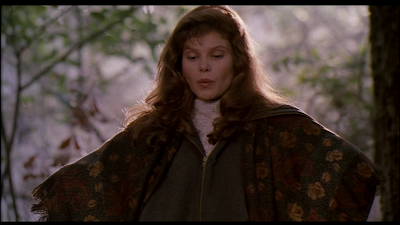


Another Argento moment comes at the very end of the film, where we think that Carter is dead and everything is safe for Jenny and her daughter. While Jenny explains what happened to one of her friends (acting as the psychiatrist from Psycho who explains the entire plot for those not smart enough to initially realize what was going on), her daughter runs off into the woods. After Jenny tracks her down, her daughter asks where her dad is. Jenny's response is that he's not around anymore, but her daughter says "Yes he is," and at the moment Jenny bends down to pick up her daughter we see Carter dressed in drag (in another moment of allusion, this reminds the viewer of De Palma's own Dressed to Kill) standing behind Jenny. This shot was famously used in Argento's 80's giallo, Tenebre (1982). De Palma has used it again since, in his fantastic noirish thriller Femme Fatale (2002). The film's climax is typical De Palma, too: it's perfectly blocked, has a great location, and (of course) is shot in slo-mo. The climax made me think of Carrie (1976) and Carlito's Way (1993) with its adequate usage of slow motion, a device that a lot of filmmakers use ineffectively, but like the split screen, is almost always used to perfection by De Palma.

It's not just the look of the film that is one big giant homage to this very specific sub-genre that De Palma obviously loves (he also pays homage to Argento in The Untouchables), but it's the plot, too. In a great call back to these types of movies there is a moment where Dr. Lynn Waldheim (Frances Sternhagen), a former colleague of Carter and his father, walks into a police station to get the detectives up to speed on Carter's mental history. This is a great scene as Waldheim provides the classic moments of dialogue where through pseudo-scientific reasoning, Carter's illness is sought to be explained and reasoned out. This is a necessary staple for these types of films (it's especially evident in Psycho, The Bird With the Crystal Plumage, Deep Red, etc.). However necessary this particular trope is, it's almost always excruciating because it's usually such a convoluted attempt to string together the loose strands of plot. Waldheim's speech is made interesting, though, by De Palma’s camera. In a virtuoso scene, he follows her and the detectives in a conversation as they walk through the multi-storied police building. The fluid camera and tilting shots (Dutch angles) as they walk down the stairs give interest to this rather blasé psychological thriller cliche. It’s a beautiful 4 minute and 50 second tracking shot that also reminds the viewer of the unbroken opening shot of Touch of Evil, with the way De Palma weaves his camera around through the building and in tight places like an elevator. The shot is there for a purpose (just like it is in Touch of Evil), as De Palma knows that his film's structure is not a linear one. This isn't a story that moves easily from point A to point B; no, these kinds of stories move in circles; they are askew plots with jagged turns, and De Palma shoots this long tracking shot accordingly—the shot is not as "smooth" (read: the film's plot) as it seems.

And then there's Lithgow's performance. He's playing three different characters, here. All of them filled with nuances and over-the-top greatness that separates them from each other. Lithgow is obviously having a lot of fun bouncing from character to character, and his Cain has to be one of the most underrated of horror villains. It got me thinking about Lithgow and his career. I don't understand how Lithgow did not become a huge star after this movie. His performance shows that he can play crazy without it being too obvious. It's all in the way he stutters as Carter, is so sure of himself when he's Cain, and the wisdom he exudes when he's playing Dr. Nix, their father. It's a brilliant multi-layered performance, and it was sad to look at his bio and notice that he never again received a film role this prominent. Sure, he went on to make his money from 3rd Rock From the Sun and the Shrek films, but never again would he headline a movie. That's a shame because I feel like Lithgow is one of the most underrated actors working today (he was phenomenal in The Adventures of Buckaroo Banzai and I have to admit...I really liked him as the evil Quinlan in Cliffhanger), and should get another chance at being the star of a movie.
I began by saying that there is no doubt people think of Raising Cain as a lesser De Palma film. I hope people will revisit this criminally underrated psychological horror film. It's one of the best experiences I've had with De Palma, and for those that read my blog you know that De Palma is a filmmaker I struggle with. There is no doubting his talent, or his eye for a great scene, but sometimes I find his allusions to be less than exhilarating (compared to say a Quentin Tarantino who does the same thing as De Palma, but with an élan that is more exciting). That leads to a general malaise about his films -- a feeling like I am out of the loop when it comes to people I respect (like the man hosting this here blog-a-thon), who rank him highly in their pantheon of great American filmmakers. That being said: I have a found a reason to re-visit some of De Palma's work in the most unlikely of places... Raising Cain.
Extra stills, since there is always so much good stuff to look at in a De Palma film:


 I think it's safe to call Raising Cain one of Brian De Palma's "lesser" films. By that I mean, start a conversation with any cinephile about the polarizing directors oeuvre, and it's unlikely that this 1992 thriller will be one of the first ten titles mentioned. Written and directed by De Palma, Raising Cain is one of the auteur's most underrated, surprising, and entertaining films. It's a swift 90 minute psychological thriller that owes a lot to Hitchcock's Psycho (1960) and any of Argento's giallo films. De Palma takes key recognizable images, or moments, from those films and inserts them into his own story about a man named Carter (John Lithgow in a fascinating performance), who may or may not have a twin brother, and an infamous father who was a renowned doctor... before accusations of stealing babies for research resulted in him dying. What follows is one of De Palma's most playful plots; full of interesting allusions and a maniacally gleeful (and pitch perfect) performance by Lithgow.
The plot is pretty standard psychological killer stuff. The film opens with Carter talking to a colleague in the car about some of his research involving children. When the conversation turns heated Carter resorts to horrifying acts to get her to go along with his plan. As Carter figures out what to do in the car (which has now pulled off to the side of the road) a figure appears outside of the window. It is Cain, Carter's twin brother. Or, so we think. One of the most ingenious things about Raising Cain is the way De Palma plays with audience in regards to Carter's psyche. Is this really Carter's twin brother? In one brilliantly bizarre scene Cain visits his father, Dr. Nix, in a hotel room where they discuss his "escape" (a great use of words). Are we sure this is even really happening (De Palma shoots the scene in a way that suggests it isn't real)?

Well Cain indeed is not real, and we're led to believe that Dr. Nix and two other entities he assumes are also part of Carter's split personalities. DePalma blocks the hotel scene perfectly—like it's out of Caligari or other German Expressionist films—thus giving the scene its much needed uncertain, otherworldly feel... since the scene is essentially taking place in Carter's head. However, we do come to find that Dr. Nix is not dead and that he is just using his son's different personalities to get different jobs done so that he can finish the research he started before his baby thievery was brought to the forefront of the country.
As I already mentioned, one of the immensely entertaining things about Raising Cain is the way De Palma plays with the audience. His master and hero Hitchcock would be proud. I have to say that I was never quite sure what was going on until about the 20 minute mark (which I think is around the hotel scene), there the film slows down (as Cain has been put to rest after he disposes the body of Carter's aforementioned colleague) and briefly turns into an interesting domestic thriller. Carter is a weak man, and Lithgow plays him as kind of hapless fool (which is necessary since Cain is needed to be the assured one) who can't seem to please his wife or family. When things heat up between his wife Jenny (Lolita Davidovich) and an acquaintance (Steven Bauer), Carter snaps and is lost forever as Cain "escapes" again, becoming the primary controller of Carter's body.

As is typical for a De Palma film, there are countless allusions to great films throughout Raising Cain. Some of the best are a scene where Carter/Cain is trying to dispose of a body in the back seat of a car. He pushes the car into the river only to have the car stop half way. This of course is a nice, almost shot-for-shot, allusion to Psycho where Anthony Perkins is trying to get rid of Janet Leigh's body. Lithgow even manages to conjure up a little Perkins in his facial expressions throughout the film. Another great homage is when Carter/Cain happens upon his wife and her lover in the woods making love. He grabs the man's trench coat, dons black gloves, and pulls a knife as he prepares to kill a woman he has agreed to give a ride home to. This wardrobe is, of course, reminiscent of the "black-gloved killer" look found in all of the gialli by Bava, Argento, Lenzi, and Fulci (and of course, there's more).


Another Argento moment comes at the very end of the film, where we think that Carter is dead and everything is safe for Jenny and her daughter. While Jenny explains what happened to one of her friends (acting as the psychiatrist from Psycho who explains the entire plot for those not smart enough to initially realize what was going on), her daughter runs off into the woods. After Jenny tracks her down, her daughter asks where her dad is. Jenny's response is that he's not around anymore, but her daughter says "Yes he is," and at the moment Jenny bends down to pick up her daughter we see Carter dressed in drag (in another moment of allusion, this reminds the viewer of De Palma's own Dressed to Kill) standing behind Jenny. This shot was famously used in Argento's 80's giallo, Tenebre (1982). De Palma has used it again since, in his fantastic noirish thriller Femme Fatale (2002). The film's climax is typical De Palma, too: it's perfectly blocked, has a great location, and (of course) is shot in slo-mo. The climax made me think of Carrie (1976) and Carlito's Way (1993) with its adequate usage of slow motion, a device that a lot of filmmakers use ineffectively, but like the split screen, is almost always used to perfection by De Palma.

It's not just the look of the film that is one big giant homage to this very specific sub-genre that De Palma obviously loves (he also pays homage to Argento in The Untouchables), but it's the plot, too. In a great call back to these types of movies there is a moment where Dr. Lynn Waldheim (Frances Sternhagen), a former colleague of Carter and his father, walks into a police station to get the detectives up to speed on Carter's mental history. This is a great scene as Waldheim provides the classic moments of dialogue where through pseudo-scientific reasoning, Carter's illness is sought to be explained and reasoned out. This is a necessary staple for these types of films (it's especially evident in Psycho, The Bird With the Crystal Plumage, Deep Red, etc.). However necessary this particular trope is, it's almost always excruciating because it's usually such a convoluted attempt to string together the loose strands of plot. Waldheim's speech is made interesting, though, by De Palma’s camera. In a virtuoso scene, he follows her and the detectives in a conversation as they walk through the multi-storied police building. The fluid camera and tilting shots (Dutch angles) as they walk down the stairs give interest to this rather blasé psychological thriller cliche. It’s a beautiful 4 minute and 50 second tracking shot that also reminds the viewer of the unbroken opening shot of Touch of Evil, with the way De Palma weaves his camera around through the building and in tight places like an elevator. The shot is there for a purpose (just like it is in Touch of Evil), as De Palma knows that his film's structure is not a linear one. This isn't a story that moves easily from point A to point B; no, these kinds of stories move in circles; they are askew plots with jagged turns, and De Palma shoots this long tracking shot accordingly—the shot is not as "smooth" (read: the film's plot) as it seems.

And then there's Lithgow's performance. He's playing three different characters, here. All of them filled with nuances and over-the-top greatness that separates them from each other. Lithgow is obviously having a lot of fun bouncing from character to character, and his Cain has to be one of the most underrated of horror villains. It got me thinking about Lithgow and his career. I don't understand how Lithgow did not become a huge star after this movie. His performance shows that he can play crazy without it being too obvious. It's all in the way he stutters as Carter, is so sure of himself when he's Cain, and the wisdom he exudes when he's playing Dr. Nix, their father. It's a brilliant multi-layered performance, and it was sad to look at his bio and notice that he never again received a film role this prominent. Sure, he went on to make his money from 3rd Rock From the Sun and the Shrek films, but never again would he headline a movie. That's a shame because I feel like Lithgow is one of the most underrated actors working today (he was phenomenal in The Adventures of Buckaroo Banzai and I have to admit...I really liked him as the evil Quinlan in Cliffhanger), and should get another chance at being the star of a movie.
I began by saying that there is no doubt people think of Raising Cain as a lesser De Palma film. I hope people will revisit this criminally underrated psychological horror film. It's one of the best experiences I've had with De Palma, and for those that read my blog you know that De Palma is a filmmaker I struggle with. There is no doubting his talent, or his eye for a great scene, but sometimes I find his allusions to be less than exhilarating (compared to say a Quentin Tarantino who does the same thing as De Palma, but with an élan that is more exciting). That leads to a general malaise about his films -- a feeling like I am out of the loop when it comes to people I respect (like the man hosting this here blog-a-thon), who rank him highly in their pantheon of great American filmmakers. That being said: I have a found a reason to re-visit some of De Palma's work in the most unlikely of places... Raising Cain.
Extra stills, since there is always so much good stuff to look at in a De Palma film:


